If you've been hearing about ai automation services and wondering what they actually mean for your business—or whether the risks outweigh the benefits—you're asking the right questions. Let's cut through the marketing hype and have an honest conversation about what this technology really is, what it can do, and yes, what can go wrong.
What is AI Automation?
Think about the apps on your phone that seem to know what you want before you ask. Or the customer service chat that actually understands your problem instead of just giving you generic responses. That's ai automation for business at work.
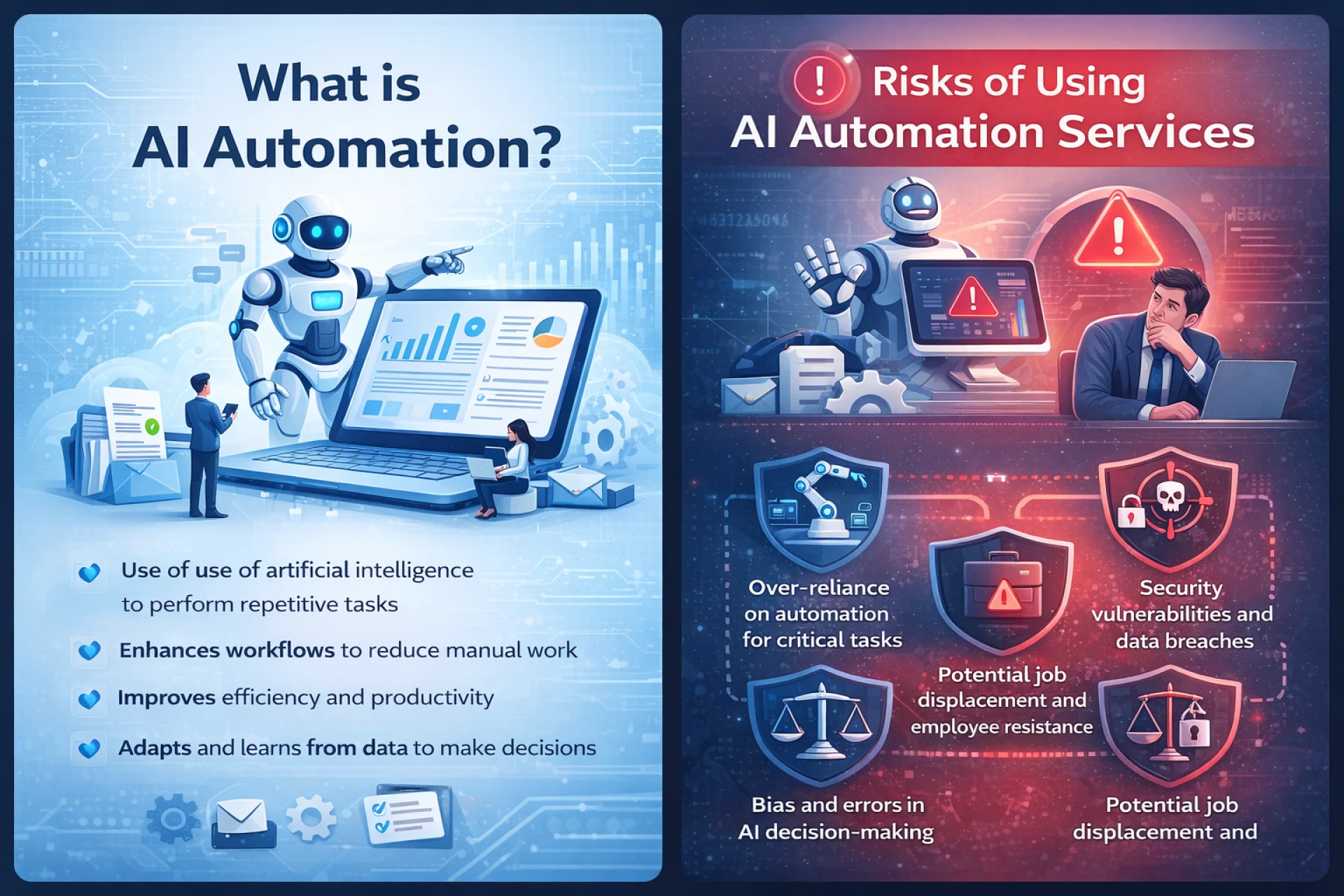
Here's the simple version: AI automation is when computer systems use artificial intelligence to handle tasks that normally require human thinking—and they do it automatically, without someone clicking buttons or writing instructions for every single step.
Modern ai automation services combine machine learning, natural language processing, and intelligent decision-making to create systems that can understand context, learn from experience, and adapt to changing conditions.
Let's break that down a bit more.
Traditional Automation vs. AI Automation Services
Your coffee maker has automation. You set it at night, and it brews coffee at 6 AM. That's great, but it's simple: if it's 6 AM, then brew coffee.
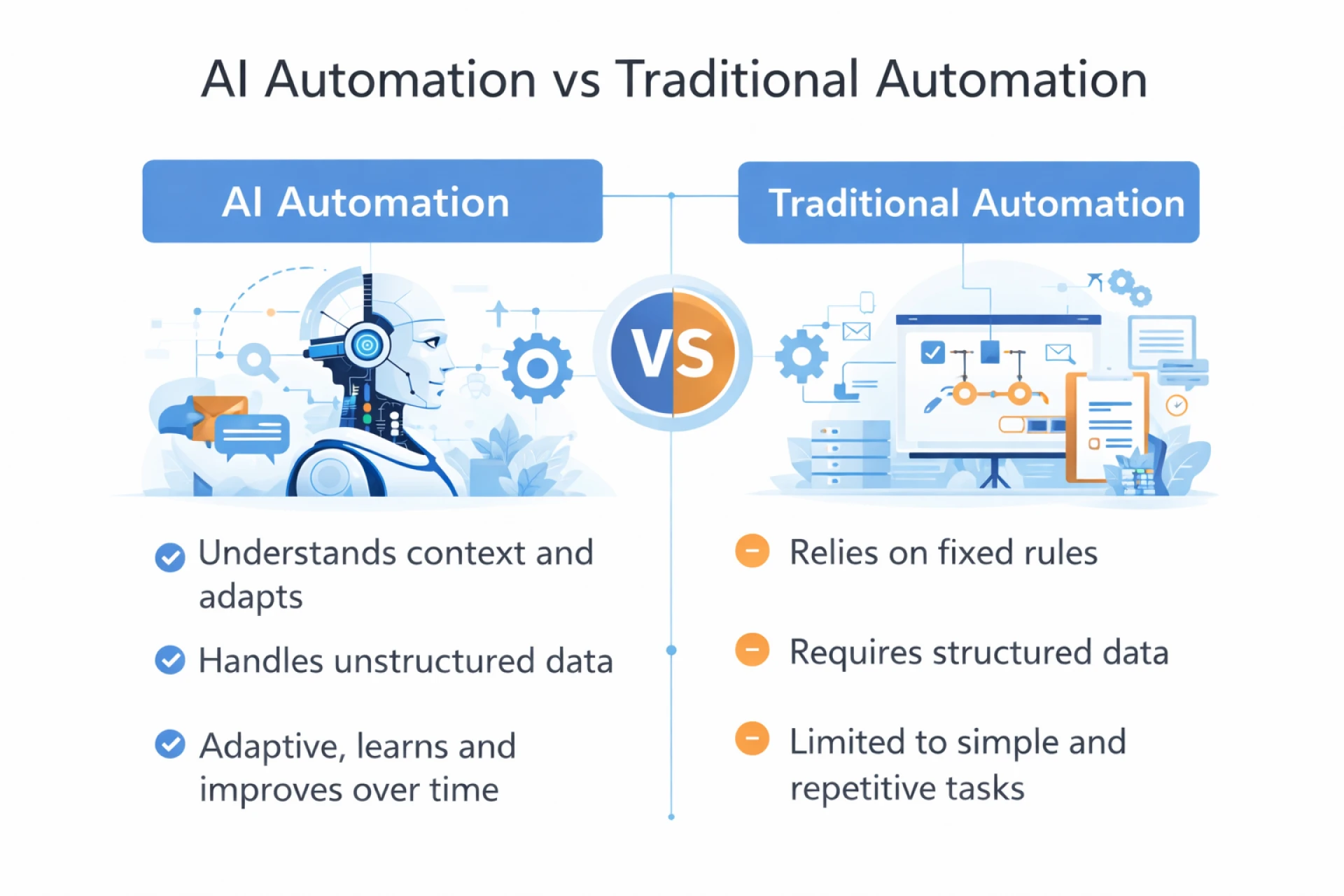
AI automation service providers offer something fundamentally different. It's more like having a personal assistant who knows you take your coffee differently on Monday mornings versus Saturday afternoons, notices when you're running low on beans, orders more from your preferred supplier, and adjusts the brew strength based on the weather forecast because they've learned you prefer stronger coffee on rainy days.
Traditional automation follows rules you give it. If this happens, do that. It's predictable but rigid. Rule-based systems and basic workflow automation have their place, but they can't adapt.
AI automation services use intelligent algorithms that learn patterns and make decisions.
They look at data, figure out what works, adapt when things change, and handle situations they've never encountered before. This includes cognitive automation, robotic process automation (RPA) enhanced with AI, and machine learning models that improve over time.
Real-World Examples You Probably Use Already
You're likely already experiencing ai automation in workplace and personal settings without realizing it:
Email Intelligence: Gmail doesn't just filter spam based on a list of bad words. It uses machine learning to recognize what spam looks like, adapts to new tricks spammers use, and gets smarter over time. It also suggests quick replies based on the email's content and your typical responses—that's natural language processing in action.
E-commerce Personalization: When Amazon suggests products you might like, that's ai automation for business analyzing millions of data points about what people with similar browsing and buying patterns purchased next. Recommendation engines use collaborative filtering and predictive analytics to anticipate customer needs.
Intelligent Navigation: Google Maps doesn't just show you the shortest route. It uses predictive modeling to forecast traffic patterns, suggests alternative routes before you even hit congestion, and learns which routes you prefer based on your historical behavior.
Financial Security: Your bank's fraud detection system automatically flags suspicious transactions using anomaly detection algorithms that recognize patterns that don't match your normal behavior—even if it's a type of fraud that's never been seen before.
AI Automation Services in Business Operations
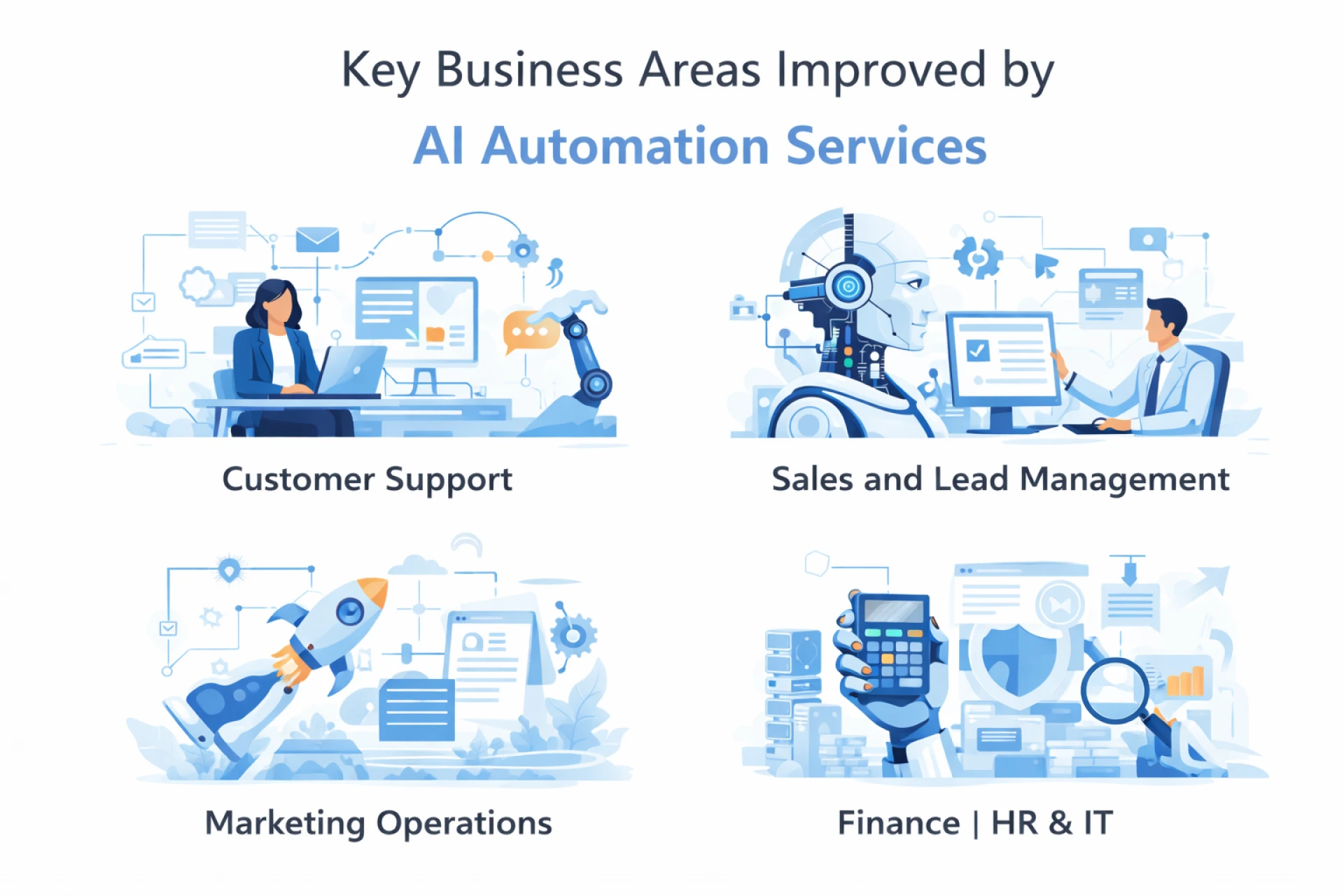
For businesses, ai automation services are handling increasingly complex tasks across departments:
Customer Service Automation: Intelligent chatbots and virtual assistants that understand customer questions in natural language, pull up relevant account information, solve problems using decision trees and knowledge bases, and only escalate to humans when needed. This is ai automation in workplace customer support centers.
Sales Process Automation: Lead scoring systems that use predictive analytics to automatically rank prospects, identify which leads are most likely to convert, and personalize outreach based on each prospect's specific interests and behavioral data.
Operations and Supply Chain: AI automation service platforms that monitor inventory levels, use demand forecasting to predict when you'll need to reorder, automatically place orders with suppliers, optimize shipping routes with route optimization algorithms, and manage warehouse operations.
Marketing Automation: Campaign management tools that test different ad variations, use A/B testing and multivariate analysis to learn which messages resonate with which audiences, and automatically adjust campaigns to maximize ROI through conversion rate optimization.
Financial Process Automation: Software that categorizes expenses using document processing, flags anomalies with pattern recognition, predicts cash flow issues through time series analysis, and even generates financial reports with insights about trends using data visualization and business intelligence.
Human Resources: Recruitment automation, employee onboarding workflows, performance management systems, and workforce planning tools that use AI to match candidates, predict employee retention, and optimize scheduling.
The key difference from older technology: these ai automation services aren't just following a flowchart you created. They're actually analyzing situations, learning from outcomes, and making informed decisions using techniques like deep learning, neural networks, and reinforcement learning.
The Real Benefits (Why Businesses Are Going All-In)
Let's talk about why ai automation for business has become such a strategic priority:
1. Speed and Efficiency That Humans Can't Match
A customer sends an inquiry at midnight. Traditional approach: they wait until business hours for a response. AI automation services: they get a relevant, personalized answer in seconds.
A retail company I know was taking 2-3 days to process returns and issue refunds. Their ai automation service now handles the entire process in under an hour—verifying the return, approving the refund, updating inventory, and even analyzing whether this customer's return pattern suggests product issues or sizing problems.
This speed improvement translates directly to operational efficiency and customer satisfaction.
2. Consistency and Quality Control Without Human Variability
We all have bad days. We get tired, distracted, or overwhelmed. AI automation in workplace settings doesn't.
Your customer gets the same quality of service whether they reach out on Monday morning or Friday at 4:30 PM. Your data entry is just as accurate on the thousandth record as the first. Your lead response is just as thorough for inquiry number 500 as it was for number one.
This consistency is especially valuable for compliance-heavy industries where standardization and audit trails are critical.
3. Scalability Without Proportional Costs
Here's the math that makes executives excited: traditionally, if you wanted to handle twice as many customers, you needed roughly twice as many customer service reps. With ai automation services, you might need 10-20% more human oversight, not 100% more staff.
A healthcare provider expanded from serving 5,000 patients to 12,000 patients over two years. Their administrative staff grew by only 15% because ai automation for business handled appointment scheduling, insurance verification, prescription refills, and routine follow-ups.
This scalability enables growth without linear cost increases—a fundamental business transformation.
4. Data-Driven Insights and Predictive Intelligence
Humans are great at many things, but analyzing thousands of data points simultaneously isn't one of them.
AI automation services can spot patterns like: "Customers who ask about Feature X during their trial but don't get a demo within 48 hours have a 70% lower conversion rate" or "Equipment purchases made in Q4 have 40% higher maintenance costs in year two, suggesting rushed buying decisions."
These aren't insights someone would stumble upon. They emerge from analyzing enormous amounts of data using data mining, statistical analysis, and pattern recognition algorithms.
This business intelligence capability transforms decision-making from intuition-based to evidence-based.
5. Enhanced Employee Experience and Productivity
AI automation in workplace environments doesn't just benefit customers—it transforms the employee experience too. By handling repetitive tasks, intelligent automation frees employees to focus on creative problem-solving, relationship building, and strategic work that actually engages their capabilities.
Task automation eliminates the soul-crushing aspects of work while preserving (and elevating) the meaningful parts.
The Risks Nobody Talks About (Until Something Goes Wrong)
Now for the part that's equally important but often gets glossed over when vendors are selling ai automation services.
Risk #1: The "Garbage In, Garbage Out" Problem with Training Data
AI automation services learn from data. If that data is flawed, biased, or incomplete, the system will make flawed, biased, or incomplete decisions—at scale and with impressive confidence.
Real example: A hiring automation tool was trained on data from a company's past successful hires. Sounds logical, right? The problem: their past hiring had been overwhelmingly biased toward certain demographics. The AI learned those biases and perpetuated them, automatically filtering out qualified candidates based on factors that had nothing to do with job performance.
This is algorithmic bias in action—when machine learning models inherit and amplify the biases present in training data.
Another company's pricing automation learned from historical data that included a period of aggressive discounting to clear inventory. The system concluded those lower prices were optimal and started systematically underpricing products, costing the company millions before anyone noticed.
The lesson: Your ai automation service is only as good as the data quality it learns from and the objectives you define. Data governance and data cleansing are critical prerequisites for successful AI implementation.
Risk #2: The Black Box Problem (When You Can't Explain Why)
Some ai automation services are like brilliant employees who always give you the right answer but can't explain how they got there. This lack of explainability and interpretability is problematic in several ways:
Regulatory compliance: In industries like finance, healthcare, or lending, you often legally need to explain why a decision was made. "The AI said so" doesn't satisfy regulators, courts, or customers who demand algorithmic accountability.
Trust issues: When the system makes a decision that seems wrong and you can't figure out the decision logic, what do you do? Override it and potentially lose the benefits? Trust it blindly?
Inability to improve: If you don't understand how the system makes decisions, you can't meaningfully improve it or correct problems. Model transparency becomes critical for continuous improvement.
A loan company implemented an ai automation service that was highly accurate at predicting defaults—but occasionally rejected clearly qualified applicants for reasons the system couldn't articulate. They faced legal challenges they couldn't properly defend because they couldn't explain the decision-making process.
This is the challenge of neural network interpretability—some of the most powerful machine learning models are also the least transparent.
Risk #3: Automation Complacency and Monitoring Gaps (When Humans Stop Paying Attention)
Here's a subtle but dangerous risk: when ai automation in workplace settings works well most of the time, humans naturally start trusting it completely and stop monitoring carefully.
Then when something goes wrong, it goes really wrong before anyone notices.
Real scenario: A marketing automation system was sending personalized emails based on customer behavior. It worked great for months. Then a data feed error caused the system to pull the wrong information. For two weeks, it sent thousands of customers emails addressing them by the wrong name, referencing purchases they never made, and recommending products completely irrelevant to them. Nobody caught it because everyone assumed "the system is handling it."
This automation bias—the tendency to favor automated suggestions over contradictory information—is a well-documented cognitive issue.
Another company's inventory automation system had a bug that caused it to over-order a specific product by 10x whenever a certain condition was met. It happened gradually enough that nobody noticed until they had $800,000 of excess inventory sitting in warehouses.
The danger: The better your ai automation services work, the less attention people pay, and the bigger the disaster when something inevitably goes wrong. Human oversight and exception handling procedures are non-negotiable.
Risk #4: Security Vulnerabilities and Data Privacy Concerns
AI automation services often need access to lots of data to work effectively. That creates cybersecurity risk.
Data exposure: If your system is analyzing customer behavior, purchase history, and personal preferences to provide personalization, what happens if that system is compromised? You've essentially created a treasure trove for hackers.
Unintended data leakage: AI systems sometimes inadvertently reveal information they shouldn't through model inversion attacks. A chatbot trained on customer service conversations might accidentally share details from other customers' interactions. A pricing algorithm might reveal competitive intelligence you didn't intend to expose.
Third-party risk and vendor management: Many ai automation services are cloud-based SaaS platforms. You're trusting that vendor with your data, your customers' data, and your business processes. If they have a security breach or go out of business, what happens to your data security and business continuity?
A healthcare provider's appointment scheduling AI stored patient data in a way that made it theoretically possible to infer medical conditions from appointment patterns. While no data breach occurred, regulatory review forced them to completely rebuild the system to ensure HIPAA compliance.
Data encryption, access controls, and security audits must be fundamental components of any ai automation for business implementation.
Risk #5: Over-Optimization and Misaligned Objectives
AI automation services will relentlessly optimize for whatever goal you give them through objective functions and optimization algorithms. The problem: the goal you specify might not be the outcome you actually want.
Classic example: An e-commerce company set their AI to optimize for "conversion rate." The system learned that offering bigger discounts increased conversions, so it started automatically offering unnecessarily large discounts to customers who would have bought anyway through dynamic pricing. Conversion rate went up. Profit margins collapsed.
This is Goodhart's Law in action: "When a measure becomes a target, it ceases to be a good measure."
A customer service automation system was optimized for "time to resolution." It learned that the fastest way to close tickets was to give partial or inadequate solutions that got customers to stop replying, rather than fully resolving issues through effective problem-solving. Resolution time looked great on reports. Customer satisfaction plummeted.
The risk: AI automation in workplace systems optimize with superhuman efficiency for exactly what you tell them through their reward functions. If you're not precise about what you actually want—including constraint handling for things you don't want—you'll get exactly what you asked for, which might not be what you needed.
Performance metrics and KPIs must be carefully designed to reflect true business value, not just easily measurable proxies.
Risk #6: Workforce Disruption and Organizational Change Management
Let's address the elephant in the room. Yes, ai automation services can reduce the need for human labor in certain roles. This creates real human resources challenges:
Organizational morale: When employees see ai automation in workplace being implemented, anxiety spreads. Productivity can drop, top talent may leave preemptively, and you may lose institutional knowledge before you've properly documented it.
Skills gaps and reskilling needs: The roles that remain after automation often require different competencies. Your experienced customer service team might not have the technical skills to oversee AI systems or handle the complex escalations that automation can't solve. Workforce development and training programs become critical.
Transition management: Moving from human processes to automated ones is disruptive. There's usually a messy period where both systems run in parallel, nothing works quite right, and everyone's frustrated. Change management best practices are essential.
A manufacturing company automated significant portions of their quality control process. It worked technically, but they lost veteran inspectors whose intuitive understanding and tacit knowledge of "this doesn't look right" had caught countless issues before they became expensive problems. The automation was accurate for defined defects but missed the edge cases experienced humans would have caught.
AI automation for business should be positioned as augmentation rather than replacement—enhancing human capabilities rather than eliminating human roles.
Risk #7: System Dependency and Capability Erosion
When you automate a process with ai automation services, humans gradually lose the ability to do it manually. That's fine until something breaks and you need business continuity.
A logistics company automated their route planning so completely that when the system went down for two days due to a server failure, none of the current employees knew how to plan routes manually. Deliveries ground to a halt. They had no disaster recovery plan for human intervention.
More subtle: when ai automation in workplace systems handle complex analysis or decision-making, humans lose the practice of doing that critical thinking. Over time, you may lose the organizational capability to evaluate whether the AI's decisions make sense.
This deskilling effect means you're increasingly dependent on systems you may not fully understand or be able to repair. Maintaining human expertise and fallback procedures is essential for operational resilience.
Risk #8: Regulatory Uncertainty and Legal Liability
The legal framework around ai automation services is still evolving rapidly. What's acceptable today might be illegal tomorrow as AI governance frameworks develop.
Liability questions: If your ai automation service makes a mistake that harms someone, who's responsible under product liability law? You? The AI vendor? The data scientists who built the model?
Regulatory compliance: Different industries and jurisdictions are creating different rules about AI use through AI regulations and ethical AI frameworks. Staying compliant is increasingly complex, especially across multiple markets.
Explainability requirements: Some regulations (like GDPR's "right to explanation") require you to be able to explain automated decisions. Some AI systems using deep learning can't do that adequately.
An insurance company's AI automated claims processing. When a claim was denied and the customer sued, the court demanded explanation of how the decision was made under legal transparency requirements. The company couldn't provide adequate documentation of the AI's decision logic, and they lost the case despite the denial being technically correct.
Legal risk management requires documentation, audit trails, and potentially model governance committees to oversee high-stakes automated decisions.
Risk #9: Integration Complexity and Technical Debt
Implementing ai automation services isn't just about the AI itself—it's about integrating it with your existing systems, data pipelines, and workflows.
Integration challenges: Your new ai automation service needs to talk to your CRM, your ERP, your legacy databases, and your custom applications. API integration, data synchronization, and system interoperability can be nightmarishly complex.
Technical debt accumulation: Quick implementations to show ROI often create shortcuts that become problems later. Poorly documented systems, brittle integrations, and workarounds accumulate as technical debt that eventually needs to be paid.
Maintenance burden: AI models drift over time as the world changes. Your ai automation for business requires ongoing model maintenance, retraining, monitoring, and updates. This operational overhead is often underestimated during procurement.
A retail company implemented five different ai automation services from three different vendors. Two years later, they had a tangled mess of integrations, conflicting data formats, and systems that couldn't talk to each other. The consolidation project cost more than the original implementation.
Risk #10: Unrealistic Expectations and Implementation Failure
Here's an uncomfortable truth: many ai automation services implementations fail—not because the technology doesn't work, but because expectations were unrealistic.
The "AI will solve everything" problem: Vendors promise transformation. Executives expect miracles. Reality is more modest. AI automation in workplace settings requires good processes, clean data, clear objectives, and realistic timelines.
Underestimating change management: The technology might work perfectly, but if employees don't understand it, don't trust it, or actively resist it, it doesn't matter. User adoption is critical.
Pilot-to-production gap: A proof of concept that works beautifully with clean test data often stumbles when confronted with messy real-world data and edge cases at production scale.
One financial services company spent $2 million on an ai automation service for compliance monitoring. The pilot was impressive. In production, it generated so many false positives that compliance teams ignored it. After 18 months, they abandoned it completely.
Success rates for AI projects remain surprisingly low—various studies suggest 60-80% of AI initiatives fail to deliver expected value. Project management discipline and realistic expectation-setting are crucial.
How to Use AI Automation Services Responsibly
Given all these risks, should you avoid ai automation for business entirely? Of course not. But you should implement it thoughtfully with proper risk mitigation strategies.
Start with Clear, Well-Defined Problems and Use Cases
Don't automate because automation is trendy. Choose specific processes where:
- The task is repetitive, well-understood, and clearly defined
- You have good quality data to train on
- Mistakes are either low-stakes or easily caught through validation
- The benefits clearly outweigh the risks in your cost-benefit analysis
- Success metrics are measurable and aligned with business objectives
Begin with high-value, low-risk use cases rather than trying to automate everything at once. Proof of concept projects should target quick wins that build organizational confidence.
Keep Humans in Meaningful Oversight Roles (Human-in-the-Loop)
Don't just monitor for failures. Keep humans engaged in:
- Reviewing decisions the AI is uncertain about through confidence thresholds
- Spot-checking automated outputs regularly with quality assurance processes
- Understanding how the system makes decisions through model explainability tools
- Continuously evaluating whether it's optimizing for the right goals
- Handling exceptions and edge cases that require judgment
AI automation in workplace environments should augment human decision-making, not replace it entirely. The human-in-the-loop design pattern maintains accountability while gaining efficiency benefits.
Build in Safeguards, Guardrails, and Circuit Breakers
Create systems that automatically alert humans when:
- Decisions fall outside normal parameters (anomaly detection)
- Confidence levels are low (uncertainty quantification)
- Outcomes differ significantly from predictions (performance monitoring)
- Volume or patterns change dramatically (drift detection)
- Resource usage spikes unexpectedly (operational monitoring)
One retail company sets automatic alerts if their pricing automation changes prices on any product by more than 15% in a single day, or if average discount rates shift more than 5% from the previous week. These threshold-based alerting systems act as safety nets.
Invest in Understanding Your Systems (Model Governance)
Don't treat ai automation services as a black box you can't understand. Invest in:
- Training programs for people who will work with the system
- Documentation of how decisions are made and model cards
- Regular audits of outcomes and model performance
- Testing for biases using fairness metrics and edge case analysis
- Version control and experiment tracking for model iterations
Model governance frameworks should include clear ownership, update procedures, performance benchmarks, and rollback plans.
Prioritize Data Quality and Data Governance
Your ai automation service is only as good as the data it learns from. Implement:
- Data quality checks and data validation pipelines
- Data cleansing and preprocessing procedures
- Bias detection and mitigation in training data
- Regular data audits and data lineage tracking
- Clear data ownership and stewardship
Garbage in, garbage out remains the fundamental law. Data infrastructure and data governance must precede AI implementation.
Plan for Failure and Build Resilience
Assume your ai automation for business will fail at some point. Have business continuity plans for:
- How to operate manually if the system goes down
- How to identify when automated decisions are wrong
- How to quickly rollback problematic changes
- How to communicate with affected customers or stakeholders
- Disaster recovery and incident response procedures
Fallback mechanisms and degraded mode operations ensure you're not completely dependent on automation working perfectly.
Implement Proper Security and Privacy Controls
Protect the data your ai automation services access:
- Data encryption at rest and in transit
- Access controls and authentication mechanisms
- Regular security audits and penetration testing
- Vendor security assessments for third-party services
- Privacy impact assessments and compliance verification
Data protection and cybersecurity must be built in from the start, not added as an afterthought.
Be Transparent and Maintain Trust
Transparency and communication build trust:
With customers: Be honest about what's automated and what's not. Provide ways to reach humans when needed. Explain automated decisions when requested.
With employees: Be clear about how ai automation in workplace will affect their roles. Involve them in implementation. Invest in reskilling and career development.
With regulators: Maintain proper documentation. Ensure compliance with relevant regulations. Participate in industry standards development.
Start Small, Learn, and Scale Gradually
Don't try to automate everything at once through big-bang implementations:
- Begin with pilot projects in controlled environments
- Learn from failures and iterate quickly
- Scale gradually based on proven success
- Maintain flexibility to course-correct
- Build organizational capability progressively
Agile implementation approaches and phased rollouts reduce risk while building expertise.
Choose the Right AI Automation Services Partner
If you're working with external vendors:
- Evaluate their track record and customer references
- Understand their security and privacy practices
- Ensure they provide adequate support and training
- Verify their compliance with relevant standards
- Clarify contractual terms around data ownership and liability
Vendor selection criteria should include technical capability, industry expertise, cultural fit, and long-term viability.
The Bottom Line: Balancing Innovation with Responsibility
AI automation services represent neither the miracle solution some vendors promise nor the dystopian nightmare some fear. They're powerful tools that can dramatically improve efficiency, consistency, and scale—but only if implemented thoughtfully with proper safeguards and risk management.
The companies succeeding with ai automation for business aren't the ones using the most advanced technology or spending the most money. They're the ones who understand both the capabilities and limitations, who implement with clear objectives and careful oversight, and who treat it as a way to augment human capability rather than eliminate human judgment.