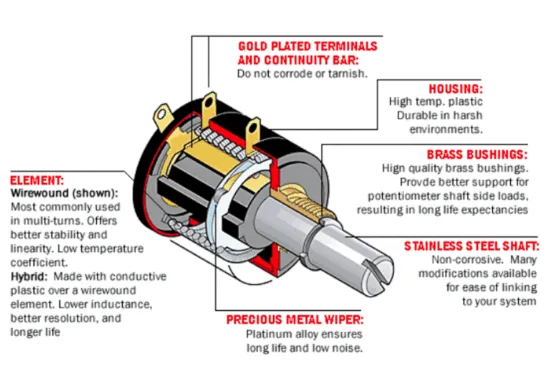
A Mutli-Turn Potentiometer is a variable resistor designed so the wiper travels across the resistive element over multiple shaft revolutions rather than in a single sweep. That multi-revolution travel increases adjustment resolution and makes it easier to set an exact value, then return to it after service or component replacement. In practical automation work, that matters when a small change in setpoint shifts motion, pressure, or timing enough to affect scrap, stability, or safety margins.
The selection decision should start with how the adjustment will be used in the field when working with a Multi-Turn Potentiometer. If a setting is rarely touched and rough positioning is acceptable, a single-turn device can be sufficient. If the setting must be dialed in precisely, verified during commissioning, and restored predictably after maintenance, a multi-turn device reduces trial-and-error and lowers the risk of overshooting a target during adjustment. The benefit is not only finer control. It is repeatable control that survives real service workflows.
How a Mutli-Turn Potentiometer Works in Real Signal Chains
A Multi-Turn Potentiometer design extends the effective mechanical travel so the electrical change per degree of rotation is smaller than a comparable single-turn part. Internally, many models use a helical resistive element and a wiper that moves along it as the shaft turns, or a gear mechanism that converts multiple turns into linear wiper motion. The result is a smoother, more controllable change in resistance, which directly improves the operator’s ability to land on a specific controller input value or calibration point.
In automation systems, the device is rarely used as an abstract resistor. It sits inside a signal chain that includes a reference supply, wiring, an analog input, and a scaling function in the controller. When teams complain that an adjustment feels “touchy,” the root cause is often that the system has too much electrical change per small knob movement, plus noise on the reference or input. A multi-turn device addresses the mechanical portion of that sensitivity by spreading the adjustment over more rotation, and it can make controller-side verification more stable when combined with proper reference handling and input filtering.
Where a Mutli-Turn Potentiometer Fits Best
A Multi-Turn Potentiometer is most useful where the adjustment is tied to a measurable baseline. Common examples include setting a speed limit, defining a ramp threshold, trimming an analog output stage, or establishing a neutral value that must be verified after an actuator, sensor, or controller card is replaced. In these scenarios, the goal is not just to set a value. The goal is to document the target and recheck it quickly during service without rebuilding the machine behavior from scratch.
They also fit well where the process has a narrow acceptable window. If a small change in setpoint causes a noticeable drift in position, pressure, or force, a single-turn adjustment can lead to overshoot and repeated back-and-forth. Multi-turn adjustment reduces that behavior and supports a cleaner commissioning routine because technicians can approach the target slowly, log the controller-side value, and confirm the response under load.
Single-Turn vs Multi-Turn Selection in Commissioning Practice
The decision should be driven by how sensitive the controlled variable is and how often the setting must be validated. A single-turn potentiometer can be faster to adjust, but it compresses the usable range into a short travel. That makes it harder to hit an exact setpoint, and it increases the likelihood of setting drift being misdiagnosed as a process issue rather than an adjustment resolution issue.
A multi-turn option makes sense when acceptance checks require repeatable numeric targets, such as confirming neutral and endpoint readings at the controller input, or matching a documented calibration value after replacement. If maintenance workflows include post-service verification, multi-turn devices often save time because they reduce the number of adjustment cycles needed to land on the recorded target. Over the equipment lifecycle, that reduces tuning time and helps preserve the original process intent.
Installation, Wiring, and Input Stability Considerations
Most multi-turn problems in the field are not caused by the potentiometer itself. They are caused by reference instability, wiring practices, or input scaling that amplifies small variations. A stable reference supply and correct grounding approach matter, especially when analog inputs share routing with noisy loads. Shielding and separation practices should be chosen to keep the analog signal from picking up switching noise that looks like setpoint movement.
On the controller side, scaling should be validated with measured endpoints, not assumed values. Commissioning should capture the expected minimum, maximum, and neutral readings at the controller input so later service can confirm whether the signal path is stable. If a multi-turn adjustment is being used for an operator setpoint, it is also worth defining what “valid” means in software, including clamping the input range, filtering out unreasonable jumps, and making the system response predictable when the knob is moved quickly.
Lifecycle Advantages and When It Is the Wrong Choice
The lifecycle advantage of a Multi-Turn Potentiometer is repeatability. When settings are logged during commissioning and rechecked after service, the system becomes easier to restore without relying on memory or repeated trial runs. Multi-turn adjustments also reduce the risk of unintended setpoint swings during maintenance, which is especially valuable when a small setpoint shift can move a machine into a fault boundary.
However, multi-turn devices are not always the right choice. If the adjustment must be changed frequently and quickly, the extra turns can slow down operation and lead to frustration. In those cases, software-based setpoints, a protected HMI parameter, or a different human interface may be more appropriate. The key is matching the adjustment method to the workflow. Multi-turn devices excel when precision and restoration matter more than speed.
Why Choose ETI Systems for Mutli-Turn Potentiometer Applications
ETI Systems supports automation teams with components used in real industrial environments where vibration exposure, temperature variation, and long duty cycles are normal operating conditions. In that context, a potentiometer is not only a control element. It is part of how the control system maintains stable setpoints through service events, replacement cycles, and long run hours.
ETI Systems also helps teams align component selection with controller inputs and service workflows so adjustments remain testable and repeatable. That includes supporting acceptance checks at the controller input, confirming interface details that prevent replacement mismatch, and maintaining documentation practices that make post-service restoration faster. When those fundamentals are handled well, multi-turn adjustment becomes a dependable tool for controlling sensitive parameters without turning maintenance into repeated retuning.
Frequently Asked Questions
What is a multi-turn potentiometer used for in automation?
A multi-turn potentiometer is commonly used when a setting must be dialed in precisely, verified at the controller input, and restored predictably after maintenance or component replacement.
How many turns does a multi-turn potentiometer typically have?
Many designs are built for multiple revolutions such as 5, 10, or more turns, chosen based on the adjustment resolution needed and how tight the acceptable setpoint window is.
Why does a multi-turn potentiometer feel more precise than a single-turn?
Because the electrical change is spread across more shaft rotation, small knob movements create smaller resistance changes, which helps technicians approach a target without overshoot.
What should be verified during commissioning when using a multi-turn potentiometer?
Commissioning should confirm controller-side readings at minimum, maximum, and neutral positions, validate scaling, and document baseline values so service teams can restore settings without guesswork.
When should you avoid using a multi-turn potentiometer?
Avoid it when operators must change the setting quickly and frequently, or when software-based setpoints and protected parameters can provide faster, more controlled adjustment.