
Ever felt overwhelmed by the time and effort required to analyze financial statements across multiple formats and entities? You're not alone. Whether you’re a credit analyst, investment banker, or financial consultant, the task of spreading financials is critical—but often tedious.
This blog answers a fundamental question—what is a financial spread—and walks you through how automation can simplify and streamline the process. We’ll also explore how AI-powered solutions eliminate manual errors, improve speed, and enhance decision-making at scale.
Understanding the Basics: What Is a Financial Spread
Before diving into automation, let’s address the core concept: what is a financial spread? In financial services, spreading refers to the process of extracting and reorganizing data from a company’s financial statements—typically balance sheets, income statements, and cash flow statements—into a standardized, analyzable format.
This process allows analysts to compare financial performance across entities, calculate key ratios, and assess trends over time. It’s foundational in commercial lending, credit underwriting, and equity research. However, traditional spreading is time-consuming and often inconsistent due to document variety and manual workflows.
Why Financial Spreading Is More Complex Than It Looks
On the surface, spreading may seem straightforward—just data entry and formatting, right? But when analysts receive financial statements in different file types, layouts, currencies, and even languages, complexity rises fast.
Understanding what is a financial spread also means recognizing the underlying challenges: reconciling totals, validating data, handling missing line items, and converting regional accounting formats. Doing this manually across hundreds of borrowers or portfolio companies becomes unsustainable, especially in a fast-paced financial environment.
Where Automation Makes the Biggest Impact
AI-powered tools now play a major role in simplifying financial spreading. These solutions use machine learning, OCR (Optical Character Recognition), and NLP (Natural Language Processing) to extract data from PDFs, scanned images, Excel files, and other unstructured formats.
Once the data is captured, the system maps it into a consistent structure, enabling seamless analysis. This means you don’t just understand what is a financial spread, but you also benefit from real-time execution of the task—accurate, fast, and at scale. This shift frees analysts to focus on what matters most: interpretation and decision-making.
The Power of Standardization and Accuracy
One of the most difficult aspects of spreading financials is consistency across statements. Even similar companies use different terminologies—for example, "Net Profit" vs. "Earnings After Tax." Without standardization, comparison becomes error-prone and subjective.
Knowing what is a financial spread is only half the equation. A reliable automation system will normalize terminology and layout, making data uniform regardless of the source. This standardization ensures analysts work with clean, comparable datasets every time, improving both speed and accuracy in modeling and assessment.
Built-In Reconciliation and Ratio Calculation
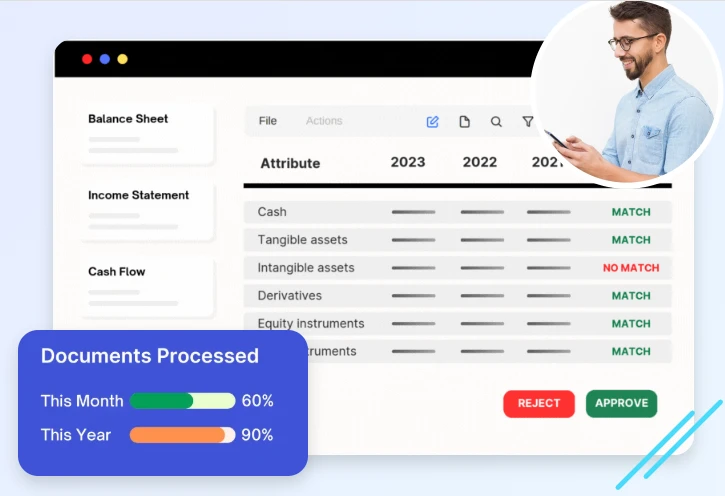
Traditional manual spreading often requires back-and-forth verification to ensure numbers add up correctly. AI-driven platforms eliminate this step through built-in reconciliation that checks consistency across reports. For instance, if liabilities and equity don’t equal assets, the system flags it automatically.
Understanding a financial spread today includes knowing it should involve intelligent, self-validating tools. Additionally, these platforms instantly calculate financial ratios such as current ratio, debt-to-equity, ROA, and more, so analysts can make informed decisions faster.
Handling Documents in Any Format or Language
A key advantage of advanced automation tools is their ability to process documents in virtually any format. Modern systems can extract and translate the relevant data, whether you’re dealing with a scanned PDF in German, an Excel spreadsheet in Japanese, or a tax filing in English.
That means if you're explaining a financial spread to a multinational team or applying it across borders, the system adapts seamlessly, ensuring consistent output regardless of language or regional standards. This makes the process ideal for global banks, PE firms, and cross-border investment teams.
Workflow Integration and Scalability
To simplify spreading, your tool must work with your broader ecosystem. Modern platforms integrate with CRMs, loan origination systems, internal databases, and dashboards via API. This allows for real-time updates and smooth transitions from data capture to credit review to reporting.
So when asking what a financial spread is, today's answer includes more than static spreadsheets—it includes live workflows, enterprise system syncs, and scalable performance that grows with your business: no more duplicated effort or siloed information.
Enabling Smarter, Faster Financial Decisions
Ultimately, spreading aims to drive smarter decisions—whether you’re approving a commercial loan, evaluating an acquisition, or monitoring portfolio risk. When your financial data is automated, accurate, and visualized, you reduce time-to-decision and improve outcomes.
By answering what a financial spread with an AI-first mindset, your organization gains speed, compliance assurance, and deeper analytical insights. The result? Empowered teams, more confident approvals, and increased productivity across departments.
Conclusion
The answer to what a financial spread is has evolved. No longer a manual chore relegated to junior analysts, it’s now a dynamic, AI-powered function at the heart of modern financial operations.
By embracing automation, organizations simplify the most time-intensive part of financial analysis. From extracting data across file formats to calculating complex ratios in seconds, automated spreading tools redefine what’s possible.
Suppose your institution wants to stay competitive, mitigate risk, and drive efficient workflows. In that case, it’s time to adopt a smarter way to spread financials—one that scales, integrates, and empowers your teams.