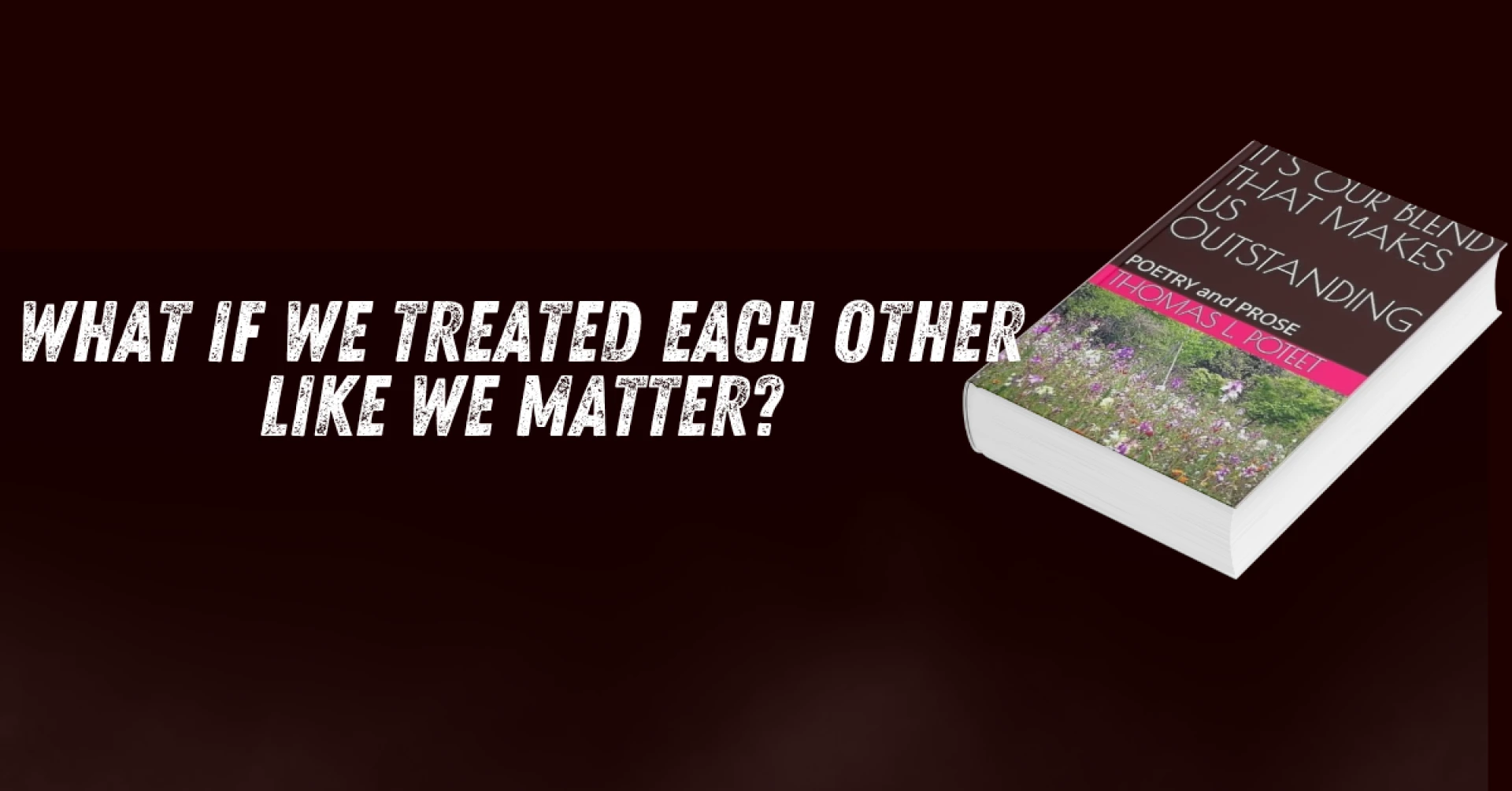
Amazon: IT'S OUR BLEND THAT MAKES US OUTSTANDING: POETRY and PROSE
There’s a kind of quiet that doesn't settle in the absence of sound—but in the presence of something deeper. Reverence, maybe. Or grief. Or love so honest it doesn’t need to announce itself. That’s the kind of quiet Thomas L. Poteet writes into. And it’s the kind of quiet that rises from the pages of It’s Our Blend That Makes Us Outstanding, long after the reading is done.
This isn’t a book of spectacle. There are no grand literary flourishes here, no clever acrobatics of form. And thank God for that. What Poteet gives us instead is far more difficult to achieve: unvarnished truth, spoken plainly, with a humility that disarms. His poems and prayers are soft in tone but ferociously committed to something radical—the full dignity of every human being.
In a time when being loud has become mistaken for being right, this collection reminds us that tenderness is a form of resistance. That choosing to see, to really see, someone else in their complexity and still offer love—that might be the most subversive thing you can do.
Poteet doesn’t make arguments. He makes invitations. With every page, he nudges us toward an uncomfortable question: What if we treated each other like we matter?
It sounds simple. It isn’t.
Because to treat someone like they matter means setting aside your categories. It means looking past your comfort. It means—especially in Poteet’s framing—remembering that you didn’t choose where you were born, what you look like, or the name you call God. Neither did anyone else. And if that’s true, then most of our pride—and most of our judgment—is misplaced.
Poteet circles this truth with a poet’s patience. He comes at it from different angles—through metaphors of wildflowers blooming in chaos, orchestras made beautiful by their many voices, and families struggling to stay stitched together across time and difference. There’s a refrain here, repeated not for emphasis but as if he’s reminding himself: We are all one. He says it often, not as a thesis, but as a discipline. As if to believe in human connection is something we must practice again and again.
There’s no performance here. Just conviction wrapped in grace.
And that grace, crucially, extends not only to the marginalized and forgotten—though they are at the center of Poteet’s vision—but also to those who struggle to get it right. He leaves space for failure. He names his own. His prayers are riddled with confession, not the dramatic kind, but the daily sort: pride, blindness, distraction, ego. These are not the sins that headline stories, but they’re the ones that quietly tear at the fabric of community. He knows this. And so he writes into the gap—not with shame, but with longing.
Longing is everywhere in this book. Not just for justice, but for presence. For connection. For the kind of peace that doesn’t ignore conflict but listens through it. Poteet’s peace is not passive. It’s the kind that kneels to see the smallest flower. The kind that reaches out when it would be easier to walk away. The kind that remembers, even when it’s painful, that the stranger is also a sibling.
There’s a poem buried in the final section—one of the bonus pieces—that barely runs a few lines. In it, Poteet watches his wife being called by different names by their grandchildren. Each name is unique. Each one is beloved. It’s a quiet scene, almost forgettable. But it pulses with something profound: love doesn’t require sameness. It adapts. It multiplies. It meets us in our language, our history, our hurt—and still remains.
What if we modeled our public life after that idea?
What if our faith traditions didn’t require uniformity but taught us to kneel in wonder before difference?
What if policy and prayer alike began from the premise that every single person—yes, even that one—carries the image of something holy?
This is not a theory for Poteet. It’s lived theology. He doesn’t write about equality. He writes from within it—acknowledging the mess, the gaps, the wounds. And yet he stays rooted. He stays soft. That’s what makes his work so powerful. It refuses to become bitter.
Bitterness, after all, is easy. But Poteet chooses something harder: hope that costs something. Hope that requires noticing the invisible, loving the difficult, and forgiving the repeat offender. Not just once but again. And again. And again.
There’s emotional gravity in that kind of writing. A worn sincerity. He’s not trying to impress anyone. He’s trying to stay human.
So what do we do with a book like this?
We don’t analyze it like a textbook. We don’t quote it for applause.
We sit with it.
We carry it.
We let it change how we move through the world—how we look at the person serving us coffee, how we speak to the relative we’ve written off, how we pray for someone who never learned how to ask for help.
Because that’s the world Poteet is building, one poem at a time. Not a perfect one. Not even a tidy one. But a world where everyone gets to bloom, even if they’re growing in the shadows.
And in this moment—this loud, divided, defensive moment—maybe that’s the most powerful vision of all. Not that we become the same. But that we begin, at last, to belong.