Preparing for ISO 15189 accreditation involves much more than laboratory testing competence. One of the most important areas auditors evaluate is documentation. Laboratories should maintain a structured quality management system supported by clear procedures, records, policies, and technical documents that demonstrate consistency and compliance.
Many laboratories struggle during implementation because documentation becomes overly complicated, incomplete, or poorly controlled. In practice, ISO 15189 documents should not only satisfy accreditation requirements but also help laboratories improve operational efficiency, reduce errors, and maintain reliable test results.
Why ISO 15189 Documentation Is Important
ISO 15189 accreditation requires laboratories to establish documented processes for both management and technical activities. Proper documentation helps ensure that laboratory staff follow standardized procedures, maintain traceability, and consistently deliver accurate results.
Auditors typically review whether laboratory documents are:
- approved and controlled
- regularly updated
- easily accessible to staff
- aligned with actual laboratory practices
Ready-to-use ISO 15189 documents also make internal audits, staff training, and corrective actions easier to manage.
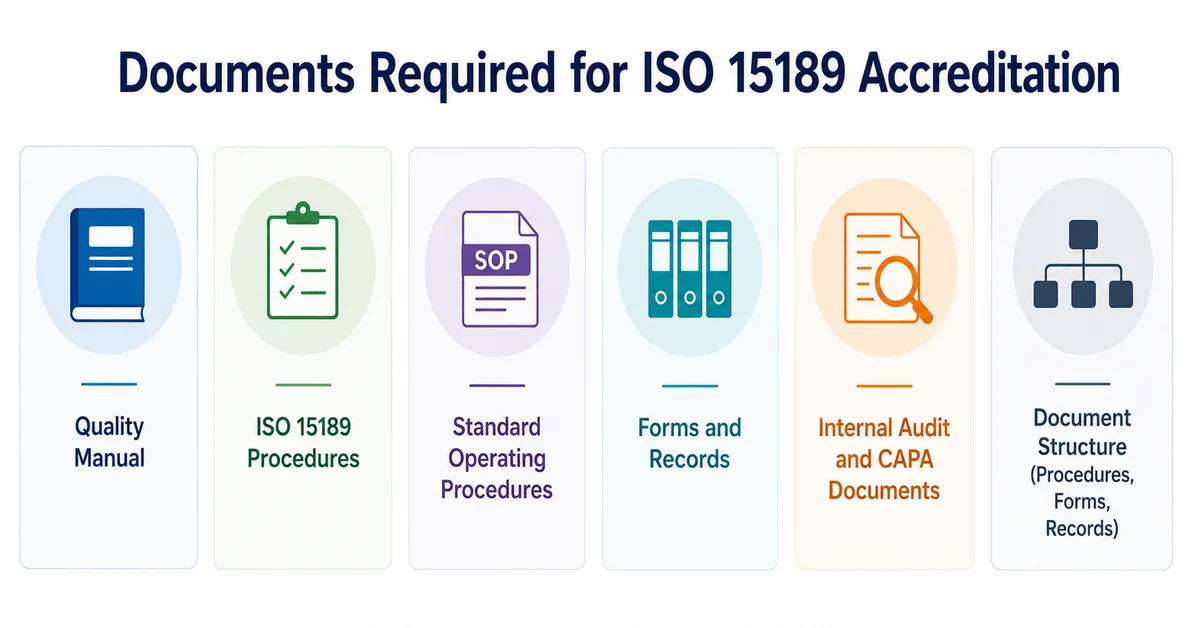
Essential Documents Required for ISO 15189 Accreditation
The exact documentation may vary depending on laboratory size and scope, but several core documents are generally required for successful accreditation.
Quality Manual
The quality manual acts as the main document describing the laboratory’s quality management system. It should include:
- quality policy and objectives
- laboratory scope
- organizational responsibilities
- document control practices
- risk management approach
- quality system structure
A properly written quality manual helps demonstrate how the laboratory complies with ISO 15189 requirements.
ISO 15189 Procedures
Procedures define how laboratory activities should be performed and controlled. Laboratories should maintain documented procedures for:
- document control
- internal audits
- corrective and preventive actions
- risk management
- equipment calibration and maintenance
- sample handling
- reporting of test results
Clearly written ISO 15189 procedures help laboratories standardize operations and improve consistency across departments.
Standard Operating Procedures (SOPs)
SOPs provide step-by-step instructions for technical and operational activities. These documents are critical because they guide laboratory personnel in performing tasks consistently and correctly.
Typical laboratory SOPs may include:
- specimen collection
- test methods
- instrument operation
- quality control activities
- storage conditions
- waste disposal
Laboratories should ensure SOPs are practical, easy to follow, and regularly reviewed.
Forms and Records
ISO 15189 also requires laboratories to maintain records that provide evidence of completed activities. Common examples include:
- equipment calibration records
- maintenance logs
- staff competency records
- training records
- audit reports
- quality control results
- nonconformity reports
These records help demonstrate traceability and ongoing compliance during accreditation audits.
Internal Audit and CAPA Documents
Internal audit documentation is essential for evaluating the effectiveness of the quality management system. Laboratories should maintain:
- audit schedules
- audit checklists
- audit findings
- corrective action reports
- root cause analysis records
Strong corrective action documentation shows that the laboratory actively addresses problems and continually improves its processes.
Difference Between Procedures, Forms, and Records
One common challenge during implementation is understanding the difference between procedures, forms, and records.
- Procedures explain how activities should be carried out.
- Forms provide a format for collecting information.
- Records serve as evidence that activities were completed.
Understanding this structure helps laboratories create a more organized and audit-ready documentation system.
Final Thoughts
Preparing documentation for ISO 15189 accreditation can become complex when laboratories attempt to create every document from scratch. Laboratories should focus on developing practical and controlled documentation that supports both compliance and operational efficiency.
Using professionally designed ISO 15189 documentation templates and procedures can help laboratories improve consistency, reduce implementation time, and simplify accreditation preparation while maintaining compliance with international laboratory quality standards.