
The Hidden Language Behind Every Bosch Tool
You pick up a tool labelled GSB 13 RE or GWS 750, and for a moment, it feels like you are looking at a code rather than a name. Many professionals recognise the brand instantly, yet the meaning behind these bosch tool codes often remains unclear.
In today’s fast-paced construction and industrial environment, the right tool is not just one that provides convenience, but actually affects productivity towards a productive direction, with safety, and keeps everything on time. Choosing incorrectly can slow down work, with increased efforts following behind, and impact the final outcome.
So what if these bosch model numbers were actually designed to make your decisions easier, not harder?
Once you understand the logic behind these bosch abbreviations, you begin to see every tool differently. What looked confusing starts becoming a clear guide. And that is exactly what we are going to decode.
Understanding the Logic Behind Bosch Tool Codes
Every tool follows a system, and the same applies to bosch tool codes.
The letters at the start are not any random ones. They represent the type of tool and its primary function. The numbers that follow give clues about power, capacity, or version. Together, they form a structured identity.
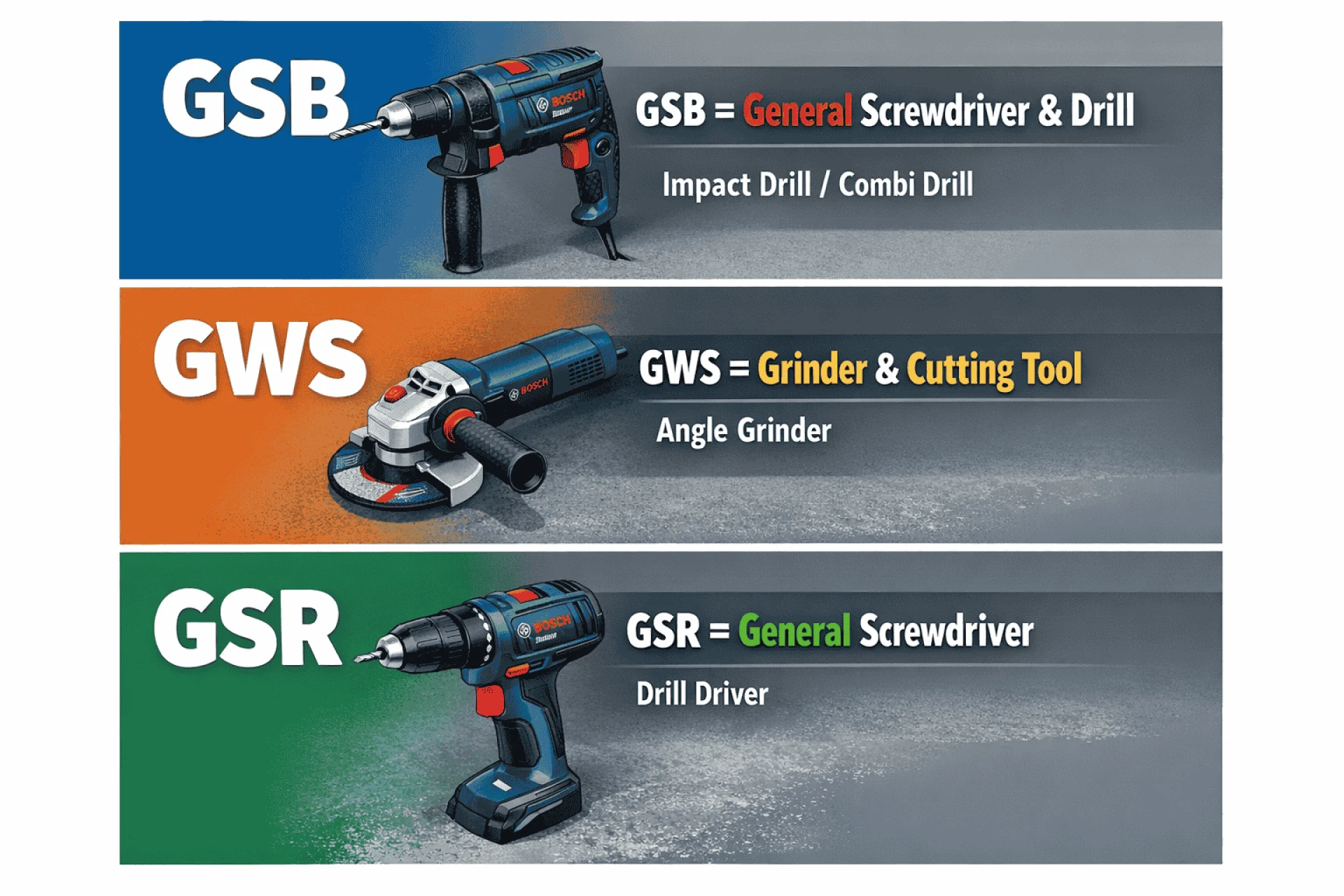
For example, when you see GSB, GWS, or GSR, you are not just reading a label. You are reading the tool’s purpose.
This standardised system exists across global markets. Bosch operates in more than 60 countries, and these bosch model numbers remain consistent everywhere. That means a professional in one country can understand the same tool in another without confusion.
Why does this matter on-site?
Because when time is the primary constraint, no one is interested in reading specifications for every tool. Recogniseing bosch abbreviations allows quicker decisions. You can shortlist tools instantly and move forward with confidence.
Think about your last purchase. Did you rely only on specifications, or would it have helped to decode the name itself?
GSB Means Power Where It Matters Most
Let’s start with one you will find most commonly used bosch tool names, GSB.
GSB refers to impact drills. These tools combine rotation with a hammering action, this combination makes them suitable for hard materials like concrete, brick, and masonry.
Why is this important?
Because standard drills struggle with such materials. They take longer and require more effort. Impact drills solve this by adding controlled force, making drilling faster and more efficient.
Many studies in construction productivity have shown that using the correct tool for the right material can uplift efficiency by up to 30% to 40%. That difference plays a significant role if you multiply it across an entire project.
Now imagine you are installing anchors into a concrete wall. Would you choose a regular drill or one designed for impact?
A GSB tool gives you that clarity. The moment you see it in bosch model numbers, you know it is built for tougher surfaces.
This simple understanding reduces guesswork. It also helps teams stay consistent in tool selection.
GWS Stands for Versatility in Cutting and Grinding
Next comes GWS, another widely used term in bosch tool codes.
GWS represents angle grinders, such tools can handle cutting, grinding, and polishing tasks. They work across diverse materials like metal, stone, and concrete.
One thing makes them unique, and that is their versatility.
Angle grinders rank among the most commonly used tools in construction and metalworking. Industry reports are consistently placing them in the top category due to their wide spectrum of applications. On a typical site, one GWS tool can perform a wide variety of roles. It can cut steel rods, smooth welded joints, remove rust, and even shape surfaces.
That flexibility saves time and reduces the need for multiple tools.
Now consider a fabrication project. You need to cut metal, smooth edges, and prepare surfaces for finishing. Instead of switching tools repeatedly, a GWS model handles it all.
The numbers in these bosch model numbers also guide your choice. Higher numbers usually indicate greater power or capacity. So a GWS 900 will typically offer more performance than a GWS 750.
This makes selection easier. You do not just pick a tool. You choose based on workload and requirement.
GSR Focuses on Precision and Everyday Efficiency
While GSB and GWS focus on heavy tasks, GSR serves a different purpose.
GSR refers to drilling drivers. These tools are designed for work that demands precision. They handle screw driving and light drilling tasks where control is the priority, rather than force.
You will not find hammer action here. Instead, you will get smooth operation, with better handling for precision work.
Why does this matter in modern workspaces?
Because not every task requires high power. Many of them demand accuracy and control.
For a more precise example, think of furniture installation, electrical fittings, or interior work. These tasks require careful control. A powerful impact tool would possibly damage expensive materials or drastically reduce accuracy drastically.
This is where GSR tools become essential.
The shift towards cordless tools has also increased the demand for such solutions. Market reports show that cordless tools now account for more than 60% of professional tool sales. Mobility and ease of use are driving this change.
So when you see GSR in bosch tool names, you know the tool is built for precision and convenience.
And that clarity helps you avoid overusing heavy tools where they are not needed.
Why These Bosch Abbreviations Matter More Than Ever
Tool selection is no longer just about availability. It is about efficiency, cost, and output.
With the global power tools market expected to cross USD 45 billion by 2030, the industry is growing rapidly. More options are entering the market, and decision making is becoming more complex.
This is where understanding bosch abbreviations becomes valuable.
Instead of getting lost in endless choices, you can filter tools quickly. You can align the tool with the task without delay.
For procurement teams, this brings consistency. For contractors, it improves speed. For technicians, it reduces effort.
Ask yourself this. How often have you seen teams use the wrong tool simply because they were unsure?
When everyone understands bosch tool codes, that confusion disappears.
And the result is smoother execution.
Reading Bosch Model Numbers Like a Professional
The letters tell you the category. The numbers complete the picture.
In most bosch model numbers, the numbers indicate various factors like power, size, or performance level. While the exact meaning may vary slightly across models, the pattern remains useful.
Higher numbers often suggest higher capacity.
So when you compare two tools, the name itself gives you a starting point.
For example, if you see two GWS models with different numbers, you can immediately identify which one offers more power. This reduces the time spent comparing specifications.
Now think about decision-making on-site.
Would you rather read through detailed sheets or make a quick, informed choice based on the name?
Once you understand how bosch tool codes work, you begin to trust the naming system. It becomes a shortcut to smarter decisions.
Turning Understanding Into Action
Clarity only matters when you apply it.
The next time you look at bosch tool names, pause for a moment. Read the abbreviation. Understand what it signals.
Is it GSB for impact drilling?
Is it GWS for cutting and grinding?
Is it GSR for precision work?
Then look at the numbers and compare capacity, then match the tool to the job. With this small shift in approach, you can save time, reduce mistakes, and improve output manyfold. And over time, it builds confidence across your team.
Actionable Takeaways
- Read bosch tool codes before checking specifications.
- Match GSB tools with masonry and concrete tasks.
- Use GWS tools for cutting, grinding, and surface work.
- Choose GSR tools for precision and controlled applications.
- Compare numbers in bosch model numbers to understand performance differences.
- Train your team to recognise common bosch abbreviations.
- Use bosch tool names as a quick filter during tool selection.
From Confusion to Confidence in Tool Selection
At first, these tool names can feel technical. Almost like a system meant only for experts.
But once you understand the logic, everything becomes simpler.
You stop guessing. You start choosing with purpose.
And that shift matters. Because every correct choice saves time, effort, and cost.
So the next time you pick up a tool, take a closer look at the name.
Are you just reading it, or are you using it to guide your decision?