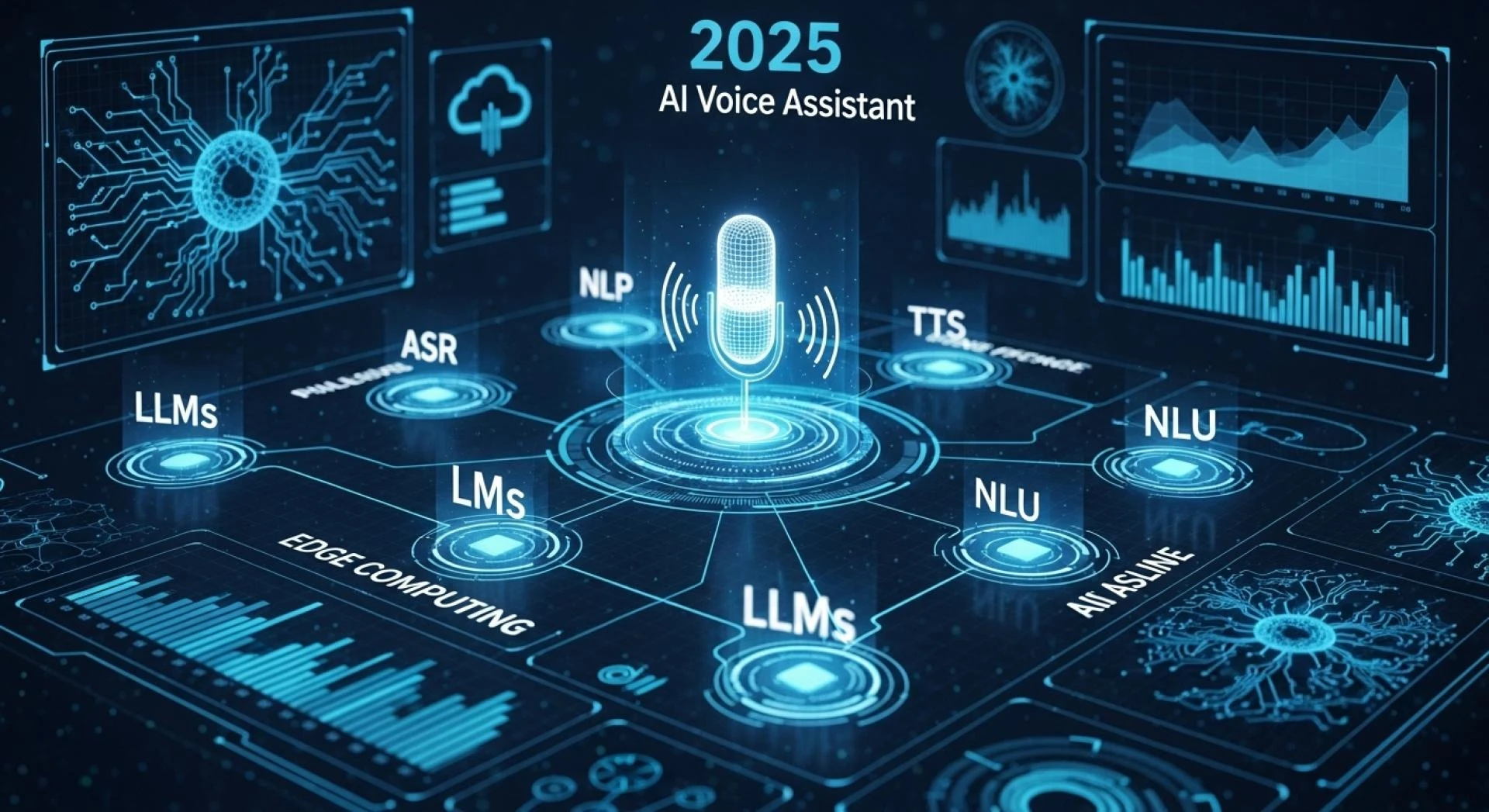
In 2025, AI voice bots have evolved from being simple automated responders to becoming advanced conversational agents capable of understanding, reasoning, and communicating almost like humans. These systems now power customer interactions across industries such as banking, retail, healthcare, and telecommunications. Businesses are embracing voice bots not only to cut costs but also to deliver faster, personalized, and contextually relevant conversations around the clock.
The shift from rule-based IVRs to intelligent voice interfaces is largely due to breakthroughs in several core technologies. These innovations—spanning natural language processing, speech recognition, large language models, and cloud computing—work together to give modern AI voice bots their remarkable capabilities.
This article explores in detail the core technologies driving modern AI voice bot solutions in 2025, explaining how each contributes to making conversations more natural, efficient, and human-like.
1. Automatic Speech Recognition (ASR): Turning Speech into Text
At the heart of every AI voice bot lies Automatic Speech Recognition (ASR). This technology converts a speaker’s voice into textual data that the AI system can analyze and interpret.
In earlier systems, ASR struggled with accents, background noise, and speech variations. However, 2025’s ASR engines are built on deep neural network architectures and massive speech datasets, allowing them to transcribe human speech with exceptional accuracy, even in noisy environments.
Key innovations driving ASR in 2025 include:
- End-to-end neural models: These systems use architectures like transformer-based models to eliminate intermediate processing steps, reducing latency and improving accuracy.
- Multilingual and accent adaptation: AI voice bots can now recognize multiple languages within a single conversation and adapt to regional accents seamlessly.
- Noise suppression and speaker separation: Embedded AI filters isolate speakers’ voices and remove ambient sounds for cleaner input.
- On-device ASR: With the advancement of edge computing, many devices now perform ASR locally, ensuring faster processing and improved privacy.
ASR serves as the first layer in the voice bot architecture, ensuring that spoken words are captured with precision before further processing takes place.
2. Natural Language Processing (NLP): Understanding Human Intent
Once speech is converted into text, Natural Language Processing (NLP) helps the system make sense of the words. NLP allows AI voice bots solutions to comprehend meaning, detect intent, and extract relevant information from the user’s message.
Modern NLP in 2025 is powered by self-learning algorithms and massive language models trained on billions of sentences. The sophistication of NLP ensures that AI voice bots understand not just keywords but the context, tone, and emotion behind a query.
Core NLP components that drive modern voice bots include:
- Tokenization and Part-of-Speech Tagging: Breaking down sentences into smaller components for grammatical analysis.
- Named Entity Recognition (NER): Identifying key entities like names, dates, locations, and products within the conversation.
- Intent Classification: Determining what the user wants to achieve, such as checking an account balance or scheduling an appointment.
- Sentiment Analysis: Gauging the emotional state of the speaker to adjust tone and response style.
- Context Tracking: Maintaining memory across multi-turn conversations so users don’t need to repeat themselves.
The combination of NLP and ASR ensures that voice bots can truly understand and respond intelligently to spoken requests rather than just following predefined scripts.
3. Natural Language Understanding (NLU) and Natural Language Generation (NLG)
Natural Language Understanding (NLU) and Natural Language Generation (NLG) are subfields of NLP that specifically handle understanding user input and crafting coherent responses.
NLU focuses on understanding intent and meaning, while NLG is responsible for producing human-like responses that sound natural and conversational.
In 2025, NLU and NLG systems are powered by transformer-based models like GPT-style architectures and fine-tuned domain-specific models that can generate responses aligned with brand tone and customer expectations.
Some critical advancements include:
- Few-shot and zero-shot learning: Voice bots can now learn new tasks from minimal data, allowing businesses to deploy AI assistants faster.
- Emotional intelligence: Bots can detect subtle emotional cues in speech and respond empathetically.
- Adaptive personalization: Responses can dynamically adjust based on the user’s profile, conversation history, and previous interactions.
- Dynamic narrative generation: NLG modules generate responses in real-time rather than relying on static templates, making each conversation unique.
This combination of NLU and NLG allows AI voice bots to move beyond task completion and create engaging, context-aware dialogues that enhance customer satisfaction.
4. Text-to-Speech (TTS): Giving Voice Bots a Natural Human Sound
To complete the conversational loop, Text-to-Speech (TTS) converts the AI’s textual response into spoken language. Earlier voice bots sounded robotic, but 2025’s TTS systems deliver near-human voice quality with emotional tone, natural rhythm, and clear articulation.
Modern TTS technologies use neural vocoders such as WaveNet and HiFi-GAN that generate speech at a sample-by-sample level, enabling lifelike intonation and prosody.
Recent innovations include:
- Emotion-aware synthesis: The system modifies pitch, tone, and rhythm to reflect emotions like happiness, concern, or urgency.
- Multi-voice customization: Brands can design unique voice profiles aligned with their identity.
- Real-time voice cloning: Using only a few samples, TTS engines can mimic voices while maintaining ethical safeguards against misuse.
- Adaptive speech pacing: TTS systems can automatically adjust speech speed and clarity based on user demographics or comprehension levels.
TTS technology makes AI voice bots not only functional but also emotionally resonant, improving the overall user experience.
5. Large Language Models (LLMs): The Brain Behind Contextual Conversations
By 2025, Large Language Models (LLMs) have become the cognitive core of voice bot systems. These models, trained on vast datasets covering multiple domains and languages, enable bots to generate contextually aware and semantically accurate responses.
LLMs integrate deeply with NLU and NLG pipelines to enable understanding that goes beyond surface-level intent. They allow voice bots to:
- Understand ambiguous or incomplete questions
- Maintain context across long conversations
- Handle follow-up queries naturally
- Provide detailed, personalized responses without pre-programming
Modern voice bots leverage domain-specific fine-tuning to align LLMs with business use cases, ensuring relevance while preventing hallucination or factual inaccuracies.
The evolution of efficient model architectures like sparse transformers and quantized inference has also made it feasible to deploy these massive models in production environments without compromising performance.
6. Speech Emotion Recognition (SER): Understanding Human Feelings
Voice is not just about words—it carries emotions, stress, and subtle cues that reveal how someone feels. Speech Emotion Recognition (SER) allows modern AI voice bots to identify emotional states through variations in pitch, tempo, and energy levels.
In 2025, SER plays a vital role in customer experience management. For instance, if a caller sounds frustrated, the bot can automatically switch to a calmer tone or escalate the issue to a human agent.
Technological advancements in SER include:
- Deep convolutional and recurrent neural networks for extracting emotional patterns from audio signals.
- Cross-lingual emotion detection, allowing bots to interpret emotions regardless of language.
- Real-time emotion adaptation, enabling instant tonal adjustments during a conversation.
By recognizing and responding to human emotions, SER gives AI voice bots the empathy required for natural communication.
7. Machine Learning and Deep Learning Frameworks
The underlying intelligence of AI voice bots depends heavily on machine learning (ML) and deep learning (DL) frameworks that help the system learn from data and improve performance over time.
Frameworks such as TensorFlow, PyTorch, and JAX enable developers to build, train, and optimize neural models for various voice-related tasks.
Machine learning powers key areas such as:
- Intent detection and entity extraction
- Speech pattern recognition
- Conversational flow optimization
- Predictive response generation
Modern voice bots use reinforcement learning to improve through feedback loops, constantly optimizing their responses based on user satisfaction and conversation outcomes.
Deep learning also supports multimodal learning, integrating voice, text, and visual data for richer, more context-aware interactions.
8. Edge Computing and Real-Time Processing
As customers demand faster response times and better privacy, edge computing has become a critical enabler for voice bots in 2025.
Rather than sending every piece of data to the cloud, edge-enabled systems process speech locally on the user’s device or at nearby servers. This reduces latency, enhances security, and allows for offline functionality.
Advantages of edge-powered voice bots include:
- Low-latency interactions: Ideal for applications like automotive voice assistants and IoT devices.
- Data privacy: Sensitive audio data can be processed locally without leaving the user’s device.
- Bandwidth efficiency: Reduces dependence on cloud infrastructure for real-time tasks.
Edge AI also allows companies to deploy voice bots in areas with limited connectivity, expanding accessibility across geographies.
9. Conversational AI Platforms and Orchestration Layers
Modern voice bots operate as part of a broader conversational AI ecosystem that integrates multiple AI services—ASR, NLP, TTS, and analytics—under a unified orchestration layer.
These orchestration layers manage conversation flows, context switching, and back-end integration with enterprise systems like CRM, ERP, and databases.
In 2025, orchestration is largely automated using AI-driven workflow engines capable of dynamically routing conversations based on user behavior and context.
Key elements include:
- Intent-based routing: Automatically determining whether a bot or human should handle the request.
- Context memory management: Keeping track of session history across devices.
- Seamless handoff mechanisms: Smoothly transitioning calls from AI to human agents when needed.
Such orchestration platforms ensure that AI voice bots deliver consistent and reliable customer experiences across all touchpoints.
10. Cloud and API Integrations
Modern AI voice bots rely heavily on cloud infrastructure and API integrations to scale globally and interact with other enterprise tools.
Cloud platforms provide the computational resources needed for training and deploying heavy AI models. APIs, meanwhile, enable seamless integration with systems such as CRM software, scheduling tools, payment gateways, and customer analytics dashboards.
By leveraging cloud and API ecosystems, organizations can deploy AI voice bots that:
- Scale dynamically during high-demand periods
- Access real-time data from multiple systems
- Deliver omnichannel consistency across phone, chat, and voice interfaces
The combination of cloud-native infrastructure and API-based connectivity is what makes 2025’s AI voice bots robust, scalable, and enterprise-ready.
11. Multimodal AI: Integrating Voice with Vision and Text
The next frontier of voice technology lies in multimodal AI, which allows systems to interpret and respond using multiple data types simultaneously—voice, text, and visuals.
For instance, a user could ask a voice bot about a product, and the bot could display images or videos while describing features verbally. This is increasingly common in retail, automotive, and education industries.
Multimodal systems rely on fusion models that combine data from audio and visual streams to understand context more deeply and provide richer responses. This holistic capability enhances engagement and comprehension, making voice interactions more interactive and informative.
12. Security, Privacy, and Ethical AI
With growing adoption of voice technology, data security and ethical AI have become fundamental to modern voice bot architecture.
In 2025, technologies such as federated learning and differential privacy enable systems to train models on user data without directly accessing or storing it. Advanced encryption ensures voice data remains protected during transmission and storage.
Ethical AI frameworks ensure transparency, accountability, and compliance with regulations like GDPR and CCPA. They also prevent misuse of synthetic voices and mitigate algorithmic bias in conversational AI responses.
As organizations deploy voice bots at scale, prioritizing these principles is essential for maintaining customer trust and brand integrity.
13. Analytics and Continuous Learning
Modern AI voice bots are not static—they evolve through continuous learning and performance monitoring. Advanced AI analytics track metrics like response accuracy, call duration, customer sentiment, and resolution rates.
Using reinforcement learning and predictive analytics, systems can automatically identify improvement areas and fine-tune dialogue flows for better outcomes.
AI-powered dashboards visualize these metrics in real time, helping enterprises understand customer preferences, identify pain points, and optimize service delivery.
Continuous improvement ensures that AI voice bots remain relevant, responsive, and aligned with evolving user expectations.
Conclusion
The AI voice bots of 2025 represent the convergence of numerous advanced technologies working in harmony—speech recognition, natural language understanding, large language models, emotion recognition, and edge computing, among others. Together, they enable machines to communicate with humans in ways that are intelligent, empathetic, and efficient.
As these technologies continue to mature, the boundaries between human and machine communication will continue to blur. Businesses adopting these next-generation voice bot solutions will not only streamline operations but also redefine how they connect with customers in an increasingly digital world.
AI voice bots are no longer just tools for automation—they are strategic assets that shape the future of customer engagement. And at the core of their success lies the technological synergy that continues to advance the limits of human-machine interaction.