
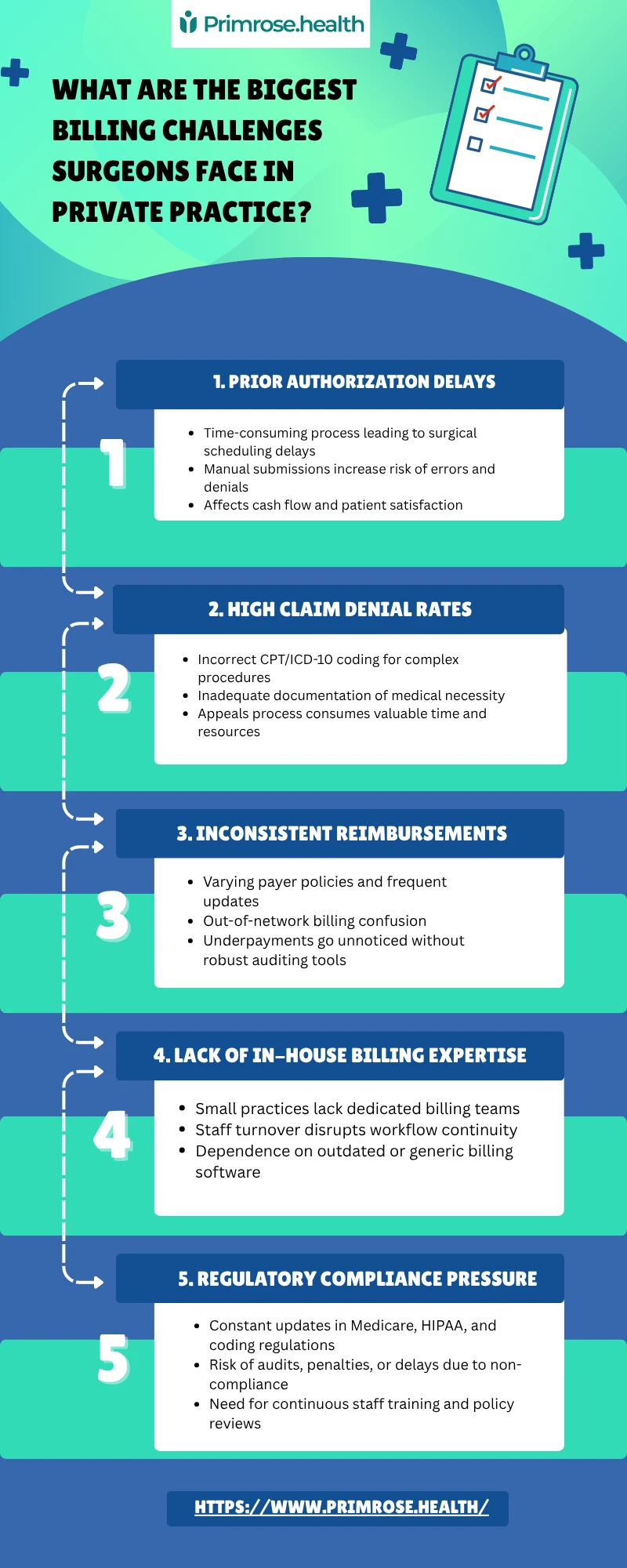
And How Primrose.health Helps Overcome Them
Running a private surgical practice comes with significant clinical responsibilities—but often, the real pain lies not in the OR, but in the back office. Medical billing, especially for surgeons, is highly complex, time-sensitive, and error-prone. A single misstep in coding, documentation, or authorization can delay payments or result in outright denials—eating away at your bottom line.
At Primrose.health, we specialize in helping surgical practices streamline their billing processes, reduce denials, and maximize collections. In this article, we’ll break down the
top billing challenges surgeons face and explain how partnering with a specialized billing company like Primrose can make a measurable difference.
1. Complex Surgical Coding & Modifier Usage
Surgeons often perform high-complexity procedures involving multiple steps, bilateral operations, or bundled services. This creates a dependency on accurate coding using CPT modifiers, ICD-10 precision, and payer-specific billing rules.
A small mistake—such as missing modifier -59 or improperly sequencing procedures—can result in claim denials or underpayments.
How Primrose.health Helps:
At Primrose, our certified surgical coders understand the intricacies of specialty-specific coding. We stay updated on the latest CPT changes, and we build payer-specific rules into our billing workflows to avoid common pitfalls. Our team audits every claim to ensure modifiers are applied correctly, reducing errors and improving first-pass acceptance rates.
2. Prior Authorization Delays & Breakdowns
Surgeries often require prior authorization from payers, especially when they involve expensive implants, outpatient procedures, or cosmetic components. Delays or incomplete prior auth submissions can lead to retroactive denials, even if the procedure is medically necessary.
The root cause? Poor coordination between front-desk, scheduling, clinical teams, and the billing department.
How Primrose.health Helps:
We integrate prior auth management into the billing cycle. Our prior auth specialists work closely with schedulers and coding teams to ensure timely submission and approval. We track auth expirations, document approvals, and flag risks early—so your surgeries don’t get delayed or denied post-facto.
3. High-Dollar Claims = High Scrutiny
Surgical claims are often high-value, which naturally attracts more scrutiny from payers. Whether it's a spine procedure, vascular surgery, or robotic-assisted operation, insurers often delay payments, request medical records, or downcode the procedure.
Without a structured follow-up and appeal process, many of these claims simply fall through the cracks.
How Primrose.health Helps:
We treat every surgical claim like it's under a microscope—because it is. Our accounts receivable (AR) team tracks high-dollar claims aggressively, follows up with payers regularly, and initiates appeals quickly when underpayments or denials occur. Our denials team doesn't quit after one appeal—we pursue every payable claim until it’s resolved or fully exhausted.
4. Denials That Go Unnoticed or Unresolved
The average denial rate in surgical billing can range from 10% to 20%, and many private practices lack the bandwidth or systems to follow up effectively. As a result, money is left on the table.
Even worse, the root causes of denials—such as authorization gaps, invalid coding, or COB issues—are often not analyzed or corrected.
How Primrose.health Helps:
Denial management is one of our strongest areas. We have robust denial tracking and root-cause analysis workflows. We not only appeal denials but also build feedback loops with coding, registration, and authorization teams so the same issue doesn’t happen again. With Primrose, denials aren’t just fixed—they’re prevented.
5. Patient Financial Responsibility & Out-of-Pocket Issues
With the rise of high-deductible plans and co-insurance, more financial responsibility is shifting to patients. For surgical procedures, out-of-pocket costs can be significant—and poor pre-billing communication or inaccurate estimates can result in billing disputes or non-payment.
Most surgeons are clinical experts—not financial counselors. And front-desk teams may not have the tools or training to navigate this complex space.
How Primrose.health Helps:
Primrose provides pre-surgical financial clearance workflows that verify eligibility, calculate patient responsibility, and generate accurate estimates in advance. We help your staff communicate with patients upfront—so there are no surprises later. Our patient engagement tools also allow for digital reminders, statements, and payment plan options.
6. Uncoordinated Teams = Workflow Gaps
In many private practices, billing, coding, scheduling, and authorization operate in silos. This lack of coordination leads to communication breakdowns and finger-pointing when things go wrong—especially when denials or delays impact revenue.
How Primrose.health Helps:
We believe that billing is a team sport. That’s why we align coders, prior auth specialists, and AR teams under one roof, working from the same data and documentation. This cross-functional model ensures fast decisions, fewer errors, and complete accountability at every step.
7. Lack of Transparency & Reporting
Many surgical practices have limited visibility into their billing performance. They receive monthly reports, but no real insight into denial trends, aging AR, coding accuracy, or process gaps. This limits their ability to make proactive decisions and improve financial outcomes.
🔍 How Primrose.health Helps:
With Primrose, you get real-time dashboards, regular performance reviews, and dedicated account managers who explain what’s working—and what needs attention. We don’t just report numbers—we help you understand them, act on them, and improve them.
8. Revenue Leakage Through Poor Reconciliation
Without consistent reconciliation between what's documented, billed, and paid, revenue leakage becomes a silent threat. Practices may miss charges, undercode procedures, or fail to follow up on payer discrepancies.
How Primrose.health Helps:
We implement multi-level reconciliation, including:
- Charge reconciliation (what services were rendered vs. billed)
- Documentation reconciliation (checking against surgeon’s notes)
- Bank deposit reconciliation (matching expected vs. actual payments)
If anything’s missing—we find it and fix it.
Conclusion: Get Back to Surgery, Leave the Billing to Us
Surgical billing is not a one-size-fits-all process. It’s highly specialized, deeply regulated, and constantly evolving. Surgeons in private practice deserve a billing partner that not only understands these nuances but actively solves them.
At Primrose.health, we provide full-spectrum billing support tailored for surgical practices—from coding and prior auth to denials, AR, and patient collections. Our proactive workflows, aligned teams, and transparent reporting give you confidence that your revenue is in good hands.