In the modern corporate landscape, efficiency is no longer just a goal—it is a survival mechanism. Organizations across the globe, from tech giants in Silicon Valley to manufacturing hubs in Southeast Asia, are constantly searching for ways to eliminate waste and enhance quality. At the heart of this operational excellence lies the Six Sigma methodology. Specifically, the Six Sigma Green Belt certification has emerged as one of the most coveted credentials for professionals aiming to bridge the gap between basic process knowledge and high-level strategic execution.
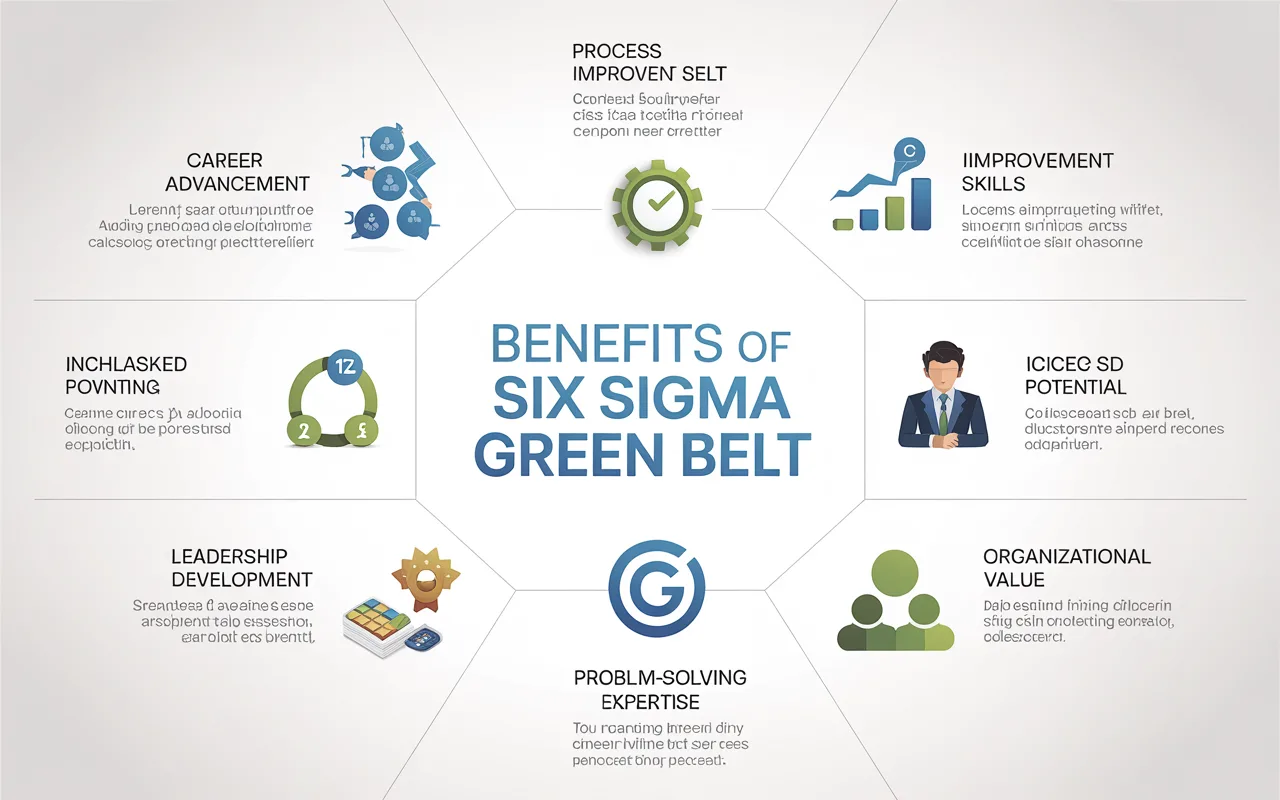
But what exactly makes this certification so impactful? Understanding what are the benefits of Six Sigma Green Belt requires looking beyond just the acronyms. It is about mastering a data-driven philosophy that empowers individuals to solve complex business problems with mathematical precision. Whether you are an aspiring project manager or a seasoned engineer, a Green Belt provides you with the toolkit to lead small-scale improvement projects and support Black Belts in enterprise-wide transformations.
In this guide, we will explore the multifaceted advantages of obtaining a Six Sigma Green Belt, ranging from personal career growth and salary hikes to the profound organizational impact you can deliver. By the end of this article, you will understand why this certification is considered a gold standard in professional development.
The Core Philosophy: Understanding Six Sigma and the Green Belt Role
To appreciate the benefits, we must first define the framework. Six Sigma is a disciplined, data-driven approach and methodology for eliminating defects in any process—from manufacturing to transactional and from product to service. The term "Six Sigma" originates from statistics; specifically, it refers to the goal of having a process produce no more than 3.4 defects per million opportunities.
The Belt Hierarchy
Six Sigma uses a martial-arts-inspired ranking system:
- White Belt: Basic understanding of the concepts.
- Yellow Belt: Familiarity with the tools and participation in project teams.
- Green Belt: The "workhorse" of the methodology. Green Belts lead local projects and possess a deep understanding of the DMAIC (Define, Measure, Analyze, Improve, and Control) framework.
- Black Belt: Full-time leaders who manage large-scale, cross-functional projects.
The Green Belt is often considered the most versatile tier. It is designed for professionals who spend a portion of their time on process improvement while maintaining their regular functional roles. This dual capability makes them incredibly valuable to employers.
1. Professional Credibility and Career Advancement
One of the most immediate answers to the question of what are the benefits of Six Sigma Green Belt is the massive boost to your professional profile. In a competitive job market, certifications act as a "shorthand" for your capabilities.
Global Recognition
Six Sigma is a globally recognized methodology. Unlike some industry-specific certifications, the principles of Lean and Six Sigma are universal. Whether you move from a healthcare role in London to a logistics role in Singapore, your Green Belt certification remains a valid testament to your problem-solving skills.
Leadership Readiness
Earning a Green Belt demonstrates to senior management that you are ready for leadership. It shows that you possess "systems thinking"—the ability to see how individual tasks connect to the broader organizational goals. Professionals with this certification are often the first in line for promotions because they have proven they can deliver measurable financial results.
2. Mastery of the DMAIC Framework
The backbone of the Green Belt training is the DMAIC methodology. Mastering this process is a life-long skill that transcends any single job title.
- Define: You learn how to identify a problem clearly, define the scope, and understand what the "Voice of the Customer" (VoC) actually requires.
- Measure: You gain the ability to collect baseline data. Instead of guessing, you use statistical tools to see how a process is currently performing.
- Analyze: This is where you find the root cause. Using tools like Fishbone Diagrams and Pareto Charts, you move past symptoms to solve the actual issue.
- Improve: You develop creative, data-backed solutions to eliminate the root causes.
- Control: Perhaps the most important phase, you learn how to sustain the gains so that the process doesn't revert to its old, inefficient ways.
When you ask what are the benefits of Six Sigma Green Belt, the ability to apply this rigorous logic to any problem is arguably the most valuable answer.
3. Tangible Financial Impact for Organizations
Organizations invest in Green Belt training because it pays for itself—often many times over. A single Green Belt project can save a company anywhere from $10,000 to $100,000 annually.
Waste Reduction
By applying "Lean" principles alongside Six Sigma, Green Belts identify the eight types of waste (DOWNTIME: Defects, Overproduction, Waiting, Non-utilized talent, Transportation, Inventory, Motion, and Extra-processing). Eliminating these wastes directly impacts the bottom line.
Improved Quality and Customer Satisfaction
When defects are reduced, the product or service quality improves. This leads to higher customer retention and brand loyalty. In the era of social media and instant reviews, maintaining a "Six Sigma level" of quality is a powerful competitive advantage.
4. Enhanced Analytical and Statistical Skills
In the age of Big Data, being able to interpret information is a superpower. A Green Belt certification takes you beyond basic spreadsheets.
Data-Driven Decision Making
Many professionals make decisions based on "gut feeling" or "the way we’ve always done it." A Green Belt professional uses Minitab or advanced Excel functions to perform hypothesis testing, regression analysis, and probability distributions.
Bridging the Gap Between IT and Business
In fields like Artificial Intelligence and Data Science, Green Belts serve as excellent intermediaries. They understand the statistical requirements of a model while maintaining a focus on the business objective. This makes them ideal for roles in technical project management and business analysis.
5. Significant Salary Increase
Let’s talk about the financial benefits for the individual. Statistics consistently show that Six Sigma certified professionals earn significantly more than their non-certified peers.
RegionAverage Salary Increase (Estimated)United States15% - 25%Europe10% - 20%India20% - 30%According to various salary surveys, a Six Sigma Green Belt in the US can expect an average salary ranging from $85,000 to $115,000, depending on the industry and years of experience. Employers are willing to pay a premium for "guaranteed" results, and a Green Belt is as close to a guarantee as you can get in the world of process improvement.
6. Versatility Across Industries
While Six Sigma started in manufacturing (thanks to Motorola and GE), it has permeated every sector imaginable.
Healthcare
Green Belts in healthcare work on reducing patient wait times, minimizing surgical errors, and optimizing the supply chain for life-saving medications. The stakes here aren't just financial; they are human.
Financial Services
In banking, Six Sigma is used to reduce the time it takes to process loan applications, eliminate errors in credit card billing, and improve the security of digital transactions.
Cloud Computing and IT
For IT professionals, a Green Belt helps in optimizing server uptime, streamlining software development lifecycles (SDLC), and managing service level agreements (SLAs) more effectively. If you are working with AWS or Azure, applying Six Sigma to resource allocation can save thousands in monthly cloud spend.
7. Strategic Importance in Project Management
If you are a Project Management Professional (PMP)®, adding a Six Sigma Green Belt creates a "force multiplier" effect.
- PMP focus: On-time, on-budget, and within scope.
- Green Belt focus: Quality, consistency, and minimal variation.
Combining these two allows you to manage projects that are not only completed on time but are also functionally superior. It provides a structured approach to risk management and quality control that basic project management frameworks sometimes lack.
8. Development of Soft Skills and Leadership
Contrary to popular belief, Six Sigma isn't just about math; it’s about people. To successfully complete a Green Belt project, you must master:
- Change Management: People often resist new processes. You learn how to bring stakeholders along on the journey.
- Communication: You gain the ability to present complex data to executives in a way that is easy to digest.
- Team Building: You learn how to lead "Kaizen" events—short, intense brainstorming sessions that foster collaboration and innovation.
9. Future-Proofing Your Career
As Machine Learning (ML) and Automation become more prevalent, the nature of work is changing. However, the need for process optimization remains constant. In fact, automation of a "bad" process only results in making mistakes faster.
Green Belts are the ones who ensure that processes are optimized before they are automated. This makes them indispensable in the era of Digital Transformation. By understanding what are the benefits of Six Sigma Green Belt, you realize that you are essentially learning how to be an architect of the modern automated world.
10. Practical Use Case: Six Sigma in Cybersecurity
To illustrate the practical application, let’s look at Cybersecurity. A Green Belt professional could treat a "security breach" or a "failed compliance check" as a defect.
- Define: Identify the specific types of vulnerabilities causing the most risk.
- Measure: Track the Mean Time to Detect (MTTD) and Mean Time to Respond (MTTR).
- Analyze: Use a "5 Whys" analysis to determine if the breaches are due to outdated software, human error, or hardware failure.
- Improve: Implement automated patching and mandatory multi-factor authentication (MFA).
- Control: Set up continuous monitoring dashboards to ensure security levels remain within the "Sigma" threshold.
This structured approach is far more effective than reactive "firefighting."
Industry Relevance and E-E-A-T
When looking for a certification provider like iCertGlobal, it is crucial to ensure the training aligns with the ASQ (American Society for Quality) or IASSC (International Association for Six Sigma Certification) bodies of knowledge. This ensures your certification carries the necessary Experience, Expertise, Authoritativeness, and Trustworthiness (E-E-A-T) required by top-tier employers.
Choosing a reputable training partner provides you with real-world case studies and access to instructors who have led multi-million dollar projects. This practical exposure is what transforms a certificate into a career-defining asset.
Challenges and Considerations
While the benefits are immense, obtaining a Green Belt is not a "walk in the park." It requires:
- Commitment: The exam is rigorous and requires a deep understanding of statistics.
- Application: Most reputable certifications require you to complete a real-world project to demonstrate your skills.
- Continuous Learning: The field of process improvement is always evolving. You will need to stay updated on new tools and software.
However, these challenges are exactly why the certification is so valuable. If it were easy, it wouldn't command the salary and respect that it does.
Future Trends: Six Sigma and AI
Looking ahead, we see the integration of Six Sigma with Artificial Intelligence. "Intelligent Process Automation" (IPA) uses AI to handle the "Analyze" and "Improve" phases of DMAIC in real-time. Professionals who understand both Six Sigma and the basics of AI will be the most sought-after consultants of the next decade.
The Green Belt provides the foundational logic that allows you to supervise these AI systems, ensuring they are optimizing for the right variables and not creating "black box" processes that the business cannot control.
Conclusion: Is the Six Sigma Green Belt Worth It?
When we summarize what are the benefits of Six Sigma Green Belt, the answer is a resounding yes. For the individual, it offers a path to higher earnings, global mobility, and a sophisticated problem-solving mindset. For the organization, it offers a way to increase profitability, enhance customer satisfaction, and foster a culture of continuous improvement.