
Uncover hidden financial networks, trace misappropriated corporate wealth, and secure your legally rightful capital with advanced forensic intelligence.
Introduction: When high-stakes litigation, loan defaults, or corporate fraud occurs, recovering what is owed to your business often becomes a complex battle. Willful defaulters and rogue business partners do not leave their wealth in plain sight; they bury it in offshore shell companies and proxy real estate. Asset investigation services provide the aggressive, legally sound framework needed to peel back these layers of obfuscation. By partnering with specialized forensic consultants, financial institutions and enterprises can definitively locate hidden properties, trace illicit money flows, and build the undeniable evidence required by courts to freeze and recover stolen capital.
What is an Asset Liability Investigation?
What does it actually mean to trace corporate assets, and how does it differ from a standard background check?
A regular background check relies on public filings, which are easily manipulated by individuals attempting to hide their true net worth. An asset liability investigation is a deep-dive, forensic dissection of a subject’s entire financial ecosystem.
Instead of just looking at what a company declares, investigators look for what they are actively hiding. They trace the movement of funds to locate undisclosed real estate, overseas bank accounts, digital assets, and hidden equity held by family members or proxy directors. This is incredibly critical during proceedings like the Insolvency and Bankruptcy Code (IBC). When a company goes to the National Company Law Tribunal (NCLT) claiming bankruptcy, an asset trace ensures that the promoters have not secretly siphoned off the company's capital right before defaulting, giving the Resolution Professional the power to claw those funds back for the creditors.
Why Do Ambitious Enterprises Need Commercial Asset Investigations?
Why are banks, law firms, and large corporations prioritizing these highly specialized traces?
Because a multi-million rupee court judgment is completely useless if the debtor claims they have no money to pay it. In today’s digitized economy, moving money across international borders takes seconds.
Enterprises rely on commercial asset investigations to bridge the gap between winning a lawsuit and actually getting paid. Before entering a massive joint venture, a pre-litigation trace reveals the true financial health of a partner, preventing you from tying your brand to a sinking ship. Furthermore, under strict regulations like the Prevention of Money Laundering Act (PMLA), financial institutions are mandated to aggressively pursue Non-Performing Assets (NPAs). Utilizing specialized tracing proves to regulators that your institution is actively mitigating financial risk and holding willful defaulters accountable.
How Do the Best Consulting Firms Execute Asset Tracing Services?
How do forensic experts actually find capital that someone has spent months or years hiding?
Finding hidden wealth is a meticulous science that combines advanced data analytics with deep legal intelligence. It is not about illegal hacking; it is about connecting fragmented public and private data points across multiple global jurisdictions.
Asset tracing services begin by scraping historical banking records, corporate registries, and property deeds. Investigators look for anomalies like a sudden transfer of business assets to a newly formed, unknown subsidiary right before a loan default. They utilize international intelligence networks to pierce the corporate veil of offshore shell companies, identifying the true "beneficial owner" behind the fake directors. By gathering digital footprints, email communications, and cross-border financial logs, they create a legally admissible map that explicitly links the hidden wealth back to the defaulting party.
What Are the Direct Benefits of Asset Tracing Investigations?
What is the real, bottom-line financial impact of deploying a forensic trace?
Deploying a professional trace transforms a written legal victory into actual, recovered cash. The primary benefits include:
- Maximized Debt Recovery: By uncovering undeclared stock portfolios, properties, and proxy businesses, you drastically increase the total capital recovered during an insolvency or default.
- Strategic Litigation Power: Knowing exactly what assets the opponent holds gives your legal counsel massive leverage during settlement negotiations.
- Enforcing Judgments: When a court orders a payout, a tracing report gives authorities the exact bank account numbers and property addresses required to immediately freeze and seize the assets.
- Corporate Deterrence: Aggressively tracking down hidden funds sends a definitive message to the market and your employees that your enterprise will pursue financial deception relentlessly.
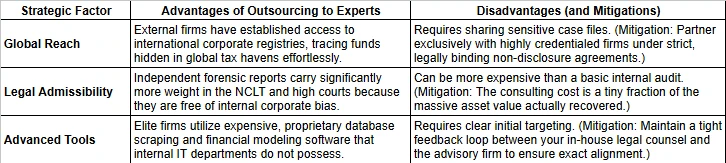
Advantages and Disadvantages of Outsourcing Your Tracing Needs
Should a bank or enterprise build its own forensic tracking department, or rely on specialized external investigators?
Executive boards must weigh the tactical differences when dealing with high-stakes financial recovery.
How ASC Group Helps
When millions are deliberately siphoned away, standard legal demands simply do not work. You need empirical, undeniable proof. ASC Group delivers an elite suite of asset tracing investigations tailored specifically for the complex Indian corporate and legal ecosystem.
Operating as your strategic financial forensics partner, our seasoned experts deploy advanced tracing methodologies to map out shell companies, locate offshore accounts, and expose proxy ownerships. We ensure every investigation strictly adheres to Indian laws, including the PMLA and IBC, ensuring total data integrity. Whether you are a lender dealing with massive NPAs, a Resolution Professional navigating an insolvency, or a corporation executing commercial litigation, ASC Group provides the legally admissible, hard evidence required to freeze accounts and seize hidden wealth, ensuring you reclaim your capital swiftly and decisively.
Conclusion: Securing Financial Integrity
In a globalized economy, hiding assets is easier than ever, but uncovering them has also become a highly precise science. Writing off massive debts or walking away from breached contracts simply because a debtor claims to be broke is a failure of corporate governance. By proactively integrating advanced tracing methodologies into your recovery strategy, you shift the balance of power. Forward-thinking enterprises use these elite forensic tools to guarantee that their judgments translate into actual, recovered capital, securing their balance sheets and deterring future financial crime permanently.
Frequently Asked Questions (FAQs)
1. Is asset tracing completely legal in India?
Yes. Professional asset tracing relies exclusively on legally permissible methods, such as analyzing public corporate registries, land records, court filings, and utilizing advanced data analytics on legally obtained financial documents. It does not involve illegal wiretapping or unauthorized hacking.
2. How do investigators trace money that has been moved to offshore tax havens?
Investigators utilize international corporate databases and cross-border intelligence networks to identify offshore shell companies. They trace the "beneficial ownership" records, effectively following the paper trail past the fake directors to find the actual individual controlling the offshore accounts.
3. What role does an asset liability investigation play in Mergers and Acquisitions (M&A)?
During M&A due diligence, a trace ensures the target company actually owns the assets they claim on their balance sheet. More importantly, it verifies they do not have massive hidden debts, proxy ownerships, or pending litigations that could bankrupt the acquiring company post-merger.
4. Can cryptocurrency be traced during a financial investigation?
Yes. While cryptocurrency is designed to be decentralized, transactions are permanently recorded on public blockchains. Advanced forensic teams use specialized blockchain analytics tools to track the flow of digital wallets and identify the exit points where the crypto is converted back into traditional fiat currency.
5. How long does a typical commercial asset investigation take?
The timeline depends heavily on how actively the subject is hiding the wealth. A domestic trace involving local real estate and bank accounts might take a few weeks, while unraveling a sophisticated, multi-jurisdictional web of shell companies can take several months of forensic work.