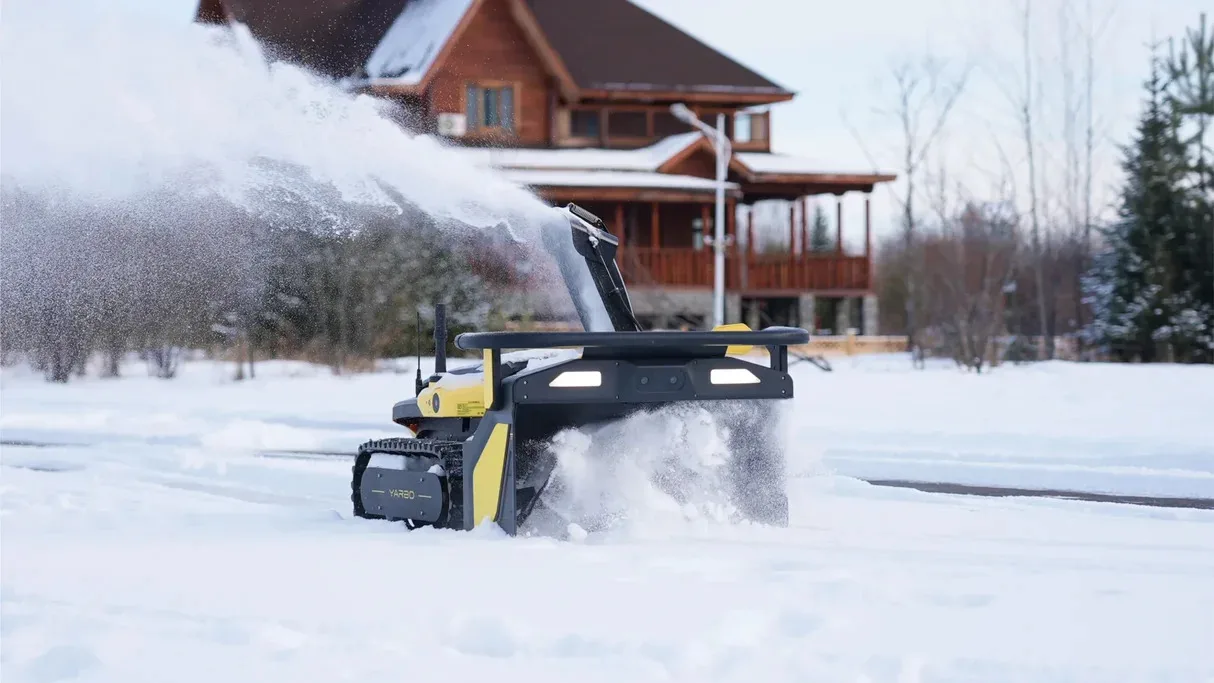
Most people picture a robot snow blower the same way they picture a regular one: a storm ends, the machine goes out, the driveway gets cleared. That’s not quite how it works, and the difference is the whole reason these machines exist.
A walk-behind blower waits for you. A robotic one doesn’t wait for anything. Here’s what a typical storm night looks like from the machine’s side, and what’s still left for you in the morning.
Before the First Flake: The Setup That Makes the Night Work
Everything that happens overnight depends on work done weeks earlier. A robotic snow blower like Yarbo’s needs a positioning setup first. That usually means an RTK base station, though in areas with NetRTK network coverage, no base station is needed.
Then come the zones. You map the driveway, the front walk, and the sidewalk in the app, and for each one you set the clearing order, intake height, throw direction, and schedule. Think of it like writing a recipe before you start cooking: the machine follows it exactly, so the quality of the night depends on how carefully you wrote it.
One detail people often skip is surface type. On a gravel driveway, Yarbo recommends raising the intake about 2 inches so the machine isn’t scooping up stones along with the snow.
Evening: Snow Starts, and So Does the Machine
This is the first real difference from a traditional blower. Yarbo can start when snow begins, run on a set schedule, or start from the app. You don’t need to be awake, dressed, or even home.
Starting early isn’t just about convenience. The machine’s intake is 12 inches high, and clearing during the storm keeps accumulation below that line. Instead of facing 10 or 14 inches of packed snow at sunrise, it deals with the storm in manageable layers.
Midnight: Why Clearing in Rounds Works Better
If you’ve ever shoveled after a big storm, you know the bottom layer is the worst part. It’s been compressed by everything above it, and sometimes it’s bonded to the pavement.
Clearing in rounds avoids most of that. Each pass removes a few inches of relatively fresh snow, which is easier to throw and less likely to turn into a hard base. The 2-stage design, with a 24-inch clearing width, handles dry, packed, and wet snow on asphalt, concrete, and gravel.
That said, very heavy, wet snow is its own category. Yarbo suggests pairing the machine with the optional Snow Plow Blade for those conditions, since pushing wet snow aside causes fewer clogs than trying to throw it.
The Battery Question
This is where most people’s skepticism kicks in. What happens when the battery runs low halfway through a storm?
The answer is less dramatic than you might expect. At about 20% battery, the machine returns to its dock, recharges to about 80% in roughly 1.5 hours, and picks up where it left off. On a long driveway, that just means more recharge stops, not an unfinished job.
How much ground it covers per charge depends on which Core you choose. The Y40 covers up to 6,000 ft² per charge and the Y40P up to 7,000 ft², both measured in 1 inch of snow. Deeper snow means less coverage per charge, which is one more reason clearing during the storm makes sense.
When Snow Hides the Edges
Here’s a problem humans solve without thinking: you know where your driveway ends even when it’s buried. A machine needs a way to know that too.
Yarbo uses a navigation system called PPVS, which combines RTK-GPS, stereo vision, odometry, and IMU sensors. Because the route comes from the map you created rather than from what the machine can see on the ground, it stays inside its zones even when snow has covered every visual edge.
The cold itself is part of the equation too. The machine is rated to operate from -13°F to 113°F, with IPX5 water resistance, which covers the overnight temperatures most snowy regions see.
Where the Snow Goes
Throwing snow is easy. Throwing it somewhere useful is the hard part. Yarbo’s snow blower module throws up to 40 feet, with a motor-driven chute that rotates from -10° to 190° and a deflector that adjusts from -5° to 50°.
In practice, this is why throw direction is set per zone. You want snow from the driveway going onto the lawn, not onto the walkway you’re about to clear next, and definitely not onto your neighbor’s car.
Morning: What’s Still Left for You
A robot snow blower reduces winter work a lot, but it doesn’t remove it entirely, and it’s worth being honest about that.
The most common leftover job is the curb pile. When the street plow comes through, it leaves a ridge of heavy, compacted snow at the end of your driveway. That pile may need an extra pass or a few minutes with a shovel.
The other is housekeeping. Cars, hoses, and anything else left in a mapped zone get in the way, so it pays to keep those areas clear before a storm is forecast.
Is This the Right Fit for Your Winter?
The honest answer depends on how often it snows where you live. If you get several storms a season and currently spend mornings clearing snow or paying a service, an autonomous machine changes your winter routine noticeably. If significant snow only shows up once or twice a year, a traditional blower or an occasional service may be the simpler choice.
If you’re deciding between models, the snow-clearing hardware is the same. The Y40 is the proven, reliable choice for a standard residential driveway, while the Y40P suits longer driveways and heavier year-round use with faster mapping and smoother handling. Both are rated for slopes up to 36% (20°), so a steep driveway alone doesn’t decide it.
It’s also worth thinking past winter. The same Core that clears snow can take a mowing module in spring, which matters if you’re comparing it to a single-season machine. Yarbo’s robot lawn mower lineup shows how that seasonal switch works.
Frequently Asked Questions
1. Does a robot snow blower wait until the storm ends?
Not necessarily. Yarbo can start as soon as snow begins, which keeps accumulation below its 12-inch intake height instead of tackling a full storm’s worth at once.
2. What happens if the battery dies mid-job?
It doesn’t simply stop. At about 20% battery it returns to its dock, recharges, and resumes where it left off.
3. Will I ever need to shovel again?
Probably a little. Curb piles left by street plows may still need an extra pass or a shovel.
The Bottom Line
The biggest shift with a robotic snow blower isn’t the hardware. It’s the timing. Instead of one big, exhausting session after the storm, the work happens in small rounds while you sleep, and the morning job shrinks to a curb pile and a cup of coffee. If that sounds like the winter routine you want, Yarbo is a good place to see how the full system fits together.