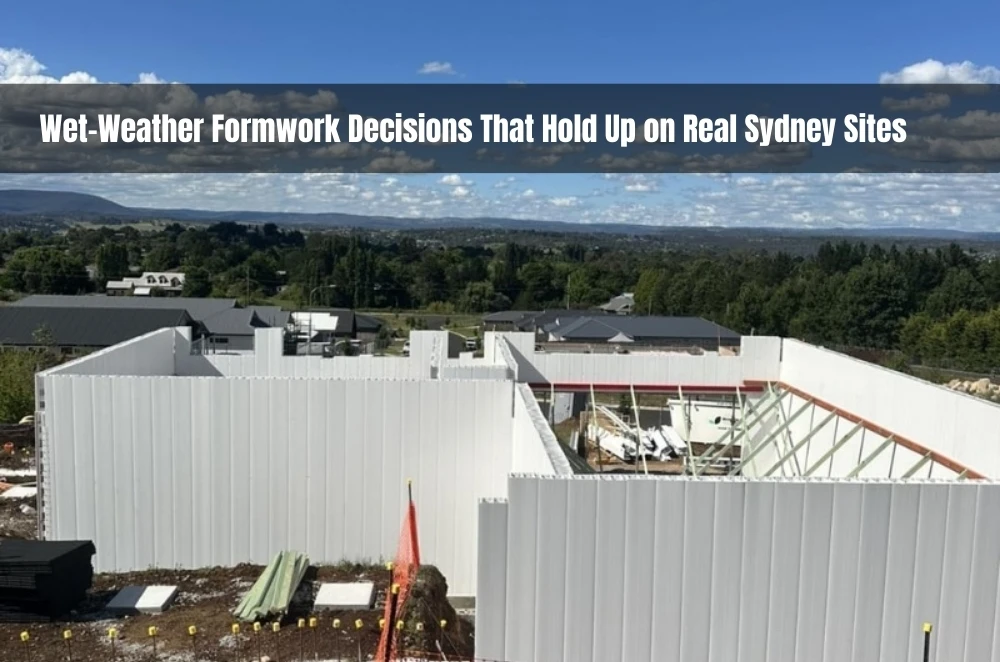
If you’ve ever tried to keep a wall pour moving after two days of drizzle, you already know the problem isn’t “rain” — it’s everything that comes with it.
Moisture turns small weaknesses into time sinks: swollen edges, sloppy joins, water sitting where it shouldn’t, and a crew that’s now doing damage control instead of building.
And when the schedule’s tight, it’s the repeatability that breaks first.
Why does moisture change the job more than people admit
Water doesn’t politely stay on the surface — something crews dealing with retaining wall build systems for Australian projects see play out on site everyday.
It finds joins, edges, penetrations, corners, and anywhere someone assumed the system would “seal itself” once it was tightened up.
Even if the rain stops, damp storage and wash-down routines can keep components wet long enough to change how they handle and how well they mate up next time.
A system can look fine on day one and still drift into problems by cycle four if the edges and joints aren’t coping.
Wet sites also change behaviour: people rush setups between showers, stack materials wherever they fit, and skip checks because everyone’s trying to beat the clock.
What “water-resistant” should mean in plain site terms
It’s not a magic label, and it’s not just about the face material.
In practice, “water-resistant” has to cover two different realities: how the system survives wet storage/handling, and how it behaves when concrete pressure rises, and water wants to escape through every gap.
If those are muddled, you end up buying something that’s tough in the yard but a pain during the pour — or the other way around.
A useful definition is simple: the system should stay predictable when it’s damp, not demand heroic effort to make it work.
That means joins that don’t turn into sponges, edges that don’t fall apart after a few knocks, and detailing that doesn’t rely on one person’s secret technique.
Decision factors that actually matter (and the ones that don’t)
There’s a lot of noise in product conversations, so it helps to anchor the decision on the things that actually cause defects and delays.
1) Joins and edges: where the job is won or lost
If edges swell, chip, or soften, joins open up, and you’ll chase grout loss, surface defects, and “why is this section different?” headaches.
Ask how edges are protected through handling and how joins are designed to stay consistent across reuse cycles, not just on the first setup.
2) Penetrations and tie points: make them boring
Every penetration is a leak opportunity, and wet conditions make it harder to spot small issues until it’s too late.
Confirm the expected approach for sealing around tie locations and penetrations, then make it a repeatable step — not “do it if it looks wet.”
3) Corners and returns: avoid anything that needs a wizard
Corners expose every shortcut, especially when you’re setting up fast between weather windows.
Prefer a corner method that’s easy to teach and easy to inspect, because complicated corners always end up being “done differently” by different crews.
4) Handling and storage: part of performance, not an afterthought
If materials are dragged through mud, stored flat on damp ground, or lifted in ways that damage the faces, any “water-resistant” claim becomes irrelevant.
Check what the system expects for stacking, lifting points, edge protection, and whether that’s realistic for the footprint you actually have.
5) Reuse cycles and condition control: decide standards early
Moisture doesn’t only affect today’s pour; it affects the next few if you don’t have a basic routine for inspection and repair.
Define what “acceptable condition” looks like, who checks it, and what gets repaired immediately versus quarantined, so people aren’t making judgment calls mid-setup.
If you want a practical reference point to compare jointing, handling, and wet-area performance, the Rise Products wall system overview is a handy way to frame the questions before you lock in a method.
One good question beats ten vague promises.
Common mistakes that turn wet conditions into rework
Treating water resistance as a feature instead of a workflow
If the plan assumes perfect storage, perfect handling, and perfect checks, it won’t survive a busy week.
Build a routine that works even when the laydown is cramped and the weather changes mid-shift.
Letting edge damage slide because it “won’t be seen”
Edge damage isn’t cosmetic when it creates gaps, inconsistent joins, or weak sealing points.
Fixing small damage early is boring — and that’s exactly why it works.
Leaving penetrations until someone notices water
By the time concrete is going in, you don’t want anyone “discovering” a pattern of poorly treated penetrations.
Make penetrations a formal check item with a name next to it.
Overcomplicating corners and interfaces
If corners require bespoke carpentry or some very specific trick, quality will vary by crew and by day.
Choose methods that are hard to get wrong, because wet conditions punish improvisation.
No clear standard for what gets repaired, rotated, or removed
Without a simple acceptance standard, people either pass everything (risk) or reject too much (delays and cost).
Set the line clearly and stick to it, even when everyone’s under the pump.
A simple 7–14 day plan that actually fits a real programme
This isn’t a “transformation project”; it’s a short reset that reduces surprises.
Days 1–2: Map the exposure points
Walk the upcoming wall scope and list the moisture risks: laydown area, access routes, wash-down points, and interfaces likely to stay damp.
Write down where water will pool and where materials will sit overnight, because that’s where damage quietly starts.
Days 3–4: Turn decisions into checks
Convert the decision factors into a one-page checklist: joins/edges, penetrations, corners, handling/storage, and condition acceptance.
Assign a single owner for each category so it doesn’t become “everyone’s problem,” which means no one owns it.
Days 5–7: Do a rehearsal setup (small, but honest)
Set up a representative section that includes a corner and a penetration-heavy zone using the actual crew, not a perfect demo team.
Inspect for the failures that show up on wet sites: gaps at joins, inconsistent sealing, and handling damage that only appears once you start moving gear quickly.
Days 8–10: Lock in storage and handling rules
Agree on stacking, edge protection, and where materials will live on the site.
If the ideal laydown isn’t possible, decide the compromise now rather than inventing it on pour day.
Days 11–14: Toolbox the few moves that matter
Keep training tight: what to check, how to check it, and what to do when it’s not right.
Make it practical enough that the newest person can follow it without guessing.
This is where jobs settle down.
Operator Experience Moment
On damp sites, the biggest improvement I’ve seen isn’t a new gadget — it’s removing “special handling” steps that never survive a rushed morning. When the system is straightforward to stack, check, and seal the same way every time, crews stop improvising. The moment it feels fiddly, people start shortcutting, and wet conditions punish that immediately.
Local SMB mini-walkthrough (Sydney/NSW)
A small builder in Western Sydney is running a tight programme with almost no laydown space.
They mark out a raised storage zone so panels aren’t sitting on wet ground after overnight rain.
They use a simple tag routine: green (ready), amber (repair today), red (quarantine).
Before each pour, one person signs off on corners and penetrations against a one-page list.
Wash-down is scheduled earlier, so components aren’t stacked dripping at the end of the day.
When the forecast turns, the routine stays the same — no last-minute “we’ll just wing it.”
Practical Opinions
Repeatable beats clever when the weather’s messy.
Corners and penetrations should be simple enough to inspect in 30 seconds.
Condition control saves more time than arguing about blame.
Key Takeaways
- “Water-resistant” only helps if joins, edges, corners, and penetrations are managed in a repeatable workflow.
- Handling and storage are part of product performance on wet sites, not a separate logistics issue.
- A short rehearsal setup can reveal leak paths and weak detailing before they show up in the finished wall.
- Clear accept/repair/quarantine standards keep reuse cycles predictable and reduce last-minute judgment calls.
Common questions we hear from businesses in Sydney, NSW, Australia
Q1) Do water-resistant systems stop leakage completely during the pour?
In most cases, they reduce leakage risk but don’t eliminate it, because setup consistency, penetrations, and corner detailing still decide the outcome. A practical next step is to add joins and penetrations to a pre-pour sign-off and assign one person to verify them. In Sydney, weather windows can be short, so the check needs to be fast enough to happen even when everyone’s trying to start early.
Q2) What should we fix first if a site is constantly damp?
Usually, start with storage and handling, because edge damage and damp stacking quietly undermine joins before the system is even erected. A practical next step is to designate a raised storage area and introduce an accept/repair/quarantine rule that the whole crew understands. Around NSW sites with tight footprints, that can mean sacrificing a bit of convenience in access to gain cleaner stacking and fewer damaged components.
Q3) How do we choose between a simpler system and one with more features?
It depends on the crew mix, how often you expect rushed setups, and how much tolerance the programme has for rework if a detail is missed. A practical next step is to rehearse a corner and a penetration-heavy section with the actual crew and see which approach stays consistent without extra supervision. In Sydney, where subcontractor teams can rotate between stages, simpler methods tend to hold up better because they’re easier to teach and inspect.
Q4) How do we stop quality from dropping across reuse cycles?
Usually, quality drops when small damage isn’t caught early, so joins degrade and the system becomes unpredictable over time. A practical next step is to tag components at pack-down (ready/repair/quarantine) and review the amber items the same day, not “when there’s time.” In NSW conditions, where gear can stay damp after wash-down, storage airflow and timing can matter as much as the repair itself.