In the modern era of industrial processing, the demand for reliable, high-efficiency filtration solutions is greater than ever before. Whether in water treatment, food and beverage, mining, chemical processing, or oil and gas industries, the quality and consistency of filtration play a decisive role in operational efficiency, product quality, safety, and compliance with environmental standards. Amid a crowded field of filtration options, one technology stands out for its unmatched durability, precision, and adaptability—the wedge wire screen.
At Anping County BT Wire Mesh Products Co.,Ltd, our expertise in bespoke wire mesh and filtration solutions has set us apart as a trusted partner to industries worldwide. Wedge wire screen technology represents a leap forward in filtration performance, combining robust mechanical strength, precision slot tolerances, and superior resistance to clogging. These unique features make wedge wire screens the preferred choice for countless industrial applications where other screens—and traditional woven meshes—simply cannot compete.
What Is a Wedge Wire Screen?
To fully grasp the value of wedge wire screens, it is important to first understand their structure and how they function.
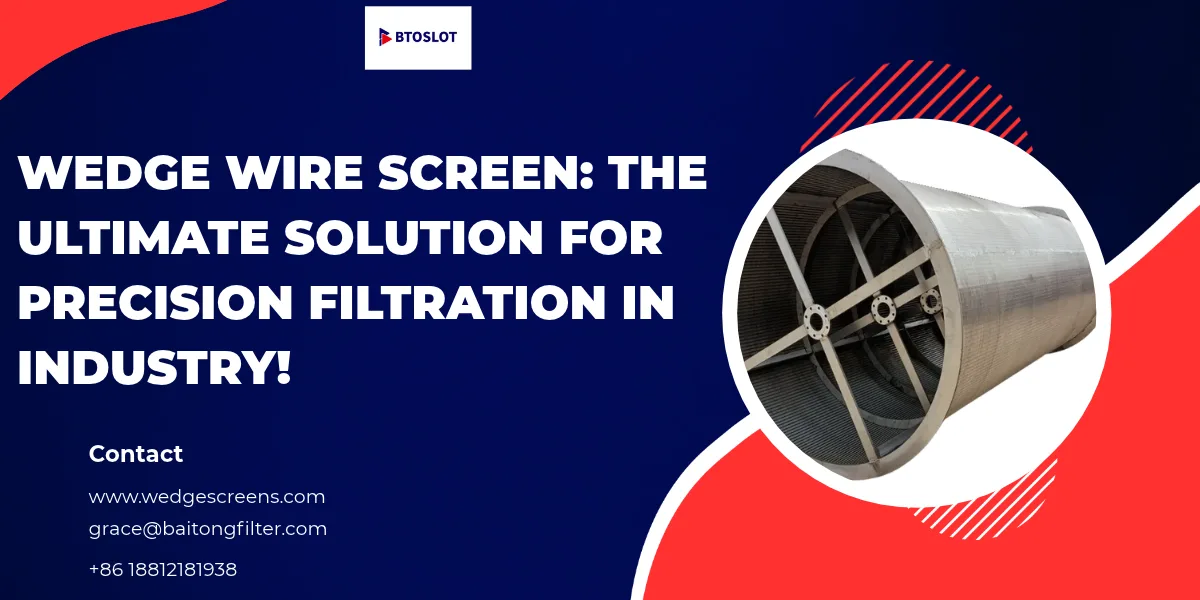
A wedge wire screen is a type of industrial screen or filter panel manufactured from precisely profiled metal wires. These wires, typically made from high-grade stainless steel, are formed into a “V” or wedge-shaped cross-section. During manufacturing, these wedge wires are welded or otherwise fixed to a series of support rods (also known as “backup rods” or “cross rods”), spacing each wire apart to form consistent, parallel slot openings.
This unique architecture gives rise to two key features:
- Precision Slot Openings: The gaps (slots) between adjacent wedge wires are carefully controlled, often to tolerances as fine as ±0.05mm, allowing for precise and reproducible filtration or separation.
- Self-Cleaning, Non-Clogging Surface: The slanted surface of the wedge wire creates a “V” slot that naturally resists blinding and particle buildup, as particles are less likely to wedge tightly into the slots.
Primary Components of a Wedge Wire Screen:
- Wedge-shaped profile wires: Form the filtration surface.
- Support rods: Provide rigidity, strength, and secure the wedge wires in place.
Forms and Variations
Wedge wire screens are available as:
- Flat panels and sieves
- Cylindrical screens (screen baskets or filter tubes)
- Sieve bends and curvilinear screens
- Conical or custom-formed screens
- Slot tubes and resin traps
This versatility allows for integration into almost any industrial process, from simple strainers to high-capacity continuous dewatering systems.
The Science Behind Wedge Wire Screen Superiority
What distinguishes the wedge wire screen from traditional mesh or perforated sheet filtration? The answer lies in both design and materials science.
1. Precision Filtration with Versatile Slot Sizes
Unlike woven meshes (which can deform or stretch), the rigid, fixed structure of a wedge wire screen ensures slot openings remain constant throughout use, even under high pressure or mechanical stress. This enables precise retention or passage of target particles, making wedge wire screens ideal for high-accuracy separation and filtration processes.
2. Exceptional Mechanical Strength
Wedge wire screens are fabricated from solid metals—most frequently stainless steel grades 304 or 316L, but also Inconel, Hastelloy, and other special alloys for aggressive environments. The welded construction and robust design mean wedge wire screens can withstand significant static and dynamic loading, including vibration, impact, and abrasive wear.
3. Non-Clogging Performance
The “V” shape of the wedge wire creates a narrow entry and wider exit, ensuring that particles are less likely to become stuck (“blinded”). Liquids and fine solids flow freely through, while oversize particles are rejected and slide off the surface. This self-cleaning effect results in longer service intervals and higher process reliability.
4. Superior Corrosion and Wear Resistance
With material options such as duplex stainless steel, wedge wire screens are resistant to corrosion from water, chemicals, acids, and even seawater. Surface finishing (such as electropolishing or passivation) further reduces fouling and enhances cleanliness, making them suitable for hygienic and high-purity applications.
Also Read - How Wedge Wire Screen Transforms Industrial Screening Processes!
Key Applications of Wedge Wire Screens
Wedge wire screens see use in nearly every process industry that requires filtration, separation, sizing, or dewatering:
1. Water and Wastewater Treatment
- Intake screens for raw water (rivers, lakes, oceans)
- Rotary drum screens for primary solids separation
- Sieve bend screens for fine screening of effluent
- Underdrain floors in sand filters
- Resin traps in ion exchange systems
2. Food & Beverage Processing
- Filtration or clarification of juices and beverages
- Starch and sugar processing
- Brewery lautering and spent grain separation
- Dairy whey separation
3. Mining and Mineral Processing
- Slurry separation and ore dewatering
- Vibrating or static classifier screens
- Coal and aggregate sizing
4. Chemical, Oil & Gas Industries
- Catalyst support grids
- Screen laterals and internals for process vessels
- Petrochemical filtration elements
5. Pulp & Paper
- Stock processing screens
- Fiber recovery units
- Dewatering and washing stages
6. Pharmaceuticals & Fine Chemicals
- Ultra-hygienic filtration screens
- Powder separation and sizing
Why Wedge Wire Screens Are the Ultimate Filtration Solution
Let’s break down the core reasons industries worldwide are switching to, or specifying, wedge wire screens as the preferred filtration medium:
1. Unmatched Filtration Precision
Engineers can specify the exact opening size required for any separation task. From ultrafine screens (down to 20 microns) to industrial dewatering and sizing, wedge wire screens are available in virtually every required slot size.
2. Extended Service Life and Low Maintenance
Wedge wire screens are robust, corrosion-resistant, and less likely to clog or blind. This results in fewer process interruptions, minimal backwashing, and lower total cost of ownership compared to many other filtration methods.
3. Customizable to Any Application
With a modular design and wide-ranging materials and geometries, wedge wire screens are truly “engineered to order”. Anping County BT Wire Mesh Products Co.,Ltd provides consultation, design, and rapid manufacturing to exact customer needs.
4. Superior Flow Dynamics
The smooth surface and open slot configuration promote laminar, even flow, reducing pressure drops and maximizing filtration efficiency even under high solids loads.
5. Hygienic and Easy to Clean
Smooth, crevice-free surfaces make wedge wire screens easy to sanitize; especially important in food, beverage, and pharmaceutical settings.
6. Sustainability and Eco-Friendliness
Durable construction and cleanability mean wedge wire screens have a long lifecycle and are 100% recyclable at end-of-life, minimizing environmental impact.
Also Read - How to Clean and Maintain Wedge Wire Screens
Latest Innovations in Wedge Wire Screen Technology
At Anping County BT Wire Mesh Products Co.,Ltd, we continually invest in R&D to ensure our wedge wire screens leverage the latest technology. Recent innovations include:
1. Advanced Alloy Options
Newly developed high-chromium and duplex stainless steels greatly enhance corrosion and wear resistance, even in hostile chemical or seawater environments.
2. Precision Welding Techniques
Our automated welding and robotics enable tighter tolerances, flawless slot uniformity, and the ability to fabricate complex or curved screens for challenging installations.
3. Integrated Backflushing and Cleaning Designs
Screens can now feature internal manifolds or swirl flow features, allowing for in-place cleaning (CIP/SIP)—a major advantage in continuous processes.
4. Special Surface Finishing
Electropolishing and passivating treatments create ultra-smooth, adherence-resistant surfaces, reducing the risk of clogging by sticky or gelatinous materials.
5. Modular and Quick-Change Systems
Innovative panel and frame systems allow operators to replace sections quickly, inimizing downtime and labor requirements.
Selecting the Right Wedge Wire Screen for Your Application
The abundance of options can be overwhelming, but these key factors should guide your choice:
1. Slot Size and Profile
- What is the cut-point or separation size required?
- Consider particle size, shape, and load characteristics.
2. Material and Surface Finish
- Choose a material that resists your process media: 304/316L stainless, duplex, Inconel, etc.
- For food or pharma, request electropolished or passivated surfaces.
3. Form Factor and Size
- Do you require flat screens, cylindrical baskets, sieve bends, or custom shapes?
- What are the dimension and fitting constraints?
4. Flow Rates and Pressure
- Ensure open area is sufficient for throughput without excessive pressure drop.
5. Support and Mounting
- How will the screen be mounted and secured?
- Does it need to be removable for cleaning?
6. Compliance and Certification
- Food grade, pharmaceutical grade, or special mechanical/pressure standards
The team at Anping County BT Wire Mesh Products Co.,Ltd will work with you to select the perfect wedge wire screen solution for mining and mineral processing.
Installation and Maintenance Tips for Wedge Wire Screens
- Clean before installation to remove manufacturing residues.
- Install with care, ensuring correct orientation for the direction of product flow.
- Periodically inspect for scaling, fouling, or mechanical damage.
- Clean with appropriate methods: backflushing, CIP, or gentle brushing for stubborn residues.
- Avoid harsh mechanical abrasion or incompatible chemicals during cleaning.
Proper care vastly extends the life and performance of your wedge wire screen investment.
Wedge Wire Screens—Engineered for Excellence
When your industrial process demands precise, reliable, and durable filtration, nothing compares to the performance of a wedge wire screen. At Anping County BT Wire Mesh Products Co.,Ltd, our commitment to excellence ensures that every customer receives a screen solution tailored to their unique needs, engineered for maximum productivity, and built to endure even the toughest operating environments.
From municipal water treatment plants to high-purity food lines, from heavy-duty mining operations to state-of-the-art chemical refineries — wedge wire screens are raising the standard of filtration worldwide.
Frequently Asked Questions (FAQ)
1. What is the minimum and maximum slot opening available in a wedge wire screen?
Slot widths can range from as small as 20 microns (0.020 mm) for ultra-fine filtration up to several millimeters for coarse separation, depending on the application and material.
2. Can wedge wire screens handle high temperatures?
Yes. With stainless and nickel alloys, wedge wire screens can operate continuously at temperatures exceeding 300°C (570°F), although specific limits depend on the alloy.
3. What materials are commonly used for wedge wire screens?
The most typical materials are 304 and 316L stainless steel, but high-performance alloys like Hastelloy, Inconel, and duplex stainless can be provided for specialized applications.
4. Are custom shapes and sizes available?
Absolutely. Anping County BT Wire Mesh Products Co.,Ltd can design and manufacture custom screens—flat, cylindrical, conical, or special forms—according to your requirements.
5. How long do wedge wire screens last?
With proper use and cleaning, service life can range from several years in harsh conditions to decades in less aggressive environments.
6. What are typical maintenance needs?
Usually just periodic washing or backflushing. In challenging applications (oil, sticky slurries), more frequent cleaning or chemical treatment may be needed.
7. Can wedge wire screens be used in food processing?
Yes. With food-grade stainless alloy and proper surface finishing, wedge wire screens are widely used for sanitary applications.
8. Is there risk of media bypass or loss through slot deformation?
No, the rigid construction and welds of wedge wire screens ensure slots remain consistent and resist deformation, unlike woven meshes.
9. Can screens be repaired if damaged?
Minor damage may be repairable by welding or patching, but in most cases, heavily damaged screens should be replaced for optimal performance.
10. Do you provide technical support and consultation?
Yes. At Anping County BT Wire Mesh Products Co.,Ltd, we offer full technical consultation from inquiry to after-sales support.