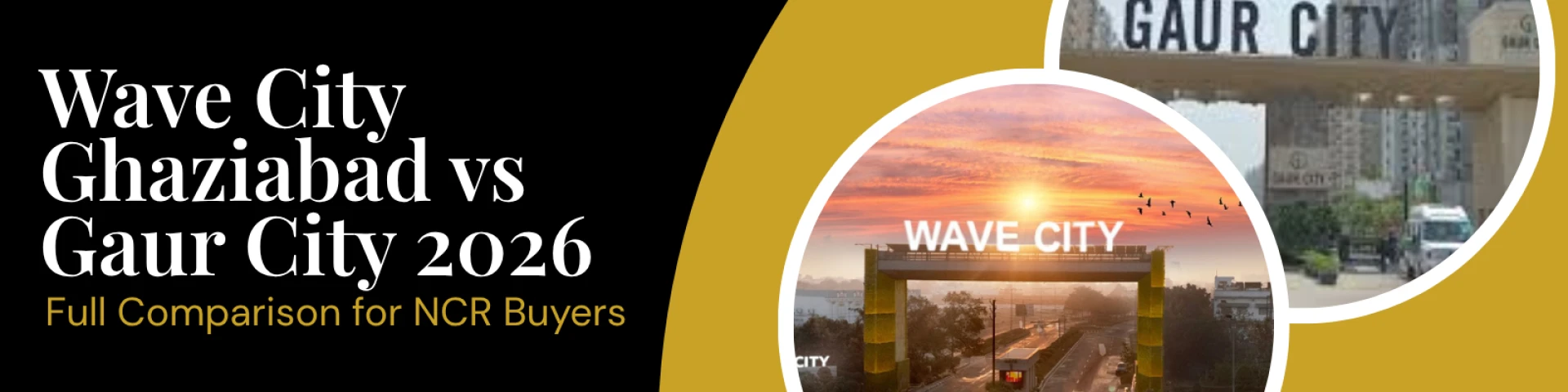
Buying a home in a township is never only about the flat price. It is also about daily comfort, future value, maintenance cost, space, and the kind of lifestyle you want. That is why the comparison between Wave City and Gaur City matters so much. Both projects are well-known, but they serve different buyer needs. One works better for buyers who want a larger township with plots and long-term flexibility. The other fits buyers who want a more mature apartment-driven setup with strong day-to-day convenience.
Wave City stands out because of its scale and mix of property options. Recent Wave City data from Ammaya shows active pricing across plotted sectors, builder floors, and apartment projects, with Phase 1 and Phase 2 offering different entry points for buyers. That gives buyers more flexibility. Someone looking for a ready apartment can still find options, while someone planning a self-built house or long-term land holding has plot choices that are hard to find in many competing townships.
Gaur City has a different strength. It is more apartment-led and already feels like a working urban ecosystem. Gaursons describes Gaur City as a walk-to-school, walk-to-work, walk-to-play township, and related project pages highlight ready-to-move apartments, completion delivery, and major daily-use infrastructure around the township. Gaur City Mall is also positioned as a major retail and entertainment hub for the area, with a large built-up footprint and multiplex access. This makes Gaur City easier for buyers who want immediate livability instead of a future-led investment story.
The biggest difference appears when budget and property type are compared together. In Wave City, plots remain one of the strongest reasons people buy. Ammaya’s 2026 ready reckoner shows that established Phase 1 plots usually require a much higher entry budget than smaller apartment purchases, while premium sectors and larger sizes go much higher. At the same time, Wave City flats still cover mid-range and premium segments. This means Wave City can work for both homebuyers and investors, but its strongest identity still comes from plotted development and long-term upside.
Gaur City is usually easier for buyers focused on apartment living and affordability within a township setting. Property listing platforms show ready-to-move and resale-heavy apartment supply across multiple avenues in Gaur City and Gaur City 2, with 2 BHK and 3 BHK options widely available. That kind of market depth makes it more practical for salaried families, first-time buyers, and people who prefer a more predictable apartment purchase over a plot-plus-construction decision.
Lifestyle is another major factor. Wave City suits buyers who prefer lower density, wider spread, and the possibility of building a larger independent home later. It is better for families who think in phases. They may buy a plot now, hold it, and build later. They may also choose Phase 1 for stronger present comfort or Phase 2 for a lower entry point and future appreciation. That kind of flexibility is a big advantage, especially for buyers who do not want to be limited to apartment-only choices.
Gaur City suits buyers who want everyday convenience from day one. The township’s positioning around walkable access, established avenues, shopping, schools, and possession history makes it stronger for immediate end use. A family moving in soon will usually value this more than future flexibility. When people want quick setup, active surroundings, and easier access to an already-functioning residential ecosystem, Gaur City often feels like the simpler answer.
Holding cost is also worth checking. Wave City’s current maintenance guide says plot owners pay ₹10 per sq yd per month, plus a one-time IFMS of ₹100 per sq yd at possession. Apartment maintenance there generally falls around ₹2.5 to ₹5 per sq ft per month, depending on the builder or RWA. This means plot ownership in Wave City offers freedom, but it also comes with recurring holding cost even before construction starts. Buyers considering land purely for long-term investment should factor that in carefully.
In practical terms, the best choice depends on the buyer profile.
A budget-focused apartment buyer will usually find Gaur City easier to enter and easier to use immediately. A buyer who wants a working township, resale choices, and a more settled apartment environment may also prefer Gaur City.
A buyer who wants plots, custom-home potential, lower-density living, and a township with more long-term land-led upside will usually find Wave City more attractive. Buyers willing to think beyond immediate possession often see more strategic value there.
So, Wave City and Gaur City are not direct equals in every sense. Gaur City is stronger for present-day apartment convenience. Wave City is stronger for space, property-type flexibility, and long-term optionality. The better township is not the same for every buyer. It depends on whether the goal is easy move-in living now or broader ownership value over time.