Most people who end up unhappy with a water softener didn't buy a bad one. They bought the wrong size. An undersized unit regenerates constantly, burns through salt and lets hard water slip through on busy mornings. An oversized one costs more up front, and if it sits too long between regenerations, it can underperform too.
The good news is that sizing isn't guesswork. It comes down to three numbers you can find in an afternoon: how hard your water is, how much of it your household uses, and how often you want the system to regenerate. Once you have those, choosing the type of system gets much easier.
Step 1: Find out exactly how hard your water is
Hardness is the amount of dissolved calcium and magnesium in your water. Lab reports usually list it in milligrams per liter (mg/L) or parts per million (ppm), which mean the same thing. Softener makers work in grains per gallon (gpg). To convert, divide mg/L by 17.1. A lab result of 256 mg/L works out to about 15 gpg.
The U.S. Geological Survey classifies water this way:
Classificationmg/L as CaCO₃Approx. gpgSoft0–600–3.5Moderately hard61–1203.5–7Hard121–1807–10.5Very hardOver 180Over 10.5Step 2: Estimate how much water you actually soften
The EPA's WaterSense program puts average home use at about 82 gallons per person per day. That figure includes outdoor watering, which most homes plumb around the softener, since there's no reason to soften water for the lawn. For indoor use, 60 to 75 gallons per person is a sensible planning figure.
Adjust for how your household actually lives. Teenagers who take long showers, a home business, or frequent guests all push the number up. A household of efficient fixtures and short showers can come in lower. If you have a water meter or recent bills, use them. Real usage beats an average every time.
Step 3: Do the math
Here's the core calculation:
People × gallons per person per day × compensated hardness (gpg) = grains removed per day
Take a family of four using 75 gallons each on 15 gpg well water with no iron:
4 × 75 × 15 = 4,500 grains per day
Most installers aim for the system to regenerate every 7 to 10 days. Longer gaps can let the resin bed compact, and shorter ones waste salt and water. Over seven days, this family needs about 31,500 grains of usable capacity between regenerations.
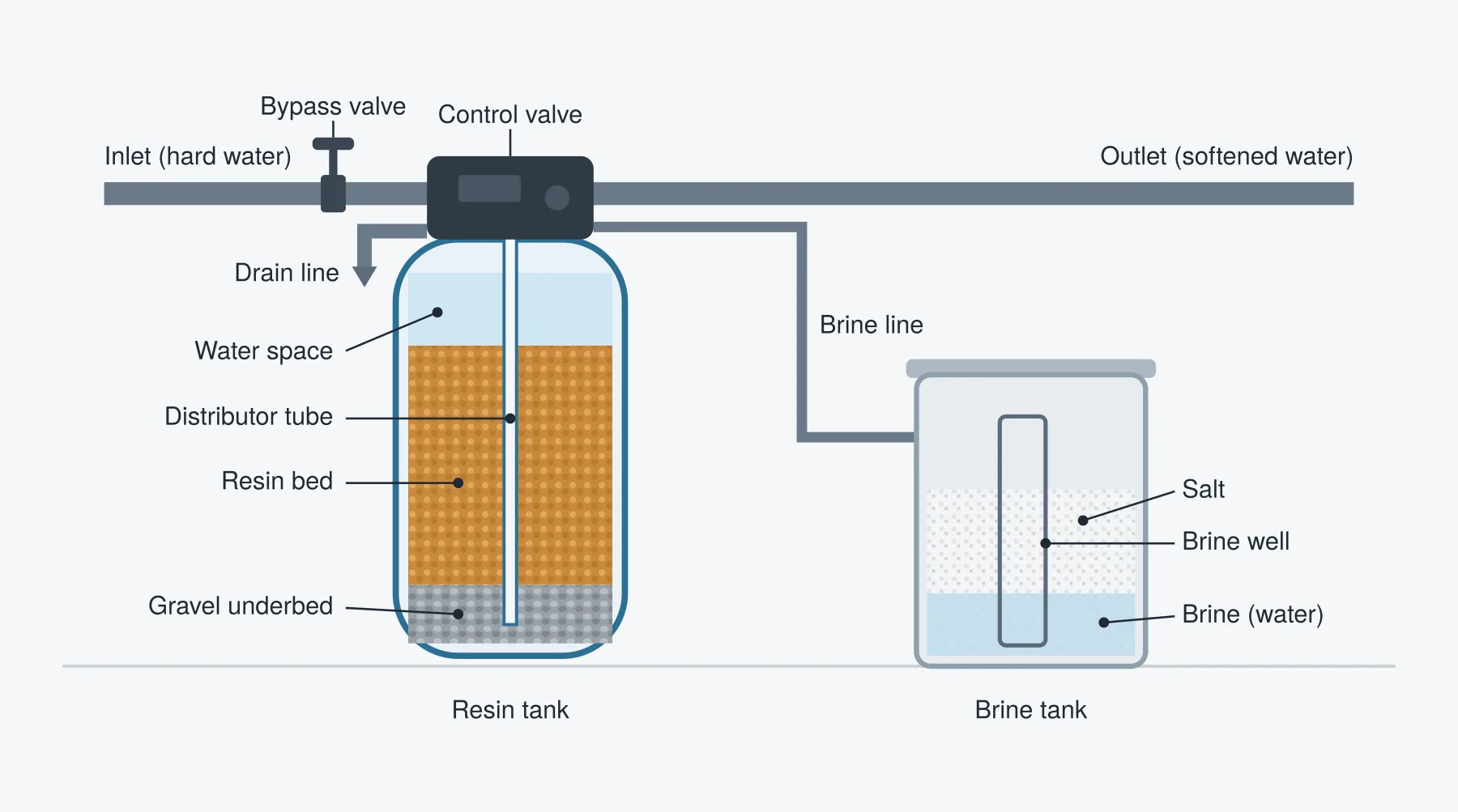
This is where most buyers go wrong, so it's worth slowing down. The number on the box, whether 32,000, 48,000 or 64,000 grains, is the maximum capacity of the resin. You only get that maximum by using a lot of salt, around 15 pounds per cubic foot of resin per regeneration. Most efficient setups use closer to 6 to 8 pounds per cubic foot. At those settings, a cubic foot of standard resin delivers roughly 20,000 to 24,000 grains, about two-thirds of its rating for well under half the salt.
So a nominal "32,000-grain" unit, which holds about one cubic foot of resin, would give our example family only about 20,000 usable grains at an efficient salt setting. That's less than five days of capacity. A 1.5-cubic-foot unit, sold as "48,000 grains", delivers about 30,000 to 36,000 grains at the same settings. That covers roughly a week, which makes it the better fit.
When you compare water softener systems for home use, convert every rating into cubic feet of resin and work from the efficient salt setting, not the headline number. It's the single most useful habit a buyer can develop.
Step 4: Check the flow rate
Capacity tells you how long a softener lasts between regenerations. Flow rate tells you whether it can keep up when the shower, the washing machine and the kitchen tap all run at once. If water moves through the resin too fast, some hardness slips through untreated, and water pressure drops.
Service flow depends on the volume of resin and on the size of the control valve. A three-bathroom home with a large family usually needs more resin and a valve with larger internal ports than a two-person condo, even if their daily grain totals look similar. Check the manufacturer's rated service flow in gallons per minute and compare it with your home's peak demand.
Choosing the type of system
Once you know the size, the type comes down to how your household uses water and what your local rules allow.
TypeHow it worksBest forTrade-offsSingle-tank, metered (demand-initiated)Tracks gallons used and regenerates only when capacity runs lowMost homesA few hours of hard water during regeneration, usually set overnightSingle-tank, timerRegenerates on a fixed schedule whatever the useVery steady usageWastes salt and water when usage drops, as when you travelTwin-tank, alternatingOne tank softens while the other regeneratesLarge families, very hard water, round-the-clock useHigher cost and a bigger footprintSalt-free conditionerChanges minerals so they scale less, without removing themScale control where brine discharge is restrictedDoesn't lower hardness, so no soap or spotting benefitA few notes on the options:
- Metered valves are the modern default. A timer-based water softener regenerates on schedule even while you're on vacation. A metered one waits until the resin actually needs it, which usually cuts salt and water use noticeably.
- Twin-tank systems solve a specific problem. If people shower at all hours, or hardness is so high that a single tank would regenerate every few days, alternating tanks mean you never get a slug of hard water.
- Salt-free conditioners aren't softeners. Most use a process called template-assisted crystallization, which helps prevent scale on pipes and heaters. They don't remove calcium or magnesium, so you won't get the softer feel, easier lathering or fewer spots on glassware.
Is it worth it?
For households on hard water, the practical benefits are well documented, though the main studies were funded by the water treatment industry and are best read with that in mind. Research funded by the Water Quality Research Foundation found that softened water let testers cut laundry and dishwasher detergent by about half and wash in cold water with the same or better results. Earlier testing by Battelle found gas storage water heaters on hard water lost up to 24% of their efficiency to scale.
Whether a water softener system pays for itself depends on your hardness and your appliances. What isn't in doubt is that a correctly sized one is cheaper to run and easier to live with than a unit chosen by the sticker on the box.