
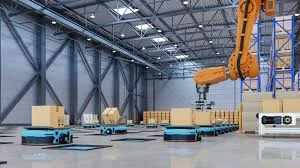
Warehouse infrastructure has undergone a major transformation in recent years, driven by the rising demand for efficiency, flexibility, and speed. As businesses seek smarter and more agile operations, the warehouse automation market has become central to reimagining warehouse design itself. No longer just storage spaces, today’s warehouses are engineered as high-performance hubs integrating robotics, software systems, and data intelligence—all of which are influencing emerging design trends in the market.
Shift Toward Vertical Storage and High-Density Layouts
As land costs soar and urban fulfillment demands rise, vertical expansion is becoming a top priority. Modern warehouse design now prioritizes vertical storage solutions using Automated Storage and Retrieval Systems (AS/RS), high-bay racking, and mezzanines to maximize cubic space rather than just square footage.
This shift not only conserves floor space but also facilitates faster order picking through automation-friendly configurations. High-density layouts, supported by narrow aisle forklifts and mobile shuttles, are particularly effective for e-commerce, pharmaceuticals, and small-item logistics.
Robotics-Centric Architecture
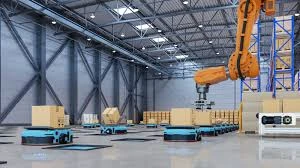
With autonomous mobile robots (AMRs), automated guided vehicles (AGVs), and robotic arms playing an increasing role in material handling, warehouse design is evolving to accommodate these machines. Layouts are now planned with defined robot pathways, charging stations, and docking zones. Surfaces must be smooth, durable, and unobstructed to support safe and efficient robot navigation.
Designers are also incorporating modular zones that allow quick reconfiguration as robotic fleets or operational needs change. Flexibility in design is essential to futureproof facilities and support scalability.
Integration of Smart Infrastructure
Smart warehouses require more than just physical upgrades—they need digital infrastructure embedded from the ground up. This includes real-time tracking systems, IoT sensors, high-speed Wi-Fi, and cloud-based Warehouse Management Systems (WMS) integrated into the architectural design.
To support this, warehouses are now being designed with server rooms, temperature-controlled tech closets, and data cable networks planned in tandem with the physical layout. The goal is to ensure seamless data flow across automation platforms, predictive maintenance tools, and inventory tracking systems.
Focus on Sustainability and Energy Efficiency
Green building practices are becoming a standard part of modern warehouse design. To meet regulatory expectations and reduce operational costs, warehouse developers are incorporating features such as:
- LED smart lighting systems
- Solar panel installations on roofs
- Rainwater harvesting and greywater recycling
- Natural ventilation and high-efficiency HVAC systems
- Insulated wall panels and reflective roofing materials
Additionally, automation itself supports sustainability by minimizing energy wastage, reducing returns, and optimizing transport planning. Warehouses designed with environmental certifications like LEED or BREEAM are increasingly favored by global enterprises.
Human-Centered Design in Hybrid Environments
Even in highly automated facilities, the human workforce plays a vital role in supervision, exception handling, and maintenance. Warehouse designs are now placing a greater focus on ergonomics, safety, and employee well-being. Key elements include:
- Ergonomic workstations that reduce strain during manual tasks
- Enhanced lighting and ventilation
- Clearly defined zones for humans and robots to prevent accidents
- Quiet zones and break areas to reduce fatigue
Designs that support smooth human-machine collaboration are becoming the new benchmark in hybrid warehouse environments.
Micro-Fulfillment and Urban Proximity Warehouses
With the explosion of same-day and next-day delivery services, companies are investing in micro-fulfillment centers located near city centers. These compact, high-speed warehouses are often retrofitted into existing retail spaces or built on smaller plots with automation at the core.
Warehouse design for micro-fulfillment focuses on maximizing throughput in a limited footprint using vertical lift modules, compact robotics, and conveyor systems. This trend is especially prominent in groceries, pharmaceuticals, and apparel.
Safety and Compliance-Driven Design
Automation brings many benefits, but it also introduces new safety challenges. Warehouse layouts must now account for emergency stop zones, automated fire suppression systems, and clear evacuation paths. Compliance with local and international safety standards is being prioritized from the design stage itself, particularly in industries such as food, chemicals, and healthcare.
Additionally, touchless entry systems, anti-slip flooring, and surveillance integration are being adopted as standard design features to enhance safety and security.
Future-Proofing Through Modularity
Finally, flexibility is the key to long-term value in warehouse design. Facilities are now being built with modular partitions, scalable rack systems, and adjustable pick modules. This allows businesses to adapt quickly to changes in demand, product lines, or automation technologies without needing full reconstruction.
Future-focused designs also consider integration with emerging technologies like AI-powered digital twins, drone-based inventory management, and 5G-enabled communication networks.
Conclusion
As the warehouse automation market continues to accelerate, the very blueprint of warehouses is changing. From vertical expansion and robotics-centric layouts to sustainability and modularity, design trends are converging around the goal of agility, intelligence, and long-term resilience. Companies that invest in forward-looking warehouse design will not only streamline operations but also position themselves for growth in an increasingly automated and competitive supply chain landscape.