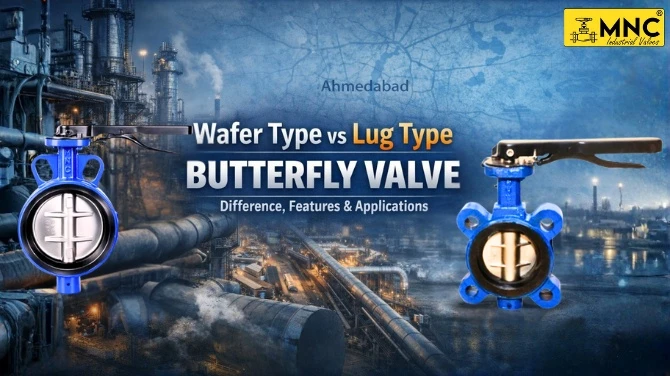
Butterfly valves' small size, speed, and affordability make them popular flow control devices in industrial piping systems. The Wafer Type Butterfly Valve and the Lug Type Butterfly Valve are two of the most popular designs; each is made to meet particular installation and running needs.
What is a Butterfly Valve?
To control or isolate fluid flow, a butterfly valve is a quarter-turn rotating valve. It is made up of a circular disk inside the valve body that is fixed on a revolving shaft. The disc either permits full flow or totally stops it when it turns 90 degrees.
Butterfly valves are prized for their quick actuation, low space requirements, and lightweight design. Water treatment, chemical processing, oil and gas, power plants, HVAC systems, and the food and pharmaceutical industries all make substantial use of them.
What is a Wafer Type Butterfly Valve?
A Wafer Type Butterfly Valve is fastened with long bolts that go through the valve body and both pipe flanges. It is made to fit between two flanges. This design keeps the valve small and light while guaranteeing a tight seal.
Features of Wafer Type Butterfly Valve
Because to its slender body profile, the Wafer Type Butterfly Valve is well-suited for installations with limited space. It usually sits in the middle of the pipeline and is sealed by flange compression. The valve body is secured between flanges rather than having threaded bolt holes.
Usually offered in high-performance or resilient-seated forms, it provides bidirectional sealing. Because of its simplistic design, installation is easy and reasonably priced.
Applications of Wafer Type Butterfly Valve
Due to its economical design and compact structure, the Wafer Type Butterfly Valve is widely used in:
- Water Treatment plants for distribution and isolation lines
- HVAC Systems for chilled and hot water circulation
- Chemical Processing units where moderate pressure control is required
- Fire protection systems
- General industrial utilities
This valve type is best suited for systems where dismantling one side of the pipeline does not require complete isolation of the other side.
What is a Lug Type Butterfly Valve?
Long through bolts are not necessary when bolting a Lug Type Butterfly Valve to pipe flanges because the valve body is surrounded by threaded inserts, or lugs. The valve is connected to each flange separately.
Features of Lug Type Butterfly Valve
The Lug Type Butterfly Valve's capacity to accommodate dead-end service is its most important feature. The valve's threaded lugs allow it to remove one side of the piping system while keeping the other side tightly sealed.
Particularly in high-pressure situations, the sturdy body design offers improved structural strength and stability. It can readily incorporate actuators and is appropriate for both automatic and manual activities.
Applications of Lug Type Butterfly Valve
Common applications for the Lug Type Butterfly Valve include:
- Oil & Gas pipelines
- Power Plants
- Chemical Processing facilities handling aggressive media
- Pharmaceutical and Food Processing industries requiring sectional maintenance
- High-pressure industrial systems
Its design allows safe isolation of equipment without shutting down the entire system.
Important Distinctions Between Lug and Wafer Type Butterfly Valves
A Wafer Type Butterfly Valve and a Lug Type Butterfly Valve differ primarily in how they are mounted and how easily they may be maintained.
Long bolts that go through the entire assembly clamp the Wafer Type Butterfly Valve between two flanges. For structural stability and sealing, the compression between flanges is crucial. On the other hand, the Lug Type Butterfly Valve has threaded lugs all around its body, which allows each flange to be bolted independently.
Service flexibility is yet another significant distinction. The Lug Type Butterfly Valve is appropriate for dead-end service because it permits the disconnecting of one pipeline side while keeping the other closed. Without further precautions, the Wafer Type Butterfly Valve usually cannot support this function.
Because of their reinforced body and threaded inserts, lug valves are often heavier and slightly more expensive from a structural perspective. Because they are smaller and lighter, wafer valves are frequently used in installations with limited funds and space.
There are significant differences in maintenance and pressure handling requirements. Butterfly valves of the lug type are typically chosen for systems that need more frequent maintenance or greater operational dependability. Applications where price and ease of use are top concerns are best suited for wafer valves.
Advantages of Wafer Type Butterfly Valve
The Wafer Type Butterfly Valve has a number of useful benefits. Because of its lightweight design, pipeline structural load and installation expenses are decreased. It is appropriate for confined locations due to its small size, particularly in utility and HVAC lines.
Large-scale water distribution networks favor it because it is more cost-effective than lug-type designs. Faster installation and replacement are also made possible by the valve's straightforward design.
Wafer valves offer dependable and efficient performance for sectors including water treatment and HVAC systems, where space minimization and cost effectiveness are crucial.
Advantages of Lug Type Butterfly Valve
The Lug Type Butterfly Valve offers exceptional flexibility in maintenance. It improves operational safety and efficiency by isolating one pipeline side without affecting the other.
Because of the increased mechanical strength provided by the threaded lugs, the valve can withstand demanding and high-pressure applications. Additionally, it is perfect for end-of-line maintenance and systems that need frequent equipment removal.
Oil and gas, power plants, and chemical processing are among the industries that profit from lug-type valves' dependability and longevity. Lug valves make maintenance simpler without sacrificing hygienic or safety standards in applications involving pharmaceuticals and food processing, where sectional shutdowns are frequent.
Industry-Wise Selection Guidance
The Wafer Type Butterfly Valve is frequently the sensible option in HVAC systems and water treatment facilities, where space and financial limitations are prevalent. It offers consistent flow control without making installation more difficult.
Depending on the pressure requirements, chemical processing facilities that handle corrosive fluids may use either kind; however, lug valves are frequently chosen for higher pressure systems and greater maintenance flexibility.
The Lug Type Butterfly Valve is usually preferred in oil and gas operations because of its strength and capacity to handle dead-end duty. Lug valves in high-pressure steam or cooling water lines are also advantageous to power plants.
Lug valves offer superior isolation capabilities during equipment servicing in the food processing and pharmaceutical industries, where controlled maintenance and sanitation are crucial.
Choosing the Right Butterfly Valve
The system design, pressure requirements, maintenance plan, and installation limitations all play a role in the decision between a lug type butterfly valve and a wafer type butterfly valve. Although both designs provide dependable flow control, they are appropriate for distinct industrial settings because to their operational and structural features.