
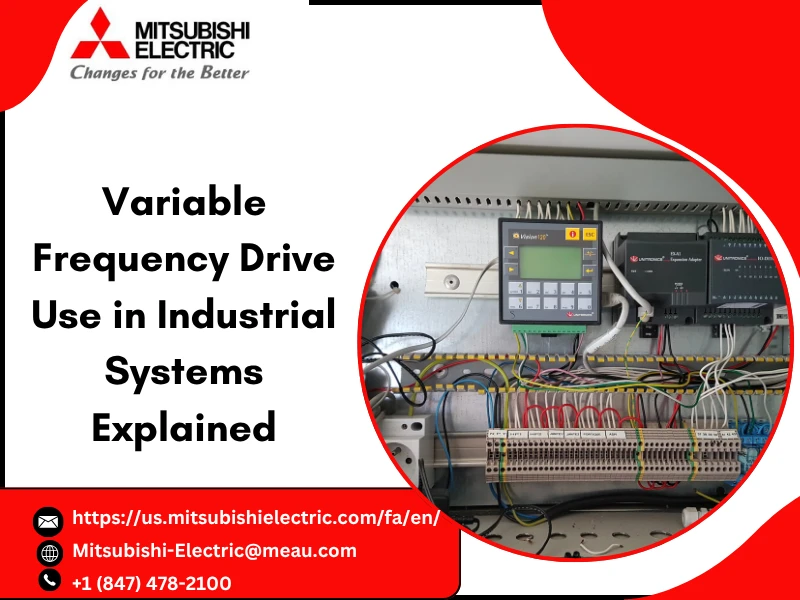
Pumps, conveyors, compressors, and fans are examples of equipment powered by motors at industrial facilities. In most of these systems, the motors have conventionally been operated at a steady rate even when the process is not consuming as much power. This was inefficient resulting in the wide use of the variable frequency drive; a technology that offers that the speed of the motor can be varied depending on the operational requirement.
In the United States, manufacturers of different industries are increasingly employing a variable frequency drive to enhance energy-saving, wear and tear of equipment, and maximization of system performance. The devices are important to contemporary automation in industries as they provide the operators with more control of motor-driven processes.
Understanding How a Variable Frequency Drive Works
Controlling Motor Speed
A variable frequency drive is used to control the electrical frequency to a motor. The drive can slow down or increase the speed of the motor by varying frequency and voltage to fine-tune to the process.
This feature enables the equipment to operate with the speed required instead of operating at full capacity all the time.
This technology may be studied further here: https://en.wikipedia.org/wiki/Variable-frequency_drive
Reducing Energy Consumption
Industrial systems using motors usually use large quantities of electricity. Energy use is reduced when the motors are run slowly with a variable frequency drive. It is especially possible to notice energy savings in the application of pumps or fans.
Protecting Equipment From Mechanical Stress
Sudden start of motors may place a mechanical load on equipment. Variable frequency drives allow a gradual acceleration and deceleration. This is a smooth operation that contributes to the prolongation of the lifespan of machinery.
Improving Process Control
Exact control of the motors enables workers to adjust the production processes. Speed adjustment enhances precision in machines which need steadiness in production. Better operational efficiency is achieved through better control.
Industrial Applications of Variable Frequency Drives
Manufacturing Automation Systems
Robotic machines are in high demand in manufacturing environments. Motors of a conveyor belt, packaging machine and robotic systems are usually driven by a variable frequency drive.
Automation enhances uniformity in the production processes.
Pump and Water System Management
Variable frequency drives are extensively used in water treatment plants, irrigation systems and industrial fluid systems to control the speed of pumps. Pump operation can be adjusted to ensure constant levels of flow.
HVAC and Building Systems
Fans and compressors are also motor-driven in heating, ventilation and air conditioning systems. Variable frequency drive helps in controlling airflow with less use of energy.
Industrial Robotics and Automation
Robots are used in advanced manufacturing environments to perform repetitiveness. Systems such as food & beverage factory robots often rely on variable speed motors to coordinate movement and production speed.
Role of Automation Monitoring Systems
Equipment Monitoring and Diagnostics
Monitoring tools help to monitor the equipment performance and identify a possible problem at an early stage. The systems assist operators to have reliability in operation.
Monitoring of automation enhances the visibility of the system.
Industrial Process Monitoring
The facilities occasionally use the same monitoring technologies in several areas. Commonly, as an example, systems designed for car wash monitoring track pump performance, water flow, and equipment operation.
Predictive Maintenance Strategies
The information gathered through the monitoring systems is used to determine the trends that can be used to show equipment wear. Predictive maintenance minimises unplanned time out of service.
Integration With Smart Control Systems
The present industrial systems are often fitted with drives, sensors and controllers which are centralized in automation platforms. These combined systems are helpful in the running of the facilities.
Variable Frequency Drives in Modern Automation
Supporting Machine Tending Solutions
The manufacturing facilities tend to be dependent on the automated machines which load and unload production materials. Variable frequency drives are used in machine tending solutions to coordinate the motion of the motors with the robotic movement.
Enhancing Energy Efficiency
Management of energy has become a significant area of concern in industries. Variable frequency drives enable companies to maximize the performance of the motors and minimise the use of electricity expenses.
Improving Production Flexibility
Variable speed drive permits plants to easily match production needs. Modern manufacturing is accommodated by flexibilities in operations.
Enabling Smart Manufacturing
Variable frequency drives are also significant in digital manufacturing systems in which automation, sensors and software collaborate. Such technologies help to have more efficient industrial functions.
Benefits of Using Variable Frequency Drives
Reduced Energy Costs
Slower motor speeds will save electricity thus greatly decrease operation costs.
Extended Equipment Lifespan
Slow motor acceleration contributes to avoiding mechanical wearing and tear.
Improved Process Efficiency
High-precision motor control enhances the precision and stability of the industrial processes.
Lower Maintenance Requirements
The operation of the motor is smooth, and this minimizes its stress on the mechanical parts.
Frequently Asked Questions
What is a variable frequency drive?
A variable frequency drive is a gadget which varies the motor speed by altering the electrical frequency fed to the motor.
Why are variable frequency drives used in industry?
They enhance efficiency in energy, offer better control of the processes and increase the life of the equipment.
Can variable frequency drives work with automated systems?
Yes. A number of automated systems, such as robotic manufacturing machines, incorporate variable frequency drives that are used to control the motor more precisely.
Supporting Efficient Industrial Systems
To be productive, modern industrial facilities rely on effective and unreliable equipment. Variable frequency drive offers the control required to provide optimal control of motor-driven systems and minimizes the use of energy and the stress on equipment. With the current evolution of automation technologies, variable frequency drives will be the vital part of efficient industrial functioning.