
On the ground floor of a high-rise building, water pressure may be more than sufficient. Dozens of floors above, however, maintaining reliable supply becomes a different challenge. Pumps, storage tanks, pressure zones and distribution pipelines must work together to deliver water at appropriate pressures throughout the property.
A valve that performs reliably in a small plumbing installation may not be suitable for a major high-rise distribution line. The operating pressure, pipe diameter, flow conditions and maintenance requirements can be substantially different.
This makes valve selection an important part of high-rise water supply design.
Gate valves, butterfly valves, non-return valves and ball valves perform different functions within the distribution network. Some provide isolation for maintenance, while others help prevent reverse flow or offer convenient shutoff at individual branches.
Selecting the right combination requires an understanding of how water behaves across the entire building, from the incoming supply and pumping system to the uppermost distribution zones.
A High-Rise Water System Is Not One Continuous Pressure Zone
Water pressure decreases as elevation increases. In a tall building, this creates a fundamental challenge: pressure sufficient to serve the highest floors may be excessive for fixtures and equipment at lower levels.
As a general hydraulic principle, a vertical rise of approximately 10 metres corresponds to a static water pressure difference of roughly 1 bar.
In a building with a substantial height difference between its lowest and highest outlets, this becomes a major design consideration.
High-rise developments therefore commonly use pressure zoning, booster pumps, intermediate storage or pressure-reducing arrangements to maintain suitable operating conditions.
Within these systems, valves have distinct responsibilities.
Isolation valves allow sections of pipework or equipment to be taken out of service. Non-return valves prevent reverse flow under appropriate operating conditions. Other specialised control valves regulate pressure and flow.
The first selection principle is consequently straightforward: a valve must be chosen for the function it is expected to perform, not simply because its nominal diameter matches the pipe.
The Isolation Decision: Gate Valve, Butterfly Valve or Ball Valve?
Consider a building undergoing maintenance on a major water distribution branch.
The maintenance team needs to isolate the affected section without interrupting supply to unrelated areas.
The valve must close reliably, withstand the applicable pressure and remain accessible for operation.
Several valve types can provide isolation, but their construction and operating characteristics differ.
Gate Valves for Main Water Supply Lines
A Plumbing Gate Valve uses a gate or wedge that moves into or out of the flow path.
When fully open, the valve generally offers a relatively unobstructed passage, making gate valves suitable for applications where the normal operating position is either fully open or fully closed.
They are not usually the preferred choice for continuous throttling because partially open operation can create unsuitable flow conditions and wear.
Watts identifies the B3001 Gate Valve and B3001N Gate Valve within its shutoff valve range.
For building water distribution, gate valves are relevant where dependable manual isolation is required.
The selection must account for the valve's connection type, material compatibility, pressure rating and intended water service.
A Water Supply Gate Valve installed in a riser or distribution branch should also remain accessible for maintenance and emergency isolation.
Large Pipeline Isolation with the E3243
The requirements change when a valve is installed on a large-diameter distribution pipeline.
The Watts E3243 is a resilient-seated, non-rising-stem gate valve intended for pipeline on-off control.
Its published technical information identifies sizes from DN50 to DN600, a PN16 nominal pressure rating and a temperature range of 0°C to 80°C.
The construction includes a ductile iron body, resilient seating, an inside-screw arrangement and epoxy coating.
The manufacturer also specifies a stem-packing arrangement incorporating O-ring seals and a dust seal.
These characteristics make the E3243 Gate Valve relevant to waterworks, building services, utilities and commercial or industrial pipeline applications.
For a high-rise project, a large Water Pipeline Gate Valve may be considered for major distribution branches, subject to the actual pressure-zone requirements.
However, PN16 does not mean the valve can be installed anywhere in a tall building without further assessment. The maximum and minimum operating pressures, possible surge pressures and system temperature must all remain within the applicable limits.
Where Butterfly Valves Offer an Alternative
Large gate valves can require considerable installation space and operating clearance.
In some plant rooms and distribution networks, butterfly valves offer a more compact alternative.
A butterfly valve uses a rotating disc to open or close the flow path. Quarter-turn operation can make it convenient for isolation duties, while suitable gear operators can support operation on larger valves.
Watts' W-W1911 Butterfly Valve range includes the W-W1911-L handle-operated and W-W1911-G worm-gear-operated centre-line wafer butterfly valves.
The manufacturer identifies their use for pipeline on-off control and flow control in applications including municipal water supply and industrial water transfer.
The product information highlights simple operation, installation convenience, sealing performance and component interchangeability.
For an Industrial Butterfly Valve, the wafer arrangement can be attractive where installation length is limited.
However, the designer must consider the disc's position within the flow path, the required flange arrangement and the pressure loss associated with the valve.
A Water Pipeline Butterfly Valve should also be evaluated for the required shutoff performance and operating torque.
In high-rise water systems, butterfly valves can be useful for major distribution lines and equipment isolation, provided the selected model meets the service conditions.
Why Ball Valves Remain Important in Smaller Branches
Not every isolation point is located on a large distribution header.
Commercial buildings contain numerous smaller connections serving fixtures, equipment and individual plumbing branches.
These locations often benefit from compact, quickly operated shutoff valves.
A Ball Valve uses a rotating ball with a central opening. When the opening aligns with the pipeline, water can pass through. A quarter-turn closes the flow path.
This operating principle makes ball valves convenient for frequent manual isolation.
Watts lists the FBV-25/25N within its ball valve range for plumbing and flow-control applications.
A Plumbing Ball Valve may be considered for smaller branch isolation, depending on the selected size, connection type and service rating.
For a Water Shutoff Ball Valve, material suitability and the ability to maintain a reliable seal are important considerations.
The choice between a gate valve and ball valve should reflect operating frequency, installation space, pressure requirements and the desired shutoff arrangement.
Neither type should be assumed suitable for every water supply application without checking the manufacturer's technical documentation.
The Hidden Risk of Reverse Flow
Isolation valves control whether water can pass through a pipeline when deliberately operated.
They do not automatically prevent water from flowing backwards when system pressure conditions change.
This distinction becomes especially important in high-rise pumping installations.
Imagine a booster pump supplying an upper-level storage tank.
While the pump operates, water moves towards the elevated tank.
If the pump stops, the pressure relationship may change. Without suitable protection, water can attempt to flow back towards the pump and lower-level piping.
Reverse flow can create operational problems, including reverse rotation of equipment, pressure disturbances and unwanted drainage of elevated sections.
A Non Return Valve, also called a check valve, is intended to permit flow in one direction and close when reverse-flow conditions develop.
Its operation is automatic, although the closing mechanism varies by valve type.
Check Valves for Building Plumbing Networks
Watts' B5002/B5002N range is listed under the manufacturer's check valve products.
A B5002N Check Valve can be considered within the broader selection of plumbing non-return devices, subject to confirmation of its specific operating characteristics and approved applications.
The critical consideration is whether the valve can respond appropriately to the system's normal and abnormal operating conditions.
For a Plumbing Check Valve, selection should consider pressure rating, flow direction, installation orientation and the expected pressure differential.
A non-return valve should not automatically be treated as a certified backflow-prevention assembly for potable-water cross-connection protection. Where regulations require a dedicated backflow preventer, the specified approved device must be used.
Pump Discharge Protection Requires More Than a Check Valve
A check valve installed after a pump helps limit reverse flow, but its behaviour during pump shutdown is important.
A valve that closes too slowly may permit reverse flow before seating.
A valve that closes abruptly under certain conditions may contribute to pressure transients.
This means the internal mechanism and operating characteristics matter as much as the nominal pipe size.
W-H44T-16Q/Z for Pipeline Non-Return Applications
Watts identifies the W-H44T-16Q/Z within its check valve range.
For a Pump Discharge Check Valve, the appropriate model must be assessed according to the flow velocity, pressure conditions, installation arrangement and manufacturer guidance.
The valve's closing behaviour should be considered as part of the overall pumping system rather than evaluated independently.
W-H77X-16Q: A Compact Wafer-Type Option
The Watts W-H77X-16Q is a wafer-style double-door check valve intended to prevent reverse flow.
According to its published technical information, the valve uses spring-assisted closure and is suitable for applications including building services, water treatment and plate heat exchangers.
The specified range covers DN50 to DN600, with a PN16 nominal pressure rating and an operating temperature range of -10°C to 120°C.
Its construction includes stainless steel discs, spring components and a resilient seat.
The manufacturer identifies a compact, lightweight arrangement and suitability for horizontal or vertical piping installations, subject to installation instructions.
These characteristics are relevant when selecting an Industrial Check Valve for large water distribution networks.
However, compact construction does not automatically establish suitability for every pump discharge arrangement. Flow conditions, pressure loss and transient behaviour still require evaluation.
Valve Selection Across Different High-Rise Locations
The same building may require several valve types because operating duties change throughout the water supply network.
| Installation location | Main operating requirement | Valve type commonly considered |
| Incoming water supply line | Isolation for inspection and maintenance | Gate valve or butterfly valve |
| Booster pump discharge | Prevention of unwanted reverse flow | Suitable non-return valve |
| Major vertical riser | Isolation of distribution sections | Gate valve or butterfly valve |
| Floor distribution branch | Local shutoff | Gate valve or ball valve |
| Equipment connection | Accessible isolation during servicing | Ball valve or other suitable isolation valve |
| Large distribution header | Isolation with appropriate operating clearance | Gate valve or geared butterfly valve |
This is a general selection framework, not a substitute for project-specific hydraulic design.
For example, a high-pressure booster discharge may require a valve with a different pressure rating from one installed in a lower-pressure floor branch.
Similarly, a valve selected for an isolated equipment connection may not be appropriate for a major distribution main.
The complete pressure profile must be considered before finalising the specification.
Pressure Ratings: Why PN16 Is Not the Whole Story
A valve's nominal pressure designation is an important selection parameter, but it does not describe every operating condition.
A high-rise water supply system may experience static pressure, pump discharge pressure, friction losses and short-duration pressure surges.
These conditions can vary significantly between pressure zones.
The design must therefore distinguish between normal working pressure and the maximum pressure that may occur under abnormal conditions.
For example, a valve located near the discharge of a booster pump may experience higher pressure than a valve installed farther along the distribution network.
If the system includes elevated tanks, the static head created by the stored water must also be considered.
A suitable Industrial Water Isolation Valve should be selected only after confirming that its pressure-temperature rating and other limitations are compatible with the installation.
Material selection is equally important.
Valve bodies, seats, seals and internal components must be appropriate for the intended water quality, temperature and service conditions.
For potable-water applications, the relevant material approvals and local regulatory requirements must also be verified.
Flow Resistance and Its Effect on Pumping Performance
Every valve introduces some resistance to water flow.
The amount depends on the valve type, size, internal geometry and operating position.
A fully open gate valve typically provides a relatively clear flow path.
A butterfly valve retains its disc within the flow passage, while a check valve introduces resistance through its moving closure mechanism.
These differences influence pressure loss.
In a large water supply network, unnecessary pressure losses can increase the pumping head required to deliver the intended flow.
This does not mean the valve with the lowest pressure loss is always the best choice.
A check valve may introduce additional resistance but provide an essential protective function.
A butterfly valve may be preferred for installation and operating reasons even if its hydraulic characteristics differ from those of a gate valve.
The correct selection balances hydraulic performance with reliability, maintenance access and operating requirements.
The Maintenance Perspective: What Happens After Installation?
A valve specification should consider how the component will be operated years after the building is occupied.
Isolation valves may remain open for long periods before being required for maintenance.
If they are difficult to access or operate, routine servicing can become unnecessarily complicated.
For large gate valves, sufficient space is needed for the operating mechanism and maintenance activities.
Butterfly valves may require appropriate clearance for the actuator or gearbox.
Check valves should be installed where inspection and replacement can be carried out without excessive disruption.
Ball valves should remain accessible at the equipment or branch they serve.
Maintenance planning should also consider whether a valve can be removed without shutting down an unnecessarily large portion of the building.
For high-rise developments, strategically located isolation points can reduce the operational impact of repairs.
This is particularly important in hotels, hospitals and occupied commercial towers where interruptions to water supply may affect numerous users.
Avoiding Common Specification Errors
Several recurring mistakes can undermine valve performance in high-rise water supply systems.
· Selecting by pipe diameter alone: Two valves with the same nominal size may have different pressure ratings, connection arrangements and operating characteristics.
· Using isolation valves for continuous regulation: Gate valves and ordinary ball valves are generally intended for shutoff duties rather than precise flow control.
· Ignoring reverse-flow conditions: Pump discharge systems may require non-return valves to limit unwanted backflow.
· Overlooking transient pressures: A valve suitable for steady-state pressure may still be exposed to damaging surge conditions if the wider system is not properly assessed.
· Failing to verify installation orientation: Check valves may have specific orientation requirements that affect their operation.
· Insufficient maintenance access: A correctly selected valve can become difficult to service if installed in an inaccessible location.
Avoiding these issues requires coordination between the hydraulic designer, plumbing contractor and equipment supplier.
Valve Technologies and the Big 5 Construction Exhibition in Dubai
High-rise developments depend on dependable water distribution infrastructure, even though much of the equipment remains hidden within plant rooms, risers and service corridors.
The big 5 construction exhibition Dubai provides an opportunity for building services professionals to examine the components that support these systems and discuss their suitability for different project requirements.
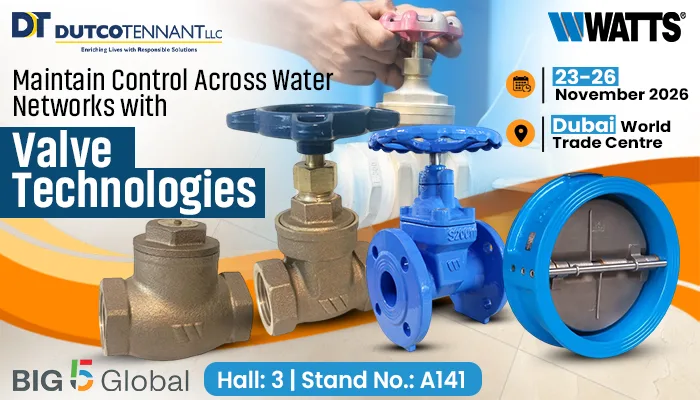
During Big 5 Global 2026, taking place from 23–26 November at Dubai World Trade Centre, Hall 3, Stand 3A141 will provide access to a selection of Watts valve technologies through Dutco Tennant LLC. The range includes B3001/B3001N and E3243 gate valves, W-W1911 butterfly valves, B5002/B5002N, W-H44T-16Q/Z and W-H77X-16Q non-return valves, and FBV-25/25N ball valves.
For professionals evaluating water supply components, these different valve categories highlight the importance of matching each product to its intended duty.
The discussion extends beyond selecting an individual valve. It includes pressure zoning, pump protection, pipeline isolation and the practical requirements of maintaining water distribution systems in occupied buildings.
Reliable Water Supply Depends on the Entire System
The performance of a high-rise water supply system cannot be determined by any single valve.
Reliable operation depends on how pumps, pressure zones, storage arrangements, pipelines and control components interact.
Gate valves and butterfly valves provide isolation for different pipeline arrangements. Ball valves offer convenient shutoff in suitable branches, while non-return valves help prevent reverse flow.
Each has limitations that must be understood before installation.
For consultants and contractors, effective selection begins with the building's hydraulic requirements and continues through material verification, installation planning and maintenance access.
When valves are chosen according to their actual operating duties, they contribute to a water distribution system that is safer to maintain, more predictable in operation and better suited to the long-term demands of high-rise buildings.