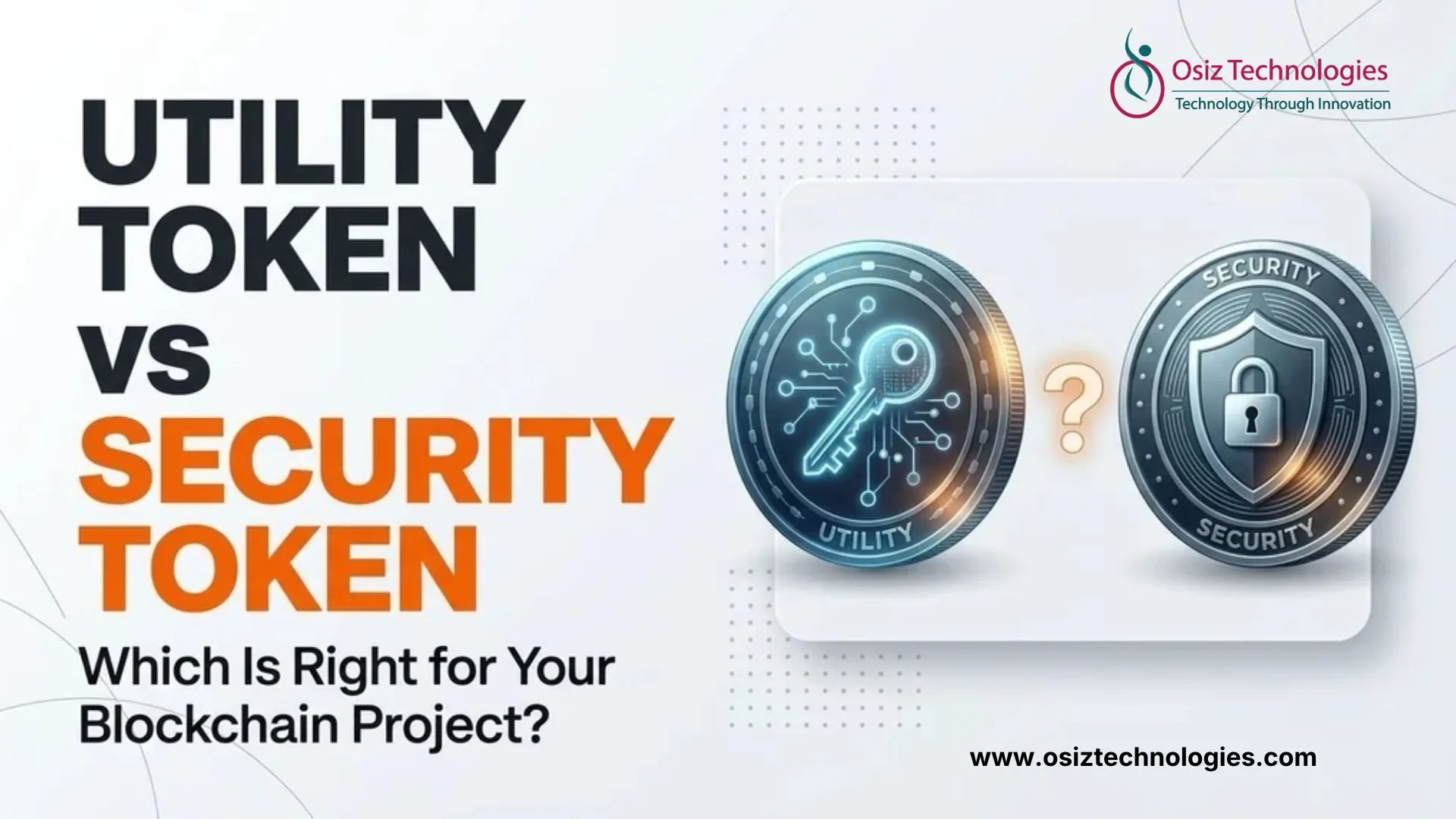
Choosing between a utility token and a security token is an important architectural decision in blockchain development. Both can be implemented through smart contracts, but their underlying logic, transfer mechanisms, ownership rights, and compliance requirements differ. For businesses planning a token launch, understanding these differences helps determine the appropriate blockchain architecture and development approach.
1. Utility Token Architecture: Access, Transactions, and Platform Functionality
A utility token is designed to perform specific functions within a blockchain ecosystem. Its smart contract defines how tokens are issued, transferred, burned, and used across the platform.
On Ethereum, developers commonly use the ERC-20 token standard to create fungible utility tokens. It provides functions such as totalSupply(), balanceOf(), transfer(), approve(), and transferFrom().
These functions allow applications, wallets, and decentralized exchanges to interact with tokens through a consistent interface. For example, a DeFi platform can use a utility token for transaction fees, staking, rewards, or accessing protocol features.
From a development perspective, important components include:
- Token supply logic: Defines initial supply, minting, burning, and distribution rules.
- Smart contract functionality: Implements transfers, allowances, and platform-specific utility.
- Tokenomics: Establishes allocation, incentives, vesting schedules, and circulation mechanisms.
- Blockchain integration: Connects the token with wallets, decentralized applications, and other protocols.
The key consideration is that a utility token's functionality should be connected to a clearly defined platform use case. Its classification also depends on its actual rights and distribution, not simply the name assigned to it.
2. Security Token Architecture: Ownership Rights and Transfer Controls
Security tokens represent financial or ownership-related rights associated with an underlying asset or enterprise. Examples include tokenized equity, real estate interests, and certain debt instruments.
Unlike a basic ERC-20 implementation, security token architecture may require additional contract-level controls to manage who can hold, receive, and transfer tokens.
The ERC-1400 security token specification describes functionality such as partitioned balances, transfer validation, issuance and redemption events, document management, and controller operations.
For example, a security token platform can integrate:
- Investor verification: Connect KYC/AML procedures with investor eligibility checks.
- Transfer restrictions: Validate whether the sender and receiver are authorized before executing a transfer.
- Permission management: Apply role-based access for issuers, administrators, and approved operators.
- Issuance and redemption: Manage token creation, allocation, and redemption according to the offering structure.
- Compliance records: Associate offering documents and relevant information with token operations.
These mechanisms help implement investment-related rules within the token infrastructure. However, smart contracts do not independently guarantee legal compliance; the overall offering must also meet applicable regulatory requirements.
3. Security Token Offering (STO): How Does It Work Technically?
A Security Token Offering (STO) involves issuing security tokens to investors under an applicable securities framework.
Unlike a general-purpose token launch, an STO requires coordination between the offering structure, investor onboarding, token contracts, and distribution process.
A typical technical workflow includes:
- Asset and rights definition: Identify the underlying asset and the rights represented by each token.
- Investor onboarding: Complete required identity verification and eligibility checks.
- Smart contract development: Configure issuance, transfer validation, permissions, and redemption logic.
- Token issuance: Mint and distribute tokens to eligible investor wallets.
- Secondary transfer management: Validate future transfers against applicable restrictions and authorization rules.
This architecture connects blockchain-based ownership records with controlled token distribution. The exact requirements depend on the asset, offering model, and jurisdiction.
4. Utility Token vs Security Token: Which Architecture Should You Choose?
The right choice depends on the function and rights attached to your digital asset.
A utility token is suitable when the primary objective is to enable platform access, execute transactions, support staking, or power application-specific features.
A security token may be appropriate when the project represents investment interests, ownership rights, or claims connected to an underlying asset. Businesses exploring asset tokenization or an STO must consider investor eligibility, transfer restrictions, disclosures, custody, and jurisdiction-specific securities requirements.
The distinction is not purely technical: a token marketed as a utility token may still be treated as a security depending on its economic characteristics and the applicable legal framework.
5. Why Choose Osiz for Token Development?
Building a token requires more than deploying a smart contract. It involves selecting an appropriate token standard, defining contract permissions, designing tokenomics, and integrating the solution with the required blockchain infrastructure.
Osiz Technologies as a token development company ,covering utility tokens, security tokens, and asset-backed token models. The development approach can include ERC-20-based token creation, custom smart contract functionality, multi-chain deployment, tokenomics implementation, and integration with blockchain applications.
For projects involving security tokens, the technical architecture can be designed around required investor verification, permission-based transfers, and issuance workflows, subject to the project's legal and compliance framework.