The UPSC Civil Services Examination (CSE) is one of India’s most competitive and prestigious examinations. The journey begins with the Preliminary Examination, which acts as a screening test to shortlist candidates for the next stage. For aspirants targeting UPSC Prelims 2026, scheduled on 24 May 2026, a clear understanding of the UPSC Syllabus and subject-wise trends is the first essential step toward success.
UPSC Prelims 2026: Overview
Understanding the exam timeline and structure helps aspirants plan their preparation effectively.
Exam Name: UPSC Civil Services Examination (CSE)
Conducting Body: Union Public Service Commission
Exam Level: National
Stage: Prelims (Screening Test)
Papers: GS Paper I & GS Paper II (CSAT)
Mode: Offline (OMR-based)
Languages: English & Hindi
Notification Release: 14 January 2026
Application Window: 14 January – 3 February 2026
Prelims Exam Date: 24 May 2026 (Sunday)
UPSC Prelims Exam Pattern 2026
The Preliminary Examination consists of two objective-type papers. While Paper I (General Studies) determines the merit list, Paper II (CSAT) is a qualifying hurdle.

Negative Marking: One-third (1/3rd) of the marks assigned to a question are deducted for each incorrect answer.
UPSC Syllabus 2026: Subject-Wise Breakdown
Paper I – General Studies
GS Paper I covers a wide range of subjects from the UPSC Syllabus, with a growing focus on applying concepts rather than recalling isolated facts.
1. Current Affairs
Current events of national and international importance
Government policies, bills and reports
International groupings, summits and global indices
Current affairs often link directly with static subjects like Polity, Economy and Environment.
2. History & Art and Culture
Ancient & Medieval: Administration (Maurya/Gupta), Buddhism, Jainism
Modern History: National Movement (1857–1947), Gandhian phase, tribal movements
Art & Culture: Temple architecture, classical dances, UNESCO heritage sites
3. Indian Polity and Governance
Constitution, Preamble, Fundamental Rights, DPSPs
Parliament, Judiciary, federal structure
Governance issues such as transparency, digital governance, and constitutional values
4. Economy and Social Development
Basics of macroeconomics: inflation, growth, banking system
RBI and monetary policy
Government schemes, Union Budget, and Economic Survey
Social sector issues like poverty, inclusion, and human development
5. Geography and Environment
Geography: Physical geography concepts, Indian river systems, map-based locations
Environment: Biodiversity, protected areas, climate change conventions, environmental laws
Environment has shown increasing weightage in recent years.
6. Science and Technology
Move away from textbook Physics/Chemistry toward Applied Science.
Frontier Tech: AI ethics, 6G, Biotechnology (CRISPR) and India's Gaganyaan mission.
Paper II – CSAT
CSAT is qualifying but crucial, as many candidates struggle to clear the minimum cutoff.
Comprehension: Understanding passages and drawing logical conclusions
Logical Reasoning: Puzzles, syllogisms and analytical reasoning
Quantitative Aptitude: Basic numeracy (Class X level), ratios, percentages, probability
Regular practice and timed mock tests are essential, especially for non-maths backgrounds.
Subject-Wise Weightage in UPSC Prelims (Indicative)
Based on analysis of recent years:
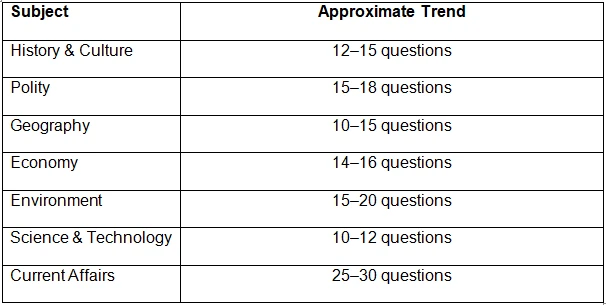
Note: Weightage varies every year and should be used only as a guiding reference.
Final Preparation Strategy for UPSC Prelims 2026
Success in Prelims depends on integrating the UPSC Syllabus with current affairs. When a topic appears in the news, revisit its static background from Polity, Economy, or Environment. Consistent revision, regular mock tests and analysing previous year questions help build both accuracy and confidence.
A disciplined, concept-driven approach aligned with the UPSC Syllabus remains the most reliable path to clearing UPSC Prelims 2026.