In today’s highly competitive industrial landscape, businesses continually seek innovative materials and manufacturing methods that can enhance product performance while reducing costs. One such versatile manufacturing technique—rubber extrusion—has gained significant traction across many sectors, including automotive, construction, electronics, and aerospace.
What is Rubber Extrusion?
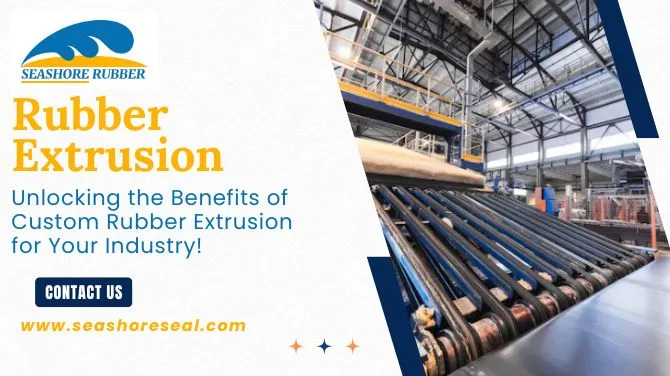
To fully appreciate the benefits of rubber extrusion, it helps to understand the process itself. Rubber extrusion is a fabrication method where raw rubber material—often in the form of pellets or crumb—is heated and forced through a shaped die to create continuous profiles of a specific cross-section. These profiles can range from simple tubes and strips to complex sealing gaskets and custom-designed shapes.
The extruded rubber can be formulated with different compounds and properties depending on the application needs, including flexibility, hardness, resistance to heat, chemicals, or abrasion. After extrusion, these products may undergo curing or vulcanization to stabilize their shape, improve elasticity, and increase lifespan.
The Importance of Custom Rubber Extrusion
While standard rubber products serve many general applications, custom rubber extrusion unlocks a higher level of precision and performance. This is particularly important in industries where off-the-shelf seals or components do not meet critical dimensional or material specifications.
Customization enables manufacturers to tailor:
- Profile Geometry: Unique sealing or insulating shapes designed for maximum efficiency.
- Material Formulation: Specific rubbers such as EPDM, silicone, neoprene, or nitrile, combined with additives to meet environmental, thermal, or chemical resistance requirements.
- Size and Length: From small batch prototype runs to high-volume production, catering to exact dimensional tolerances.
- Finish and Secondary Processes: Cutting, splicing, or coiling services to facilitate installation and integration.
By opting for custom rubber extrusion, companies can achieve product designs that enhance performance while reducing material waste and assembly time.
Key Benefits of Custom Rubber Extrusion in Various Industries:
1. Enhanced Product Performance
When rubber profiles are precisely designed and extruded to meet application-specific needs, they perform better under demanding conditions. For example, automotive manufacturers require seals that withstand extreme temperatures and constant vibration. Custom rubber extrusion delivers durable, airtight, and vibration-absorbing profiles designed to meet such rigorous standards.
2. Cost Efficiency and Waste Reduction
Unlike traditional molding methods that often generate excess scrap, extrusion produces continuous rubber profiles with minimal waste. Additionally, producing components in an optimized shape reduces the need for further machining or modifications, leading to lower overall production costs.
3. Design Flexibility
Rubber extrusion allows for the creation of complex shapes that may be impossible or prohibitively expensive using other manufacturing techniques. This flexibility can lead to innovative solutions in gasketing, weatherstripping, tubing, vibration dampening, and more.
4. Faster Production and Scalability
Extrusion is inherently a continuous process, which translates into quicker turnaround times compared to batch manufacturing methods. This scalability is advantageous when moving from small prototype runs to mass production without compromising consistency.
5. Superior Material Properties
By carefully selecting rubber compounds and extrusion parameters, manufacturers can produce profiles with enhanced resistance characteristics, including UV exposure, ozone degradation, chemical exposure, and mechanical wear—essential for industrial durability.
How Qingdao Seashore Industrial Co., Ltd. Advances Custom Rubber Extrusion?
At Qingdao Seashore Industrial Co., Ltd., we combine decades of expertise with cutting-edge extrusion technology to provide tailor-made rubber profiles that meet and exceed client expectations. Our commitment to quality ensures:
- Precision Tooling and Die Design: Engineering custom dies that produce exact profile geometries.
- Wide Material Selection: Offering EPDM, silicone, neoprene, nitrile, and blended compounds designed for specific operational demands.
- Advanced Extrusion Lines: Utilizing computer-controlled equipment for uniformity, accuracy, and efficiency.
- Rigorous Quality Assurance: Comprehensive testing regimes to ensure material performance and adherence to specifications.
- Customer-Centric Customization: Collaborating closely to refine designs and optimize solutions for unique challenges.
This holistic approach ensures our rubber extrusions deliver reliable performance in virtually any industrial environment.
Common Applications of Custom Rubber Extrusion
Custom rubber extrusion finds diverse applications across various sectors:
- Automotive: Door seals, window gaskets, airbag seals, vibration dampeners, and bumpers.
- Construction: Window and door weatherstripping, sealing strips for curtain walls, expansion joints.
- Electronics: Cable sheathing, protective tubing, insulating gaskets for enclosures.
- Medical: Flexible tubing, seals for medical devices that require biocompatibility.
- Aerospace: Lightweight seals, shock-absorbing strips designed to meet stringent safety and endurance standards.
- Marine: Seals resistant to saltwater and UV exposure for boat hatches and windows.
By employing custom extruded rubber profiles, industries gain improved reliability and enhanced product lifecycle.
Custom rubber extrusion offers industries an unprecedented blend of efficiency, performance, and design versatility. By tailoring rubber profiles to exact specifications, companies can overcome challenges related to sealing, insulation, vibration dampening, and protection in demanding environments.
Steps to Implement Custom Rubber Extrusion Solutions
1. Application Analysis
Understanding the environmental factors, mechanical stresses, temperature ranges, and regulatory requirements is critical to specifying the right rubber material and profile design.
2. Design and Prototyping
Collaborative design sessions help produce CAD drawings and prototypes, allowing for iterative improvements before bulk production.
3. Tooling and Die Fabrication
Creating the extrusion die requires precision machining to accommodate the desired cross-sectional shape, which directly influences the quality of the final product.
4. Material Compounding and Extrusion
Selecting the compound and manufacturing the profiles through advanced extrusion techniques ensures consistent quality.
5. Quality Control and Testing
Post-production testing—including dimensional accuracy, hardness, tensile strength, and aging resistance—confirms conformance with client specifications.
Frequently Asked Questions (FAQ) About Rubber Extrusion
Q1: What industries benefit most from rubber extrusion?
Rubber extrusion is widely used in automotive, construction, electronics, aerospace, medical, and marine industries due to its versatility and customization capabilities.
Q2: How does rubber extrusion differ from molding?
Extrusion is a continuous process producing long, consistent profiles through a shaped die, whereas molding creates discrete parts by injecting rubber into molds. Extrusion is ideal for seals and strips with constant cross-sections.
Q3: What are the most common rubber materials used for extrusion?
EPDM, silicone, neoprene, nitrile (NBR), and thermoplastic elastomers are common choices, selected based on their chemical, thermal, and mechanical properties.
Q4: Can custom rubber extrusions be produced in small quantities?
Yes, many manufacturers including Qingdao Seashore Industrial Co., Ltd. support small batch runs and prototype development alongside large volume production.
Q5: How do I ensure the extruded rubber profile fits my application?
Working closely with your supplier to provide accurate measurements, environmental conditions, and functional requirements is critical for proper design and die fabrication.
Q6: Are custom rubber extrusions resistant to environmental factors?
Yes, with appropriate material selection and compounding, extruded rubber profiles are resistant to ozone, UV, heat, chemicals, and abrasion.
Q7: How long does lead time typically take for custom rubber extrusion orders?
Lead times vary by order size and complexity but generally range from a few weeks for prototypes to longer for mass production.
Q8: Can rubber extrusions be post-processed after extrusion?
Yes, processes like cutting, splicing, vulcanizing, and coiling can be applied depending on final application needs.