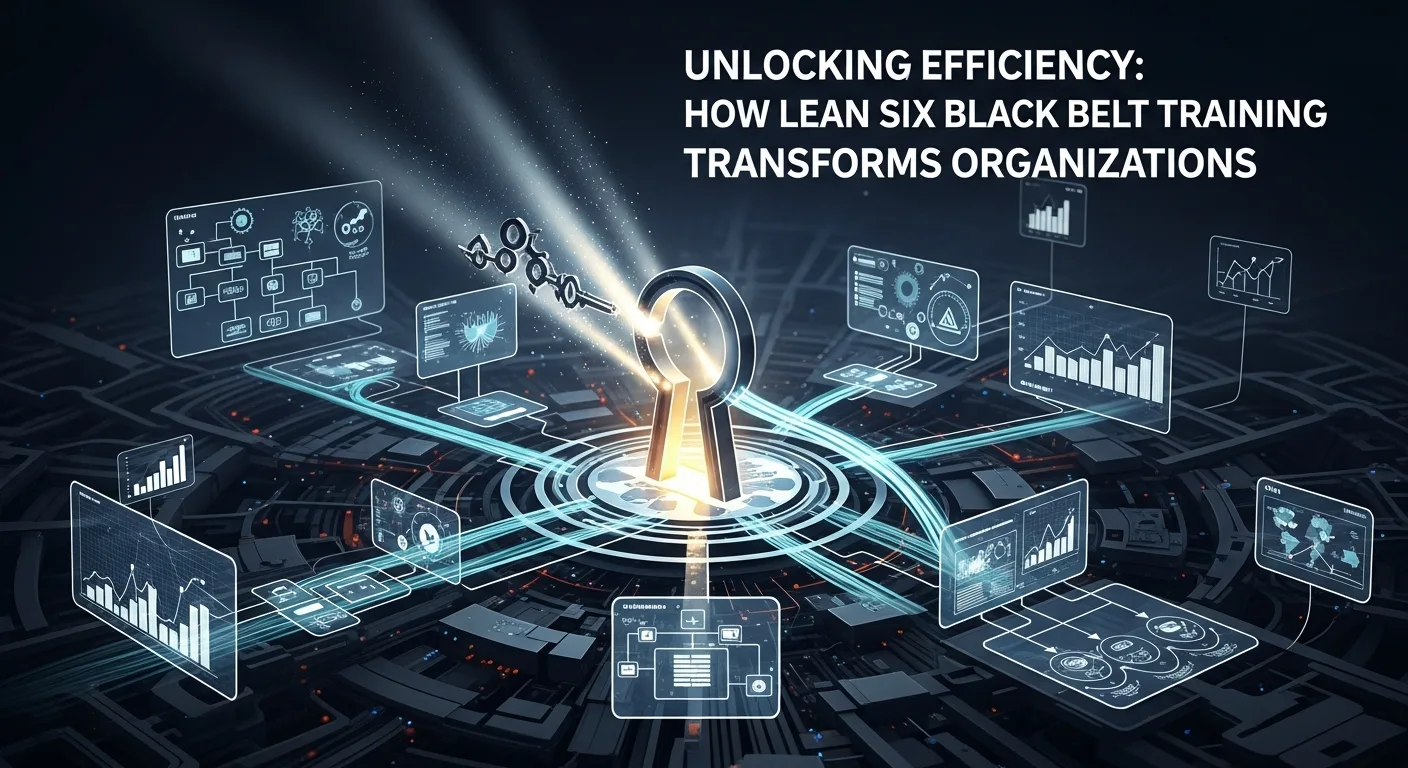
In an era defined by rapid technological disruption and fluctuating market demands, efficiency is the divide between industry leaders and those struggling to survive. While many organizations attempt to improve their bottom line through brute-force cost-cutting, true transformation requires a more surgical approach. This is where Lean Six Sigma Black Belt training acts as the ultimate key to unlocking hidden organizational potential.
A Six Sigma Black Belt certification does not just signify a person’s ability to use statistical tools; it represents a commitment to a methodology that can fundamentally alter an organization's DNA. By training high-potential employees to the Black Belt level, companies are embedding an "efficiency engine" into their leadership structure—one that systematically eliminates waste, reduces variation, and focuses relentlessly on customer value.
1. Beyond the Basics: The Strategic Role of the Black Belt
To understand how a Black Belt transforms an organization, we must first look at the jump from the Green Belt level. If a Green Belt is a project participant, the Black Belt is the project architect. Six Sigma Black Belt training prepares individuals to handle complex, cross-functional problems that do not have obvious solutions.
The Architect of Change
Black Belts are typically assigned to the most critical business challenges—those that are high-risk and high-reward. Their role is to:
- Mentor Green Belts: Acting as a force multiplier by guiding smaller project teams.
- Analyze Systemic Issues: Looking at the "Big Picture" to see how a bottleneck in one department causes a failure in another.
- Communicate with Executives: Translating complex data into the language of ROI and strategic growth.
2. Reducing Costs Without Sacrificing Quality
The most immediate impact of Lean Six Sigma Black Belt training is seen in the financial statements. Traditional cost-cutting often involves reducing headcount or lowering the quality of raw materials—both of which can harm the brand long-term. In contrast, a Black Belt finds savings by removing Muda (waste).
The Eight Wastes (DOWNTIME)
Black Belts are trained to identify and eliminate:
- Defects: The cost of rework and scrapped materials.
- Overproduction: Making more than the customer ordered.
- Waiting: Employees or machines sitting idle due to poor flow.
- Non-utilized Talent: Failing to use the creative skills of the workforce.
- Transportation: Unnecessary moving of products or information.
- Inventory: Capital tied up in excess stock.
- Motion: Inefficient physical movement by workers.
- Extra-Processing: Doing more work than the customer actually requires.
By systematically addressing these, a Black Belt can save an organization millions of dollars while actually improving the end product.
3. Data-Driven Decision Making in the Age of AI
In the modern business environment, data is everywhere, but insights are rare. Many organizations suffer from "analysis paralysis" or, worse, make decisions based on the "HiPPO" (Highest Paid Person's Opinion).
Six Sigma Black Belt training changes this dynamic by introducing rigorous statistical validation. Whether an organization is managing a global supply chain or a complex Cloud Computing infrastructure on AWS or Azure, the Black Belt uses data to prove what is happening.
Statistical Tools for Organizational Success
- Regression Analysis: Understanding which variables (like temperature, software version, or shift time) truly drive quality.
- Hypothesis Testing: Proving with 95% or 99% confidence that a proposed change will actually result in an improvement.
- Design of Experiments (DOE): Testing multiple variables simultaneously to find the optimal configuration for a process.
As we integrate Artificial Intelligence into business processes, the Black Belt’s ability to clean and interpret data becomes even more critical. They ensure that AI models are built on lean, high-quality processes rather than automating existing inefficiencies.
4. Improving Customer Loyalty through Reduced Variation
For a customer, "quality" is defined by consistency. If a coffee shop serves a perfect latte on Monday but a mediocre one on Tuesday, the customer is dissatisfied. In Six Sigma terms, this is variation.
The primary goal of a professional with a Six Sigma Black Belt certification is to "squeeze" the variation out of a process. By ensuring that every outcome falls within a tight range of acceptability, the organization builds immense trust and brand equity.
Voice of the Customer (VoC)
Black Belts use VoC techniques to ensure the organization isn't just "efficiently" doing something the customer doesn't care about. They translate customer desires into Critical to Quality (CTQ) requirements, ensuring every process improvement directly impacts customer satisfaction and retention.
5. Enhancing Employee Engagement and Culture
One of the most profound, yet overlooked, transformations is the cultural shift. When an organization invests in Lean Six Sigma Black Belt training, it sends a message that it values logic, data, and continuous improvement over "the way we’ve always done it."
Empowering the Front Line
Black Belts use Gemba Walks to go to the place where the work happens. Instead of issuing orders from an ivory tower, they engage with employees to identify roadblocks. This leads to:
- Increased Morale: Employees are less frustrated when they have the tools to fix their own processes.
- Standardization: Everyone knows the "best way" to do a job, reducing stress and ambiguity.
- A Culture of Excellence: Improvement becomes a daily habit rather than a yearly project.
6. Industry-Specific Transformations
The beauty of the Six Sigma Black Belt certification is its versatility. Here is how it transforms diverse sectors:
Healthcare
In a hospital setting, a Black Belt might focus on reducing the time between a patient entering the ER and receiving treatment. By applying Lean flow techniques, they can save lives while reducing hospital overhead.
Information Technology & Cybersecurity
In IT, "efficiency" means uptime and speed. A Black Belt can use Six Sigma to analyze the root causes of server outages or to streamline the Cybersecurity patch management process, ensuring vulnerabilities are closed faster with fewer resources.
Finance and Banking
For banks, the "product" is information and transactions. A Black Belt can transform a mortgage application process that took 30 days into one that takes 48 hours, providing a massive competitive advantage in a crowded market.
7. The ROI of Black Belt Training: A Business Case
If you are a business leader considering the investment in Six Sigma Black Belt training for your staff, the business case is clear. While the upfront cost of training and certification may seem high, the return is multi-fold.
FactorTransformation ImpactHard SavingsDirect reduction in waste, energy, and material costs.Soft SavingsImproved employee retention and reduced "firefighting" time for managers.Revenue GrowthFaster time-to-market for new products and higher customer lifetime value.Risk MitigationProactive identification of process failures before they become legal or safety liabilities.Most organizations find that a single Black Belt project pays for the cost of the entire training program several times over within the first six months.
8. Navigating the Future: Black Belts and Digital Transformation
By 2026, the concept of "Operational Excellence" will be inseparable from "Digital Transformation." The modern Black Belt is increasingly a "Digital Black Belt."
They are the bridge between the old world of physical processes and the new world of Machine Learning and automated workflows. They ensure that as companies move to the cloud or implement RPA (Robotic Process Automation), they are not just making "fast mistakes." They use the DMAIC framework to ensure the underlying process is optimized before it is digitized.
9. Challenges in Organizational Transformation
It is important to acknowledge that training a Black Belt is not a "magic pill." For the transformation to work, the organization must provide:
- Executive Support: Leaders must be willing to act on the data provided by the Black Belt, even if it contradicts their intuition.
- Time and Resources: Black Belts need dedicated time to run projects; they cannot be expected to perform these high-level analyses in their "spare time."
- Access to Data: The organization must have systems in place to collect and share the data necessary for analysis.
10. How iCertGlobal Empowers This Transformation
At iCertGlobal, we understand that a Six Sigma Black Belt certification is more than just a certificate—it is a career and organizational turning point. Our training programs are designed by industry experts to be practical, rigorous, and immediately applicable.
We don't just teach the formulas; we teach the leadership skills required to manage stakeholders, lead teams, and drive the cultural change that makes efficiency permanent. Our curriculum stays ahead of the curve, integrating modern concepts like Agile-Lean and Digital Six Sigma to ensure our graduates are ready for the challenges of today and tomorrow.
Conclusion: The Ultimate Competitive Edge
In the final analysis, unlocking efficiency is about more than just saving money. It is about creating an organization that is agile, resilient, and focused on delivering the highest possible value to its customers.