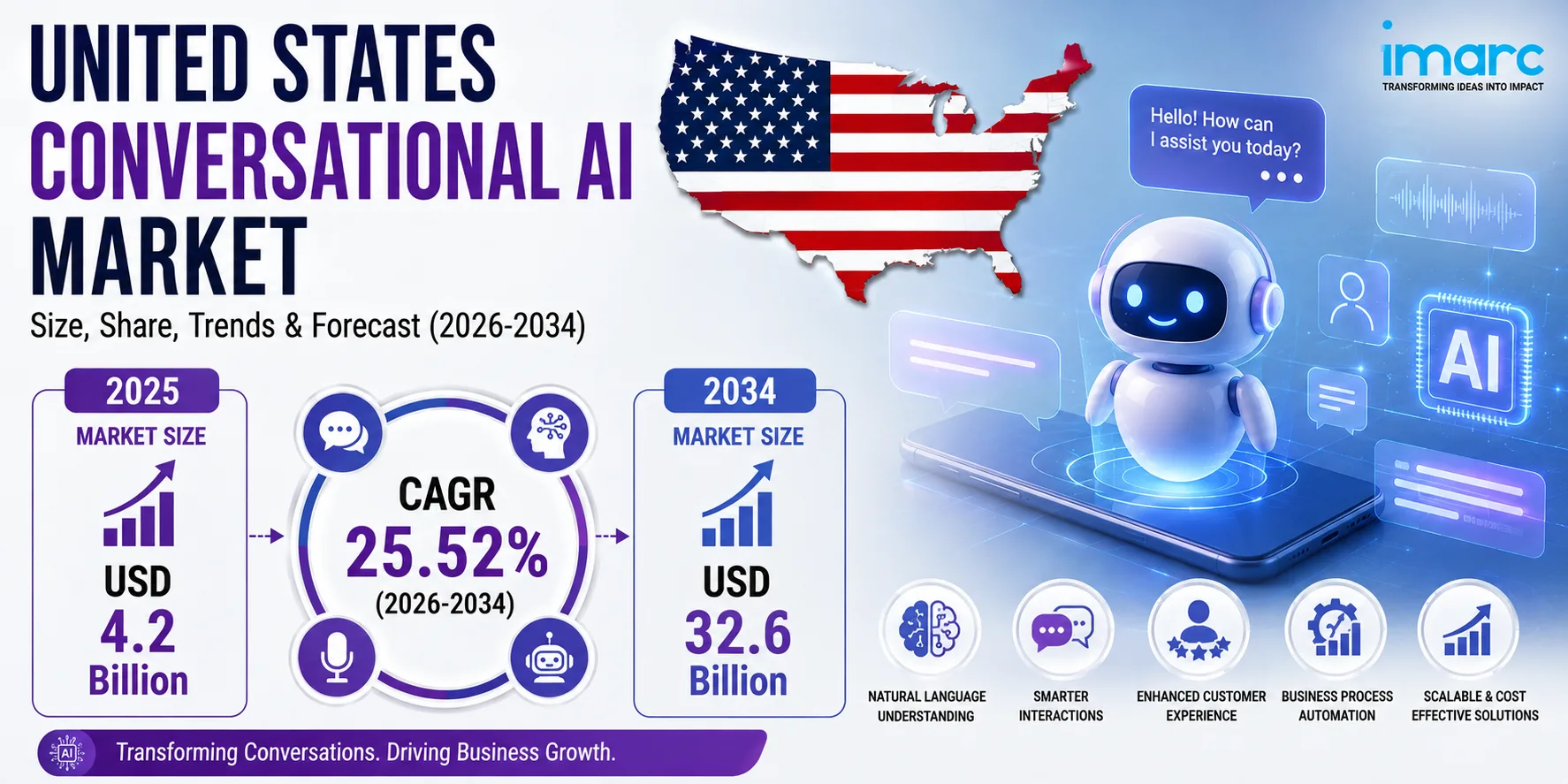
IMARC Group has released a new research report titled “United States Conversational AI Market Report by Component, Type, Technology, Deployment Mode, Organization Size, End User, and Region, 2026–2034.” The report explores the industry’s current landscape, key growth drivers, emerging trends, market segmentation, investment opportunities, and competitive environment to provide insights into future market developments.
United States Conversational AI Market Size, Growth, and Forecast (2026–2034)
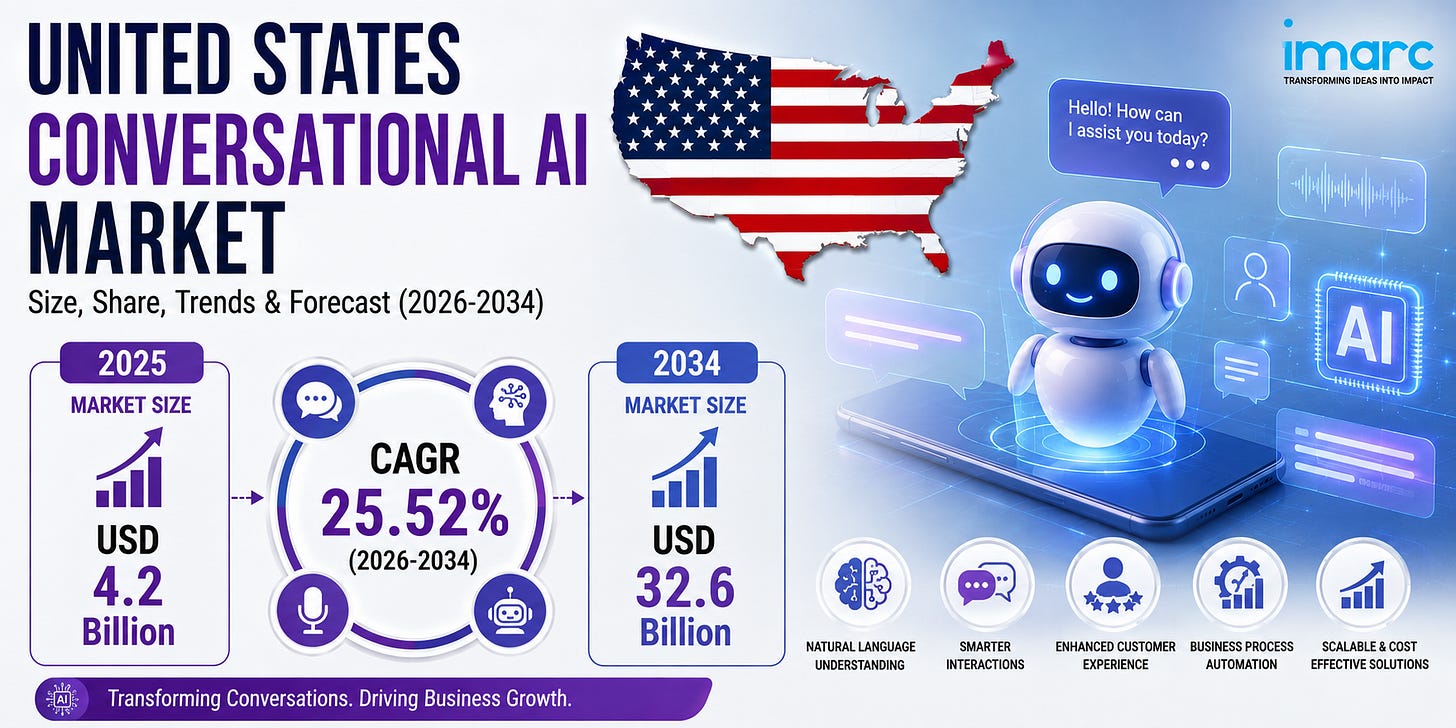
The United States conversational AI market reached USD 4.2 billion in 2025 and is projected to grow to USD 32.6 billion by 2034, registering a CAGR of 25.52% during 2026–2034. The growing popularity of messaging applications, combined with increasing business adoption of AI-powered conversational tools, is supporting market expansion.
Conversational AI uses artificial intelligence technologies to enable natural interactions between people and digital systems. By combining natural language processing, machine learning, and chatbot technologies, these solutions can understand user queries, interpret intent, and generate relevant responses. Common applications include chatbots, virtual assistants, and voice-enabled systems used for customer support, information retrieval, and routine task automation.
The increasing need for accessible, round-the-clock customer service is encouraging businesses to adopt conversational AI solutions. Advances in natural language processing are also making these systems more capable of handling complex interactions. As a result, industries such as banking, financial services and insurance (BFSI), retail and e-commerce, healthcare, and travel and hospitality are increasingly exploring conversational AI to improve customer engagement and operational efficiency.
Discover emerging opportunities in the United States conversational AI market. Request your sample report below: https://www.imarcgroup.com/united-states-conversational-ai-market/requestsample
Key Trends Driving the United States Conversational AI Market
1. Multimodal AI Is Improving User Experiences
Conversational AI is evolving beyond traditional text-based chatbots to incorporate voice recognition, visual processing, and other interaction methods. These capabilities allow users to communicate with digital systems through different channels while maintaining conversational context.
For example, healthcare providers can use voice-enabled assistants to support appointment scheduling, while retailers can combine visual search with conversational interfaces to help customers find products. This shift toward multimodal interactions is creating opportunities for businesses to deliver more intuitive and personalized experiences.
2. Enterprise Security and Regulatory Compliance Are Becoming Priorities
As conversational AI adoption expands into regulated industries, businesses are placing greater emphasis on data protection, privacy, and compliance. Financial institutions and healthcare organizations require solutions that address relevant requirements, including HIPAA, PCI DSS, and SOX, where applicable.
Integrating enterprise-grade security and compliance capabilities can help organizations manage sensitive information and build confidence in AI-powered interactions. These considerations are becoming increasingly important as businesses deploy conversational AI across customer-facing services and internal operations.
3. Agentic AI Is Enabling More Autonomous Workflows
Conversational AI systems are progressing toward agentic capabilities that allow them to perform multistep tasks with limited human intervention. Instead of simply answering questions, these systems can support workflows involving document processing, information verification, customer requests, and operational updates.
Financial institutions may use AI agents to assist with loan application workflows, while retailers can explore automated handling of returns and inventory-related requests. These capabilities are expanding the potential role of conversational AI beyond customer support into broader business operations.
United States Conversational AI Market Segmentation
The IMARC Group report analyzes the market across component, type, technology, deployment mode, organization size, end user, and region. This segmentation helps businesses understand adoption patterns and identify areas of potential growth.
Component Insights
The component segment covers platforms and services that support the implementation and operation of conversational AI systems.
Platforms: Conversational AI platforms provide the underlying capabilities required to develop, deploy, and manage intelligent virtual assistants and chatbots. These platforms support language understanding, response generation, and integration with business applications.
Services: Services include support and maintenance, training and consulting, and system integration. These offerings help organizations implement conversational AI solutions, connect them with existing infrastructure, and maintain their performance over time.
Type Insights
- Intelligent Virtual Assistants (IVAs)
Intelligent virtual assistants support more complex interactions and workflows, helping users complete tasks, retrieve information, and navigate digital services. Their ability to handle contextual conversations makes them suitable for a wide range of enterprise applications.
- Chatbots
Chatbots are commonly used to answer customer questions, provide product information, and automate routine service requests. They help businesses manage high volumes of interactions and provide support across digital channels.
Technology Insights
- Machine Learning and Deep Learning
Machine learning and deep learning enable conversational AI systems to identify patterns in data, improve their understanding of user behavior, and generate increasingly relevant responses.
- Natural Language Processing (NLP)
Natural language processing helps AI systems interpret written and spoken language, identify user intent, and maintain context during conversations. Advances in NLP are expanding the range of interactions these systems can manage.
Automatic Speech Recognition (ASR)
Automatic speech recognition converts spoken language into text that AI systems can process. This technology supports voice-enabled customer service, virtual assistants, and other applications that allow users to interact with systems through speech.
Deployment Mode Insights
- Cloud-Based Deployment
Cloud-based solutions offer scalability, flexible access, and the ability to integrate conversational AI into digital services without requiring organizations to manage all underlying infrastructure themselves. This model can be particularly useful for businesses with changing workloads or distributed operations.
- On-Premises Deployment
On-premises solutions allow organizations to maintain greater control over their infrastructure and data environments. This approach may appeal to businesses with specific security, privacy, or data governance requirements.
Organization Size Insights
Large Enterprises
Large enterprises represent an important customer group because they often manage extensive customer interactions and complex technology environments. Conversational AI can help these organizations automate repetitive tasks, improve service availability, and support operational efficiency.
Small and Medium-Sized Enterprises (SMEs)
SMEs can use conversational AI to improve customer support without significantly expanding their service teams. Automated responses, virtual assistants, and self-service tools can help smaller businesses manage customer inquiries and extend service availability.
End User Insights
The market serves a broad range of industries, including:
- BFSI: Financial institutions use conversational AI to support customer inquiries, provide account information, and assist with selected service workflows.
- Retail and E-commerce: Businesses deploy chatbots and virtual assistants to help customers discover products, track orders, and resolve routine queries.
- Healthcare and Life Sciences: Conversational AI supports appointment scheduling, patient communication, and access to general healthcare information.
- Travel and Hospitality: AI-powered assistants help users access booking information, manage reservations, and obtain travel-related support.
- Telecom: Telecommunications providers use conversational AI to manage service inquiries, troubleshoot common issues, and improve customer support.
- Media and Entertainment: Conversational interfaces help users discover content, navigate digital platforms, and receive personalized recommendations.
Regional Insights
The United States conversational AI market spans the Northeast, Midwest, South, and West. Technology hubs, enterprise activity, and the presence of digital infrastructure across these regions contribute to adoption.
The Northeast benefits from established financial services and business ecosystems, while the Midwest offers opportunities across manufacturing and other enterprise sectors. The South continues to develop as a business and technology hub, and the West benefits from a strong technology ecosystem and concentration of AI-focused companies.
Recent News and Developments in the United States Conversational AI Market
May 2025: At Microsoft Build 2025, Microsoft highlighted developments in AI agents and the emerging agentic web. The company reported that more than 15 million developers used GitHub Copilot and over 230,000 organizations leveraged Copilot Studio to build agents. Azure AI Foundry was also highlighted as a platform supporting innovation across healthcare and enterprise applications.
April 2025: At Google Cloud Next 2025, Google introduced its Ironwood tensor processing units (TPUs) and announced enhancements to its Gemini models, including reasoning capabilities. The company also highlighted multi-agent development tools, including the Agent Development Kit and Agent2Agent protocol, designed to support collaboration and interoperability across AI systems.
Challenges Affecting the United States Conversational AI Market
Despite its growth potential, the market faces challenges related to data privacy and security. Organizations must ensure that conversational AI systems handle sensitive customer and business information appropriately while meeting applicable regulatory requirements. These concerns can complicate adoption, particularly in industries that manage confidential data.
Integration with existing enterprise systems presents another challenge. Businesses may need to connect conversational AI platforms with customer relationship management systems, databases, internal applications, and legacy infrastructure. Technical complexity and implementation costs can slow deployment.
User trust also remains important. Some customers prefer human assistance when dealing with sensitive, complicated, or high-stakes issues. Businesses must therefore balance automation with appropriate human support to maintain service quality and customer confidence.
Investment Opportunities in the United States Conversational AI Market
The United States conversational AI market offers investment opportunities across generative AI, large language models, enterprise automation, and industry-specific applications. With the market projected to expand from USD 4.2 billion in 2025 to USD 32.6 billion by 2034, companies are exploring ways to develop solutions that address specialized business needs.
Healthcare, education, and financial services present opportunities for tailored conversational AI applications. Businesses can also explore integration with Internet of Things (IoT) devices and smart home ecosystems, where conversational interfaces can simplify device control and access to information.
Advanced analytics and sentiment analysis represent additional areas of interest. These capabilities can help businesses understand customer feedback, identify service issues, and generate actionable insights from conversations. Companies that combine agentic AI functionality with strong security and effective enterprise integration may be better positioned to compete as adoption expands.
Outlook of the United States Conversational AI Market (2026–2034)
The outlook for the United States conversational AI market remains promising, supported by increasing demand for automated customer service, improvements in natural language processing, and the growing adoption of AI agents across enterprise environments.
The market is projected to increase from USD 4.2 billion in 2025 to USD 32.6 billion by 2034, registering a CAGR of 25.52% during 2026–2034. The expansion of multimodal interfaces, improved integration with enterprise applications, and the development of AI systems capable of handling complex tasks are expected to shape the market’s evolution.
As businesses continue to prioritize operational efficiency and customer experience, conversational AI is likely to play an increasingly important role in digital transformation strategies. Solutions that combine reliable performance, security, scalability, and contextual understanding may find growing demand across industries.
Key Players in the United States Conversational AI Market
The competitive landscape includes major technology companies developing AI platforms, cloud infrastructure, virtual assistants, and enterprise automation tools. Market participants are investing in advanced language models, agent development frameworks, and tools that help businesses deploy conversational AI at scale.
- Microsoft Corporation: Microsoft continues to expand its enterprise AI capabilities through products and services such as GitHub Copilot, Copilot Studio, and Azure AI Foundry. These offerings support developers and organizations in building and deploying AI-powered assistants and agents across different business functions.
- Google LLC: Google is expanding its conversational AI and cloud AI ecosystem through the Gemini model family and multi-agent development tools. Initiatives such as the Agent Development Kit and Agent2Agent protocol support the development and interoperability of AI agents for enterprise applications.
Other global technology companies also participate in the broader conversational AI ecosystem, offering platforms, software, cloud infrastructure, and enterprise implementation services.
Frequently Asked Questions (FAQs): United States Conversational AI Market
1. What is the current size of the United States conversational AI market?
The United States conversational AI market reached USD 4.2 billion in 2025 and is projected to reach USD 32.6 billion by 2034, growing at a CAGR of 25.52% during 2026–2034.
2. What is conversational AI?
Conversational AI refers to artificial intelligence technologies that enable natural interactions between computers and users. It combines capabilities such as natural language processing, machine learning, and chatbot technology to power virtual assistants, chatbots, and voice-enabled systems.
3. What are the key drivers of the US conversational AI market?
Major growth drivers include the increasing use of messaging applications, rising demand for round-the-clock customer support, advancements in natural language processing, and growing enterprise adoption of AI-powered automation.
4. Which end-user industries are adopting conversational AI?
Key end-user industries include BFSI, retail and e-commerce, healthcare and life sciences, travel and hospitality, telecommunications, and media and entertainment.
5. Who are the key players in the United States conversational AI market?
Microsoft Corporation and Google LLC are among the companies highlighted in the market report. Other participants operate across conversational AI platforms, cloud services, enterprise software, and AI implementation solutions.
Author IMARC Group
IMARC Group is a global management consulting firm that helps the world’s most ambitious changemakers to create a lasting impact. The company provide a comprehensive suite of market entry and expansion services. IMARC offerings include thorough market assessment, feasibility studies, company incorporation assistance, factory setup support, regulatory approvals and licensing navigation, branding, marketing and sales strategies, competitive landscape and benchmarking analyses, pricing and cost research, and procurement research.
Contact Us
IMARC Group,
134 N 4th St. Brooklyn, NY 11249, USA,
Email: [email protected],
United States: +1-201971-6302