
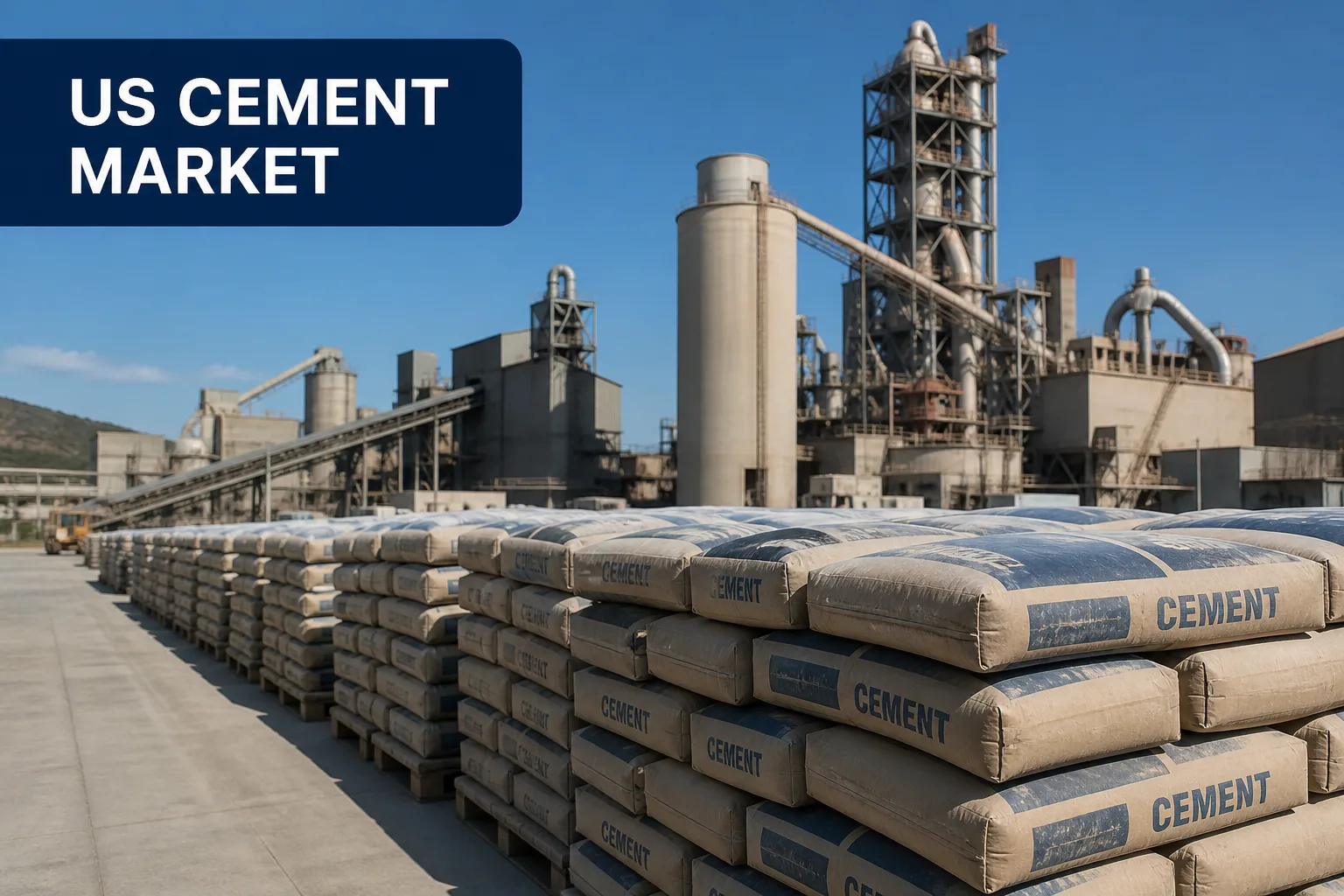
According to IMARC Group, the United States cement market was valued at USD 105.86 Billion in 2025 and is projected to reach USD 164.31 Billion by 2034, growing at a CAGR of 4.86% during 2026–2034.
Market valued at USD 105.86 Bn in 2025; forecast to reach USD 164.31 Bn by 2034
CAGR of 4.86% across the 2026–2034 forecast period
Infrastructure segment dominates with 44.3% share
Portland cement leads with 52.6% market share
Southern U.S. leads regionally with 36.7% share
United States Cement Market Overview
The United States cement market is experiencing stable growth driven by large-scale infrastructure investments, ongoing housing demand, and expanding commercial and industrial construction activities. Cement remains a fundamental material across construction sectors, including residential, commercial, and infrastructure development.
Strong demand from infrastructure projects such as roads, bridges, and water systems
Persistent housing deficit supporting residential construction activity
Growth in industrial projects including data centers and semiconductor plants
Rising focus on sustainable and low-carbon cement solutions
Get Insights on the United States Cement Market, Access the IMARC Sample Report: https://www.imarcgroup.com/us-cement-market/requestsample
Key Market Trends
Infrastructure-Led Demand Growth
Government-backed infrastructure spending is a major growth catalyst.
- Infrastructure Investment and Jobs Act (IIJA) driving long-term demand
- Significant investments in transportation and public utilities
- Multi-year funding pipeline ensuring consistent cement consumption
- Infrastructure accounts for 44.3% of total demand
Shift Toward Low-Carbon Cement
Sustainability is transforming the cement industry landscape.
- Increasing adoption of Portland-limestone cement (PLC)
- Government mandates encouraging low-carbon construction materials
- Blended cement emerging as the fastest-growing segment
- Carbon capture and green cement technologies gaining traction
Growth in Residential and Industrial Construction
Demand from housing and industrial sectors continues to expand.
- Housing shortage supporting new residential construction
- Each new home significantly contributes to cement demand
- Growth in semiconductor fabs and data centers boosting industrial demand
- Commercial construction diversifying beyond traditional sectors
Digitalization and Efficiency Improvements
Technology is enhancing cement production and supply chains.
- AI-driven kiln optimization improving efficiency
- Digital logistics platforms enhancing supply chain visibility
- Automation reducing operational costs and emissions
- Increased use of data analytics in production planning
United States Cement Market Segmentation
IMARC Group segments the market based on Type, End-Use, and Region.
By Type
- Largest segment: Portland Cement (52.6%)
- Widely used across construction due to standardization and reliability
- Blended Cement (fastest-growing)
- Others (specialty cement types)
By End-Use
- Largest segment: Infrastructure (44.3%)
- Driven by public infrastructure projects
- Residential (32.5%)
- Commercial (23.2%)
By Region
- Leading region: South (36.7%)
- Strong construction activity in Texas, Florida, and Georgia
- West (24.1%)
- Midwest (21.6%)
- Northeast (17.6%)
Market Growth Drivers
- Massive federal infrastructure funding under IIJA
- Persistent U.S. housing shortage driving residential demand
- Rapid growth in industrial construction (data centers, semiconductor plants)
- Increasing adoption of sustainable and low-carbon cement
- Expansion of urban infrastructure and smart city projects
United States Cement Market Challenges
- Strict environmental regulations increasing compliance costs
- High carbon emissions associated with cement production
- Capacity constraints leading to reliance on imports
- Volatility in raw material and energy prices
High capital investment requirements for plant upgrades
Competitive Landscape
The U.S. cement market is moderately consolidated, with major global and regional players dominating production and distribution.
Key Players Include:
- Amrize Ltd
- Heidelberg Materials AG
- CEMEX, S.A.B. de C.V.
- CRH plc
- Buzzi Unicem S.p.A.
- Eagle Materials Inc.
- GCC, S.A.B. de C.V.
Frequently Asked Questions (FAQs)
Q1. What is the size of the United States cement market?
The market was valued at USD 105.86 Billion in 2025 and is projected to reach USD 164.31 Billion by 2034, growing at a CAGR of 4.86%.
Q2. What is driving the market growth?
Key drivers include infrastructure investments, housing demand, and growth in industrial construction projects.
Q3. Which segment dominates the market?
Infrastructure leads with a 44.3% share due to large-scale public projects.
Q4. Which type of cement is most widely used?
Portland cement dominates with a 52.6% share.
Q5. Which region leads the market?
The South leads with a 36.7% share due to strong construction activity.
Q6. What is the future outlook?
The market outlook is positive, supported by sustained infrastructure spending, housing demand, and increasing adoption of sustainable cement technologies.
Author IMARC Group
IMARC Group is a leading market research company offering management strategy and market research worldwide. It provides services including market entry strategies, feasibility studies, competitive analysis, and business expansion planning.
Contact Us
IMARC Group
134 N 4th St. Brooklyn, NY 11249, USA
Email: [email protected]
Tel: +1-201-971-6302