IMARC Group has recently released a new research study titled “United States Autonomous Vehicle Market Report by Propulsion Type, Level, Vehicle Type, and Region, 2026-2034,” offering a detailed analysis of the market drivers, segmentation, growth opportunities, trends, and competitive landscape to understand the current and future market scenarios.
United States Autonomous Vehicle Market Size, Growth, and Forecast (2026-2034)
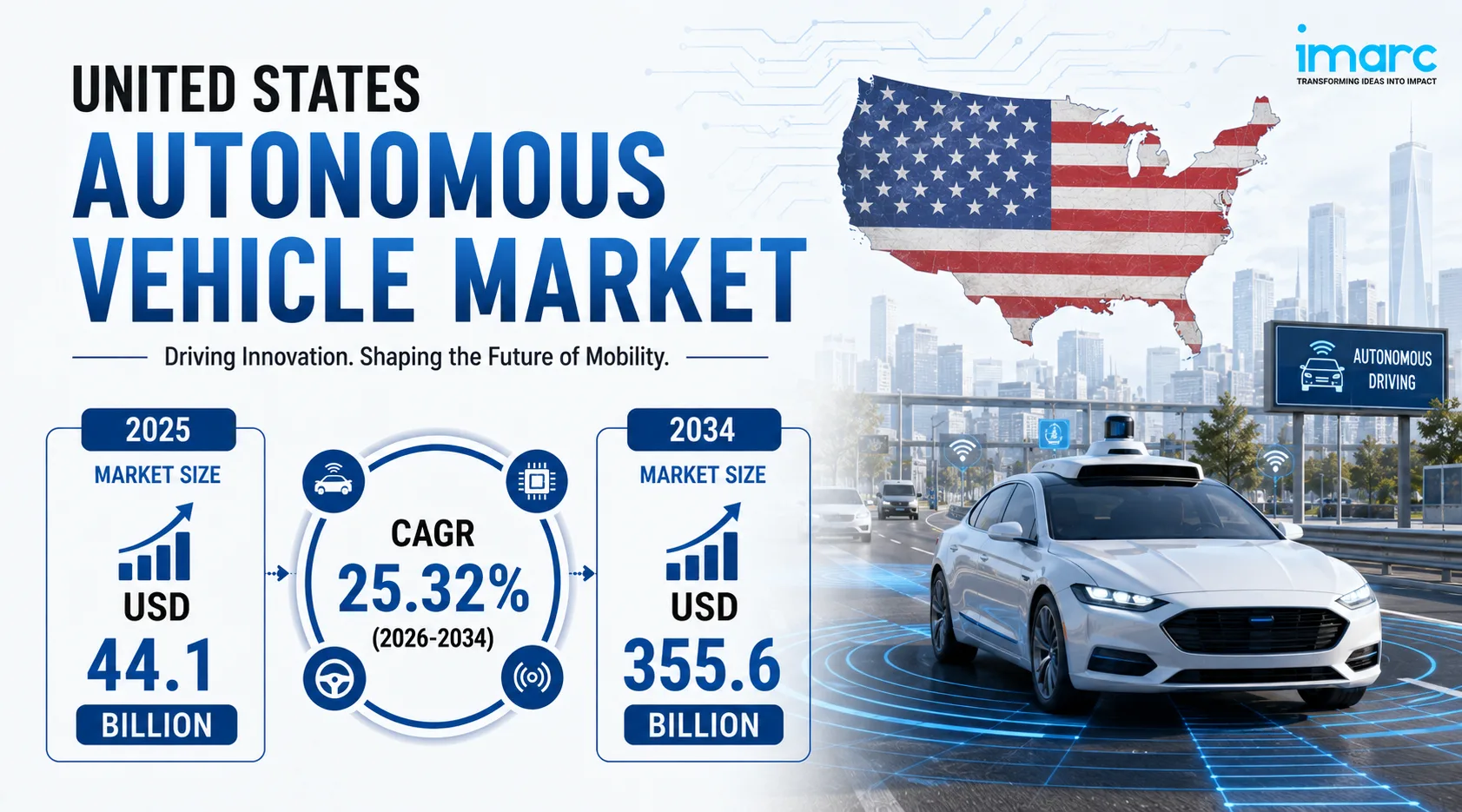
The us autonomous vehicles market size reached USD 44.1 Billion in 2025 and is projected to reach USD 355.6 Billion by 2034, exhibiting a CAGR of 25.32% during 2026-2034. Significant technological advancements, supportive government policies, and increasing consumer acceptance of autonomous technology are the primary factors driving the market.
KEY STATISTICS
- Base Year: 2025
- Forecast Years: 2026-2034
- Market Size in 2025: USD 44.1 Billion
- Market Forecast in 2034: USD 355.6 Billion
- Market Growth Rate 2026-2034: 25.32%
Widespread vehicle utilization to reduce traffic accidents, rising adoption by businesses, growing environmental concerns, and increasing demand to minimize traffic congestion are further propelling the us autonomous vehicles market. According to the National Highway Traffic Safety Administration, human errors such as drunk driving and speeding account for around 94% of all incidents on U.S. roadways, a factor accelerating consumer interest in automated driving systems.
Demand in the united states autonomous passenger car market is being shaped by consumers seeking a more relaxed commute, smart navigation, and optimized fuel consumption, while autonomous commercial vehicles are gaining traction among businesses for round-the-clock operation and consistent performance across supply chain and logistics applications.
Explore Growth Opportunities in the United States Autonomous Vehicle Market — Grab Your Sample Report for Evaluation: https://www.imarcgroup.com/united-states-autonomous-vehicle-market/requestsample
Key Trends Driving the United States Autonomous Vehicle Market
- Significant technological advancements: The introduction of new sensors such as LIDAR, RADAR, and high-definition cameras is giving autonomous vehicles a more comprehensive understanding of their environment. For instance, in September 2023, Mercedes-Benz launched Drive Pilot, a certified SAE Level 3 system in the U.S. that incorporates LiDAR, a rear camera, and microphones for emergency vehicle detection.
- Supportive government policies: Regulatory bodies at the federal and state level are actively working to create a conducive environment for testing and deploying autonomous vehicles. In March 2022, USDOT created the Automated Vehicles Comprehensive Plan to prioritize safety while modernizing the regulatory environment for Automated Driving Systems.
- Growing demand for autonomous cars: Rising safety concerns and the potential to reduce accidents caused by human error are increasing consumer inclination toward autonomous technology. This is reinforcing momentum in the united states autonomous passenger car market, alongside a broader shift toward electric and autonomous vehicles driven by environmental concerns.
United States Autonomous Vehicle Market Report Segmentation
The United States autonomous vehicle market report provides a detailed segmentation analysis to help businesses identify key growth segments and evolving industry dynamics. The market is categorized based on propulsion type, level, vehicle type, and region, offering comprehensive insights across the us autonomous vehicles market.
Propulsion Type Insights:
- Semi Autonomous: Semi-autonomous vehicles incorporate features such as adaptive cruise control, lane-keeping, and emergency braking, offering a transitional step between traditional cars and fully autonomous vehicles.
- Fully Autonomous: Fully autonomous vehicles have the potential to remove human error altogether, with the ability to communicate with other vehicles to streamline traffic flow and reduce congestion.
Level Insights:
- Level 1 and Level 2: Driver assistance and partial automation levels help maintain safe distances and provide lane-keeping assist, serving as a transition point for consumers adapting to autonomous technology.
- Level 3: Conditional automation alerts the driver when human intervention is needed, adapting to changing traffic conditions and potentially reducing congestion.
- Level 4 and Level 5: High and full automation can operate without human attention in predefined or universal scenarios, enabling round-the-clock operation without human drivers.
Vehicle Type Insights:
- Passenger Car: Autonomous passenger cars can communicate with each other to maintain optimum speeds and distances, helping to alleviate congestion while giving passengers freedom to engage in other activities while commuting, a key growth avenue for the united states autonomous passenger car market.
- Commercial Car: Autonomous commercial vehicles can operate around the clock, increasing efficiency and productivity for businesses while offering consistent performance and integration into controlled supply chain management systems.
Regional Insights:
- Northeast: An extensive road network and well-maintained urban settings support initial testing and deployment, with the region serving as a center for technology and innovation attracting venture capital.
- Midwest: The presence of major automotive companies and suppliers eases partnerships and supply chain linkages, supported by a skilled manufacturing and technology workforce.
- South: A warm climate supports year-round testing without the complications of snow or extreme cold, across a mix of urban and rural landscapes.
- West: Strong receptiveness to tech innovation and easy access to venture capital funds continue to support autonomous vehicle development on the West Coast.
United States Autonomous Vehicle Market News
- May 2024: Volvo Autonomous Solutions demonstrated an autonomous truck equipped with driving technology developed by Aurora Innovation at the ACT Expo in Las Vegas, featuring high-resolution cameras, imaging radar, long-range LIDAR, and twin onboard computers.
- February 2024: Oxa launched a commercial self-driving bus in Florida, with Oxa driver software supporting the driverless service operated by American shuttle provider Beep in partnership with the Jacksonville Transport Authority and Florida State College at Jacksonville.
Challenges Impacting the United States Autonomous Vehicle Market
Regulatory hurdles across federal and state jurisdictions continue to create uncertainty for developers seeking to scale testing and commercial deployment of autonomous vehicles nationwide.
Safety concerns and cybersecurity risks tied to connected and autonomous driving systems remain significant restraints, requiring continued investment in fail-safes, redundancies, and data protection to build public trust.
Investment Opportunities in the United States Autonomous Vehicle Market
The us autonomous vehicles market presents compelling investment opportunities supported by its projected growth from USD 44.1 Billion in 2025 to USD 355.6 Billion by 2034. Advanced sensor technology, including LIDAR, RADAR, and machine learning-based perception systems, represents a high-value opportunity as automakers race to scale Level 3 and above capabilities.
Autonomous ride-hailing and commercial fleet deployment represent a growing investment frontier, as companies gather extensive road and traffic data to train machine learning models and improve vehicle performance across the united states autonomous passenger car market and commercial segments alike.
Outlook of the United States Autonomous Vehicle Market (2026-2034)
The outlook for the us autonomous vehicles market is positive, supported by continued technological innovation, supportive federal and state policy frameworks, and rising consumer acceptance of autonomous driving systems. The market is projected to grow from USD 44.1 Billion in 2025 to USD 355.6 Billion by 2034 at a CAGR of 25.32%.
Continued advancement in sensor fusion and AI-based perception, expansion of autonomous ride-hailing and commercial fleets, and progress in resolving regulatory and cybersecurity challenges will be the defining trends shaping the us autonomous vehicles market through 2034.
Key Players in the United States Autonomous Vehicle Market
The us autonomous vehicles market is served by a mix of traditional automakers, technology firms, and autonomous driving specialists competing on the basis of sensor innovation, AI capability, and regulatory engagement.
• Mercedes-Benz: A global automaker with an established presence in the United States, Mercedes-Benz launched Drive Pilot in September 2023, a certified SAE Level 3 autonomous system that allows drivers to disengage from the dynamic driving task under qualifying conditions.
• Aurora Innovation: An autonomous driving technology developer, Aurora Innovation partnered with Volvo Autonomous Solutions to demonstrate an autonomous truck at the ACT Expo in 2024, reinforcing its position in the commercial autonomous vehicle segment.
Conclusion
With rapid sensor and AI innovation, supportive federal and state policy frameworks, and expanding real-world deployments across passenger and commercial segments, the us autonomous vehicles market is positioned for rapid growth through 2034. Companies that pair technical execution with proactive regulatory engagement stand to benefit most from this expanding market.
Frequently Asked Questions (FAQs): United States Autonomous Vehicle Market
1. What is the current United States autonomous vehicle market size?
The United States autonomous vehicle market size reached USD 44.1 Billion in 2025 and is projected to reach USD 355.6 Billion by 2034, growing at a CAGR of 25.32% during 2026-2034.
2. What does the United States autonomous vehicle market include?
The us autonomous vehicles market covers semi autonomous and fully autonomous vehicles across Levels 1 through 5, spanning passenger cars and commercial vehicles deployed across the Northeast, Midwest, South, and West regions.
3. What are the key drivers of the United States autonomous vehicle market?
Key drivers include significant technological advancements in sensors and AI, supportive government policies at the federal and state level, and growing consumer demand to reduce traffic accidents caused by human error.
4. Which segment leads the United States autonomous vehicle market?
The united states autonomous passenger car market remains a core growth segment alongside commercial vehicles, while semi autonomous systems continue to serve as a transitional step toward fully autonomous adoption.
5. Where can I find United States autonomous vehicle market news?
Recent United states autonomous vehicle market news includes Volvo Autonomous Solutions' 2024 autonomous truck demonstration with Aurora Innovation and Oxa's launch of a commercial self-driving bus service in Florida.
6. Who are the key players in the United States autonomous vehicle market?
Key players in the us autonomous vehicles market include Mercedes-Benz and Aurora Innovation, alongside other automakers, technology firms, and autonomous driving specialists serving passenger and commercial segments.
Author IMARC Group
IMARC Group is a global management consulting firm that helps the world's most ambitious changemakers to create a lasting impact. The company provide a comprehensive suite of market entry and expansion services. IMARC offerings include thorough market assessment, feasibility studies, company incorporation assistance, factory setup support, regulatory approvals and licensing navigation, branding, marketing and sales strategies, competitive landscape and benchmarking analyses, pricing and cost research, and procurement research.
Contact Us
IMARC Group,
134 N 4th St. Brooklyn, NY 11249, USA,
Email: [email protected],
United States: +1-201971-6302