
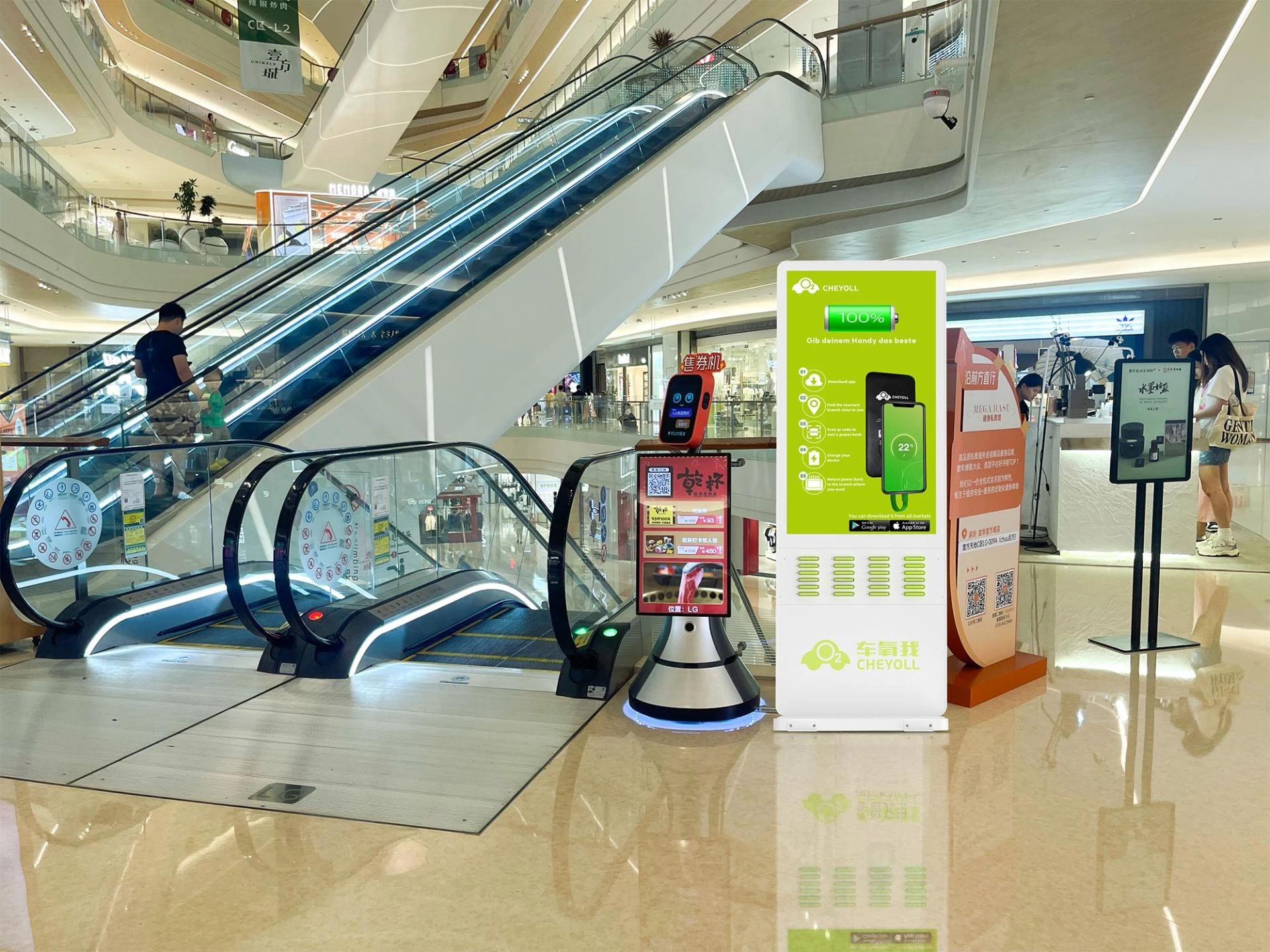
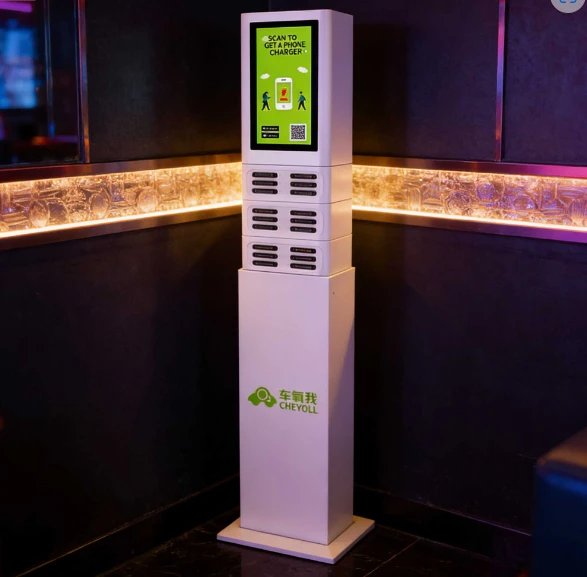
In the era of mobile intelligence, shared power banks have become an essential "power supply station" for travel. As the core hub connecting devices and electrical energy, interfaces directly determine the charging experience, device compatibility, and usage safety. The interface standards of high-quality shared power banks are not a one-dimensional parameter definition, but a comprehensive system covering interface types, protocol compatibility, safety protection, durability, and other aspects. Starting from the core dimensions, this article will take you to fully understand the interface standards of high-quality shared power banks.
Core Interface Types: Meeting Full-Scenario Compatibility Needs
The primary principle for the interface design of high-quality shared power banks is "full-scenario adaptation", which needs to cover the charging interface types of current mainstream electronic devices while taking into account the usage needs of old devices. Combined with industry practices and new national standard requirements, the core interface types mainly include the following three categories:
1. Type-C Interface: Mainstream Core Interface
With advantages such as reversible plugging, high-power transmission, and bidirectional power supply, the Type-C interface has become the core standard interface for high-quality shared power banks. The Type-C interface of high-quality products must meet strict specification requirements: support the USB Power Delivery (PD) protocol, cover mainstream voltage levels such as 5V/3A, 9V/3A, 12V/3A, and the maximum output power of a single port can reach 22.5W, 65W or even higher according to product positioning, adapting to various modern smart devices such as mobile phones, tablets, and laptops. Some high-end products also support the PPS (Programmable Power Supply) protocol, which can provide precise voltage regulation for devices of brands such as Samsung to achieve an ultra-fast charging experience.
2. Lightning Interface: Exclusive Adaptation for Apple Devices
For the Apple user group, high-quality shared power banks must be equipped with compliant Lightning interfaces and pass Apple's MFi certification to ensure compatibility and charging safety with devices such as iPhones and iPads. The interface must support the Apple 2.4A charging protocol to ensure stable charging efficiency and avoid problems such as device overheating and charging interruption caused by mismatched protocols. Some products adopt a detachable Lightning cable design to improve plugging convenience and cable durability.
3. Micro-USB Interface: Compatibility Guarantee for Old Devices
Although the Micro-USB interface is gradually withdrawing from the mainstream, to adapt to old Android phones, Bluetooth headsets, small digital devices, etc., high-quality shared power banks still need to retain this interface or provide corresponding charging cables. Its output must meet the specification of 5V/2A or above to ensure stable charging power for old devices, and at the same time, through strict interface reinforcement design, the durability of repeated plugging and unplugging is improved.
It is worth noting that the new national standard "General Technical Specifications for Shared Power Banks" (GB/T 43892-2024) clearly requires that high-quality shared power banks must be equipped with at least 3 different types of charging interfaces, further ensuring full-scenario compatibility. Some brands adopt an integrated "one-cable-for-three-uses" cable or a detachable three-cable design, which not only simplifies user operations but also improves the comprehensiveness of interface adaptation.
Fast Charging Protocol Standards: Core Support for Efficient Charging
Fast charging protocols are the "soul" of the interfaces of high-quality shared power banks, directly determining charging efficiency and device compatibility. The current mainstream fast charging protocol standards can be divided into two categories, and high-quality products must achieve multi-protocol compatibility:
1. Universal Fusion Protocol: UFCS Leads Industry Unification
UFCS (Universal Fast Charging Specification) is a new generation of fast charging protocol formulated by the China Academy of Information and Communications Technology (CAICT) in conjunction with enterprises such as Huawei, OPPO, and vivo, aiming to solve the problem of incompatible fast charging between devices of different brands. If a high-quality shared power bank is equipped with the UFCS protocol, it can realize fast charging interconnection of cross-brand devices. By intelligently adjusting voltage and current, it not only improves charging efficiency (such as 22.5W super fast charging) but also avoids damage to devices caused by overcharging and overheating. At present, brands such as Global Charger under Youdian Intelligence have taken the lead in adopting UFCS technology, becoming industry benchmarks.
2. Mainstream Brand Protocols: Fully Covering Segmented Needs
In addition to universal protocols, high-quality shared power banks also need to be compatible with mainstream brand-specific fast charging protocols, including Qualcomm QC3.0/4.0, Huawei FCP/SCP, Samsung AFC, etc. For example, an interface supporting the QC3.0 protocol can achieve 9V/2A fast charging output, adapting to most Android flagship models; an interface supporting the Huawei SCP protocol can provide a high-power fast charging experience for Huawei devices. By integrating high-integration protocol handshake chips (such as chips from brands like Injoinic and Nanxin), high-quality products can realize the full-process intelligent control of "automatic device identification - matching the optimal protocol - adjusting charging parameters".
Safety Protection Standards: Guarding the Entire Charging Process
The public use attribute of shared power banks determines that their interfaces must have strict safety protection standards, which is also the core difference between high-quality products and low-quality products. The interface safety protection of high-quality shared power banks covers multiple dimensions:
1. Electrical Safety Protection
The interface must integrate multiple circuit protection mechanisms such as overvoltage protection, overcurrent protection, short-circuit protection, and undervoltage protection. For example, when the voltage rises abnormally during charging, the corresponding protection circuit of the interface will start immediately to cut off the power supply link; if a short-circuit fault occurs, the short-circuit protection mechanism can respond in milliseconds to avoid equipment damage or fire risks. Some high-end products also introduce the SHA256 verification algorithm to enhance the privacy of interface communication and prevent malicious attacks.
2. Physical Safety Protection
The interface adopts a metal reinforcement design to improve the plugging and unplugging life, ensuring stable contact after thousands of repeated plugging and unplugging; the edge of the interface is chamfered to avoid scratching devices or users during plugging and unplugging; the shell is made of PC+ABS material with a flame retardant rating of V0 to prevent combustion caused by interface overheating. At the same time, the interface area is equipped with dustproof and waterproof designs to reduce damage to internal circuits caused by dust and liquid ingress, adapting to complex usage environments such as shopping malls, restaurants, and outdoors.
3. Temperature Safety Protection
A thermistor must be installed near the interface of high-quality shared power banks to monitor the charging temperature in real-time. When the temperature exceeds the safe threshold (usually 60℃), the device will automatically reduce the charging power or stop charging, avoiding safety hazards such as battery bulging and interface melting caused by overheating. Some products also quickly conduct heat from the interface area to the shell through an intelligent heat dissipation system to ensure stable temperature during charging.
Industry Standards and Certifications: Compliance Guarantee for High-Quality Interfaces
The interface standards of high-quality shared power banks must comply with relevant national and industry specifications, and product quality must be ensured through authoritative certifications. The "General Technical Specifications for Shared Power Banks" (GB/T 43892-2024) implemented in June 2024 clearly defines 32 technical indicators for interfaces, including interface types, charging efficiency, safety protection, identification marking, etc., providing a unified basis for interface standards. In addition, high-quality products must also pass authoritative certifications such as CCC (China Compulsory Certification), CE, and FCC. The relevant parameters of the interface must pass strict testing and verification to ensure compliance with international safety standards.
In actual procurement scenarios, such as public institutions like colleges and universities, hospitals, the requirements for the compliance of shared power bank interfaces are more stringent. For example, in the procurement of shared power banks by the Air Force Medical University, it is clearly required that the interfaces must have overcharge, overvoltage, overcurrent, and short-circuit protection functions, and the equipment must pass CCC certification and provide a product insurance liability certificate.
Future Trends: Intelligent and Integrated Upgrades
With the development of technology, the interface standards of high-quality shared power banks are moving towards intelligent and integrated upgrades. In the future, interfaces will pay more attention to intelligent identification capabilities, which can automatically judge device types and battery status, accurately match charging parameters, and realize "on-demand power supply"; wireless charging interfaces will gradually become popular, supporting plug-free charging of devices such as mobile phones and headsets through the Qi protocol, further improving usage convenience; at the same time, interfaces will be linked with the device's remote monitoring system to feedback interface status in real-time, and can be remotely locked when a fault occurs to avoid safety risks caused by users using damaged interfaces.
Conclusion: The interface standards of high-quality shared power banks are a comprehensive embodiment of compatibility, efficiency, and safety. Understanding core standards such as interface types, fast charging protocols, and safety protection can not only help users accurately select products suitable for their own devices when renting but also promote industry enterprises to develop in the direction of standardization and high quality. With the full implementation of the new national standard and the continuous innovation of technology, the interfaces of shared power banks will become more intelligent, safe, and convenient, providing more reliable support for the power guarantee of mobile travel.
To learn more about shared power banks, please visit sharedpowerbank.net.
If you are interested in shared charging stations, please feel free to contact me.