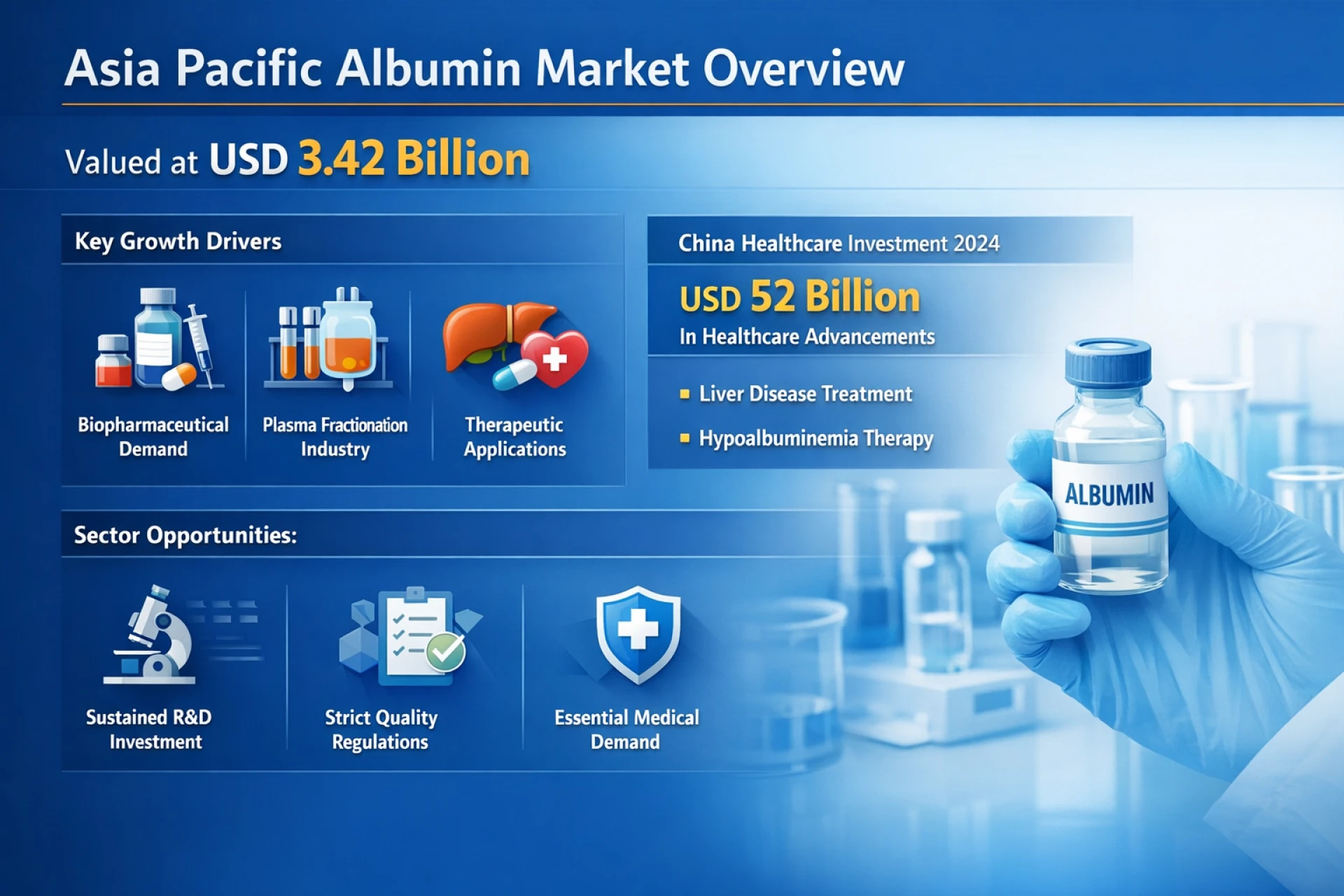
The Asia Pacific albumin market has reached a valuation of USD 3.42 billion, driven by increasing demand in biopharmaceuticals and the expanding plasma fractionation industry. This valuation reflects the cumulative effect of sustained R&D investment, growing therapeutic application adoption, and a regulatory environment that is progressively tightening quality standards in ways that favor established, compliance-capable producers. In 2024, China invested approximately USD 52 billion in healthcare advancements, with albumin demand for therapeutic uses including liver disease and hypoalbuminemia treatments representing a meaningful component of that biopharmaceutical investment. For the Asia Pacific Albumin Market, the demand base is both broad and medically essential, making it substantially less cyclical than most consumer healthcare markets.
China, Japan and India Form a Three-Tier Demand Architecture With Different Growth Drivers
The geographic structure of the Asia Pacific albumin market is defined by three primary national markets that each have distinct growth drivers. China leads through large-scale production facilities and government-backed research funding, combining supply-side manufacturing scale with demand-side healthcare investment. Japan contributes through advanced biopharmaceutical infrastructure and regulatory frameworks that favor biotechnology expansion. India's contribution is growing through regulatory framework development and rising healthcare investment, with the National Health Regulatory Authority's 2024 enforcement of stricter compliance norms including bi-annual facility audits and comprehensive testing protocols reflecting the country's commitment to meeting international quality standards for albumin production.
According to Ken Research Analysis, China, Japan, and India dominate the Asia Pacific albumin market due to their advanced biopharmaceutical infrastructure and rising healthcare investments, with China leading as a key player owing to large-scale production facilities and government-backed research funding.
Q: How is Asia pacific albumin industry size distributed across sources and applications?
The Asia Pacific Albumin Industry Size is distributed across three source categories and four primary applications. By source, Human Serum Albumin holds the dominant share due to its high efficacy in therapeutic applications, particularly for liver disease and hypovolemia patients where its clinical effectiveness is most clearly established. Bovine Serum Albumin serves a significant secondary role in research and diagnostic applications. Recombinant Albumin is an emerging category driven by biosafety advantages and production scalability. By application, Therapeutics holds the dominant share, followed by Drug Formulation and Drug Delivery, Vaccine Ingredient, and Cell Culture. The therapeutic dominance reflects albumin's critical role in managing protein deficiency, restoring blood volume, and enhancing immune responses in clinical settings across all three primary APAC markets.
Human Serum Albumin's Clinical Dominance Is Built on Therapeutic Irreplaceability
Human Serum Albumin (HSA) holds the largest source segment share in the Asia Pacific albumin market because its clinical role in conditions including liver cirrhosis, severe burns, hypoalbuminemia, and shock is both well-established and difficult to substitute. Unlike many biopharmaceutical products where therapeutic alternatives exist, albumin's mechanism of action in maintaining oncotic pressure and fluid balance in critical care settings makes it clinically irreplaceable in specific treatment contexts. This therapeutic necessity creates demand that is relatively inelastic to price changes, particularly in hospital and critical care procurement contexts. The growing aging population across APAC, which increases the incidence of liver disease and chronic conditions requiring albumin therapy, provides a long-term structural demand foundation that compounds the existing therapeutic application base.
Therapeutic application analysis from Ken Research Insights, confirms that Human Serum Albumin holds dominant market share within the Asia Pacific albumin source segmentation, attributed to its high efficacy in therapeutic applications particularly for patients with liver disease and hypovolemia.
Q: Where do the most commercially significant Asia pacific albumin sector opportunities concentrate?
The clearest Asia Pacific Albumin Sector Opportunities concentrate across four areas. First, biopharmaceutical expansion in China: China's USD 52 billion healthcare investment in 2024 is driving albumin demand for both therapeutic use and as a stabilizer in vaccine and drug formulation. Second, plasma fractionation capacity expansion: Japan and South Korea's government support for local plasma fractionation infrastructure is creating domestic production opportunities that reduce import dependency. Third, therapeutic demand growth from aging populations: the aging demographic profiles of Japan, South Korea, and China are increasing the incidence of conditions that require albumin therapy including liver disease and critical care needs. Fourth, recombinant albumin development: the biosafety advantages of recombinant albumin over plasma-derived sources are driving R&D investment that could open new production opportunities for operators with biotechnology manufacturing capability.
Plasma Fractionation Expansion Is Building Production Self-Sufficiency Across the Region
Plasma fractionation processes, essential for albumin extraction, are expanding across Asia Pacific with government support for local production capabilities. Japan and South Korea's investments in domestic fractionation infrastructure reflect a strategic priority to reduce dependence on imported albumin and build supply chain resilience for a therapeutically critical biopharmaceutical product. China's large-scale production facilities represent the most advanced domestic fractionation capability in the region. For operators in the albumin supply chain, the expansion of domestic fractionation capacity creates both competitive dynamics, as more local producers enter the market, and partnership opportunities, as governments seek to establish supply chain relationships with technically qualified international partners who can accelerate domestic capability development.
Production infrastructure analysis from Ken Research Data, identifies plasma fractionation expansion as a primary market growth driver in Asia Pacific, with substantial government support for local production capabilities in Japan and South Korea creating domestic supply chain development that is reshaping the regional albumin production landscape.
Conclusion
The Asia Pacific albumin market at USD 3.42 billion is built on a combination of therapeutic necessity, biopharmaceutical expansion, and government investment in domestic production infrastructure. The demand base is medically essential and structurally growing as aging populations increase the incidence of conditions requiring albumin therapy. China's healthcare investment scale, Japan and South Korea's fractionation infrastructure development, and India's regulatory maturation are all expanding the market from different directions simultaneously. For operators across the albumin value chain, the sector opportunities are real, near-term, and backed by both clinical demand and government procurement commitment.