The printing industry continues to evolve as businesses seek efficient production methods, consistent print quality and flexible workflows. Digital inkjet technology has become an important option for printing companies that want to manage changing job requirements while maintaining productive operations. A digital inkjet roll fed printing machine can be suitable for applications where printing from a continuous paper roll is an important part of the production process.
Understanding Roll-Fed Digital Inkjet Printing
A roll-fed printing machine uses paper supplied from a continuous reel rather than individual sheets. The paper moves through the printing system while digital inkjet technology transfers text, graphics and other content onto the media.
This configuration can support continuous production workflows and reduce the need to load individual sheets. Actual productivity depends on machine configuration, printing specifications, paper characteristics and operating conditions.
Benefits of Roll-Fed Printing Technology
One of the key considerations when choosing a roll-fed system is its ability to handle continuous paper movement. This can be useful for printing businesses with regular production schedules and suitable long-run jobs.
Digital workflows can also simplify job preparation for compatible applications. Businesses may be able to change digital files without the conventional plate-making process required by traditional printing methods.
Other factors, including paper handling, drying, ink consumption and finishing, should be considered when evaluating the complete production process.
Introducing DIGIGRAF by Ronald Web Offset
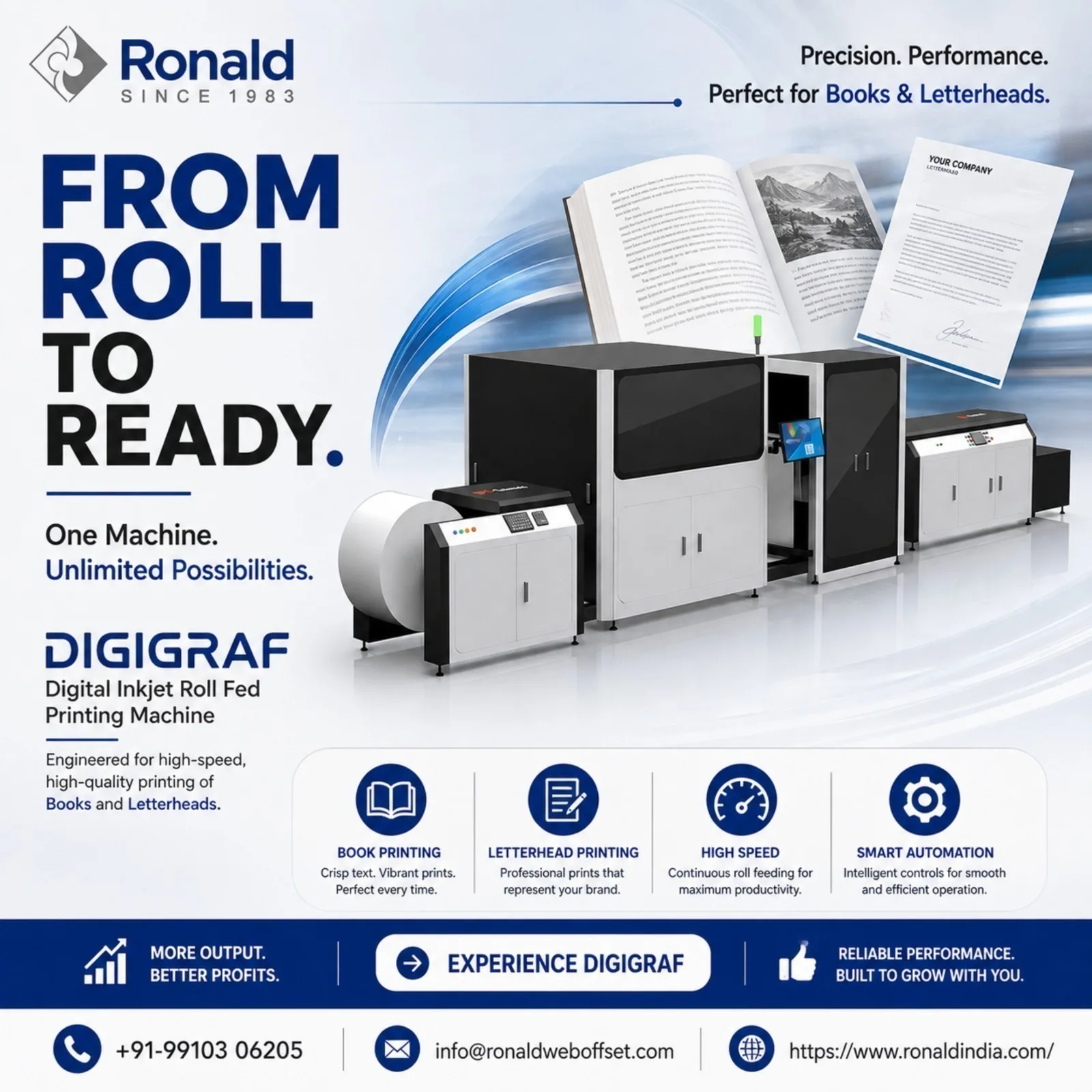
DIGIGRAF is a digital inkjet roll-fed printing machine offered by Ronald Web Offset Pvt. Ltd. It is designed for production environments that require roll-based paper printing.
The machine's stated specifications include industrial piezoelectric circulation-on-demand printhead technology, full servo motion control and an intelligent infrared drying system. These features are relevant when assessing the requirements of an industrial printing workflow.
Businesses should verify the current machine configuration, available print widths, colour options and media compatibility with the manufacturer before making a purchasing decision.
What Should Businesses Consider Before Investing?
Selecting a digital inkjet machine requires a practical assessment of several factors:
- Required printing width and production volume.
- Paper types, media weights and ink compatibility.
- Print quality and resolution requirements.
- Drying performance and paper handling.
- Ink consumption, maintenance and operating expenses.
- Integration with existing finishing equipment.
A review of actual job requirements helps businesses determine whether a roll-fed system fits their production needs.
Conclusion
A digital inkjet roll fed printing machine can be a useful option for businesses looking to introduce digital technology into continuous paper printing workflows. The right choice depends on the intended application, material requirements and overall production economics.
DIGIGRAF from Ronald Web Offset Pvt. Ltd. provides an industrial roll-fed digital inkjet printing option for businesses evaluating modern printing technology.
Explore more at https://www.ronaldindia.com/digigraf-digital-inkjet-roll-fed-printing-machine/