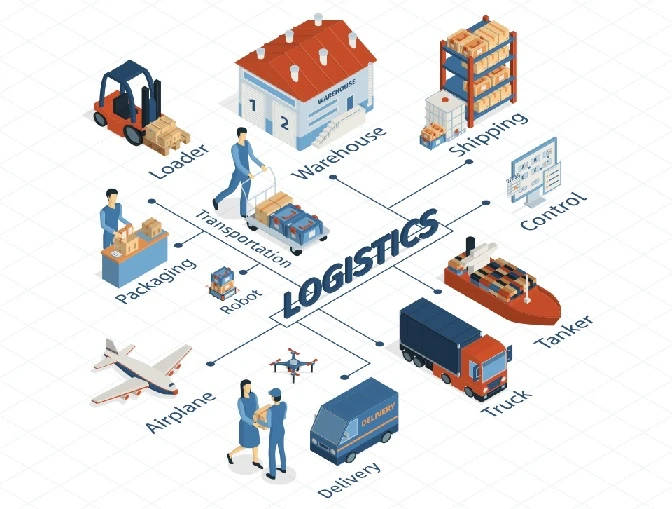
In today’s fast-paced digital economy, ecommerce and logistics are more intertwined than ever. Behind every “Buy Now” button lies a complex network of fulfillment processes that ensure a product gets from a warehouse shelf to a customer's doorstep efficiently.
This article aims at taking a deep dive into ecommerce logistics, in particular, and discussing how an organization should build streamlined fulfillment operations. It also takes a look at the ways through which brands can optimize these processes using their partner.
Ecommerce Logistics: What It Entails
Ecommerce logistics can be described as all activities involved in the storage, management and delivery of goods that are ordered via internet platforms. It covers a wide range of functions such as inventory storage, order processing, packaging, shipping or return handling. Therefore, it is vital for any successful ecommerce and logistics company to be able to meet customers’ demands within time and cost-effectively, thus gaining their trust continuously.
The process begins once an order is made by a client and ends when the product is received at his doorstep but magic usually happens midway especially at the fulfilment center.
Key Components of Ecommerce Logistics
#1. Inventory Storage
After manufacturing, the produced goods must be securely stored in warehouses or other places where they can be easily accessed.
#2. Order Management
When a customer makes a transaction, payment should be confirmed, inventory checked, and everything for fulfillment prepared. The order management system (OMS) plays a critical role in synchronizing various sales outlets while maintaining stock levels and working with different shipping providers.
#3. Order Fulfillment
This entails removing goods that have already received orders from shelves within warehouses packing them safely before transportation starts. To enhance accuracy during this moment, modern fulfilment centers apply technology like automation and barcode scanning most.
#4. Shipping and Delivery
Whereby shipping aims at assigning specific delivery modes and selecting appropriate carriers based on each client’s order, whose origin or destination may not necessarily be the same. It calls for many companies to work with more than one courier service to balance cost and speed. Such a system ensures that there is on-time delivery and visibility into where that parcel is at any particular moment when returning to the sender's address.
#5. Returns Management
Ecommerce cannot do without managing returns while efficient handling of returns that is also known as reverse logistics guarantees customer’s trust and helps maintain inventory accuracy.
E-commerce and Logistics: The Role of Technology
Modern ecommerce and logistics can hardly be imagined without technology. The days of just tracking trucks on a map are long gone – today’s world is all about AI-driven demand forecasting, real-time tracking or automated sorting.
Key tech-enabled attributes include:
- Real-time inventory management
- Automated order routing
- Delivery time predictions
- Integrated customer communication
- Analytics dashboards for performance optimization
How Eshopbox Streamlines Ecommerce Logistics
Eshopbox is an end-to-end ecommerce fulfillment platform that solves some major problems in ecommerce logistics today. From inventory management to last mile deliveries, Eshopbox helps brands offer a world-class ecommerce experience.
1. Speed And Scale From Distributed Fulfillment Centers
Eshopbox has built multiple fulfillment centers across the country to reduce transit times and cost for its clients. This way, it saves time for buyers and businesses using their services.
2. Order Management With Technology As The Enabler
Through Eshopbox’s solid software system, brands have the chance to merge several sale channels into one inventory view, alongside their orders as well as any returns right under the same roof. This holistic approach increases efficiency within ecommerce and logistics processes.
3. Seamless Shipping Via Trusted Partners
To ensure reliable, fast, and affordable delivery, Eshopbox partners with top-tier courier services. There are pre-negotiated shipping rates for brands and they also make use of intelligent selection algorithms for each parcel.
4. Returns & Finance Operations
The process of returning items is expedited by a reverse logistics management system that is easy to handle. Aspects of financial operations such as payment reconciliation and invoicing, which are often neglected in ecommerce logistics, become easier with Eshopbox.
5. Analytics and Operational Support
Detailed analytics provided by Eshopbox help brands to optimise sales, warehousing and shipping channels among other operations in order for them to perform at the highest level possible. This includes fast resolution of any operational problems through on-site support staff.
Conclusion
Brands that seek growth in the digital market need to have a comprehensive knowledge of ecommerce logistics. Furthermore, businesses can fine-tune every aspect of their fulfillment process – from the fulfillment center to final delivery – by utilizing proper strategies and tools.
Eshopbox may be considered with full-stack fulfillment capabilities along with real-time visibility into what is going on at the last mile.
Explore how Eshopbox can transform your ecommerce logistics—visit Eshopbox today.