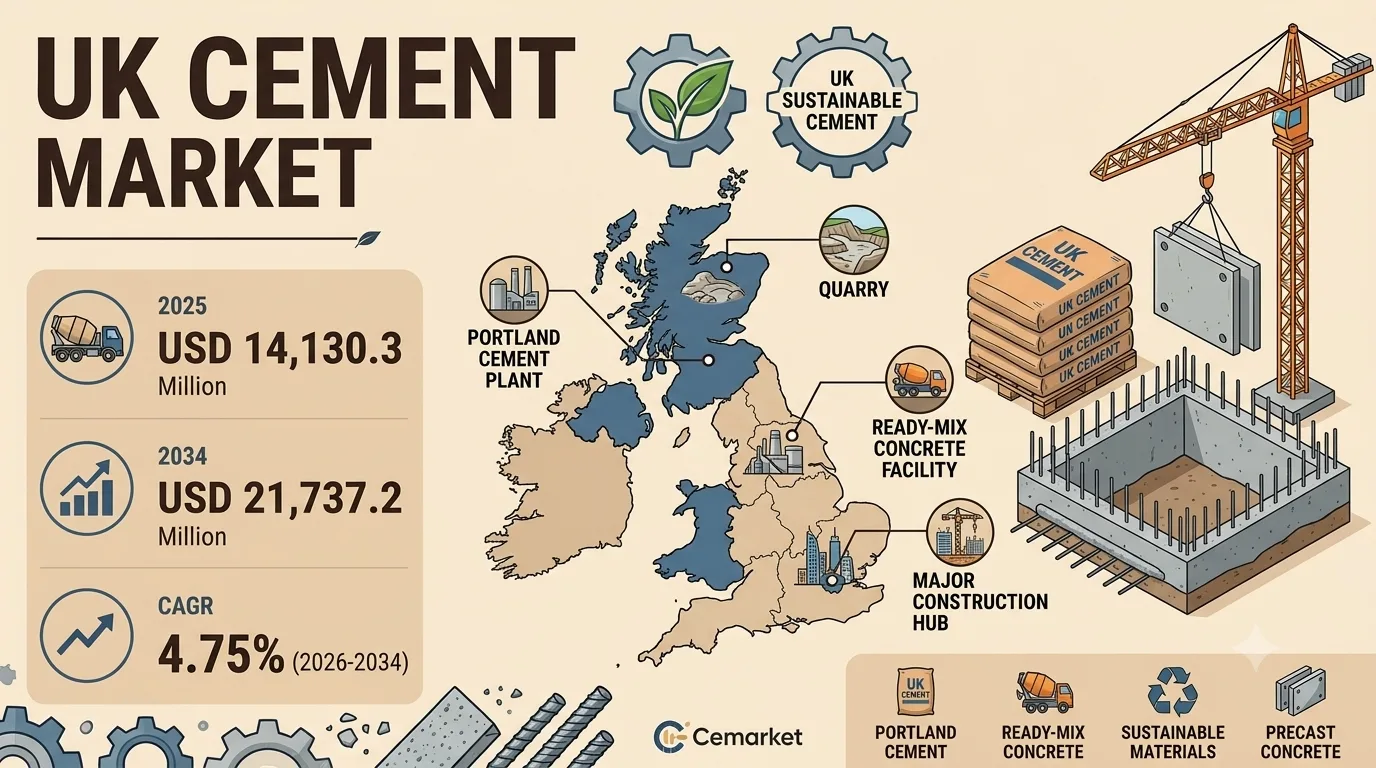
The UK cement market is witnessing significant growth driven by large-scale infrastructure projects, government-led initiatives promoting green construction, and robust demand from residential and commercial real estate sectors. The market size reached USD 14,130.3 Million in 2025 and is projected to reach USD 21,737.2 Million by 2034, exhibiting a compound annual growth rate (CAGR) of 4.75% during 2026-2034. Major infrastructure programs, including High-Speed 2 (HS2) and extensive public retrofit projects under the National Infrastructure Strategy, along with substantial government funding for housing and transport, are creating strong consumption patterns for cement across the country. This market is strategically important to the UK’s economy as it directly supports the nation's construction, infrastructure, and industrial manufacturing sectors.
The UK cement market is poised for sustained expansion, driven by a significant infrastructure pipeline and a decisive shift towards sustainable construction. With a projected CAGR of 4.75% through 2034, the market presents substantial opportunities for established producers and new entrants focused on low-carbon and innovative cement formulations.
UK CEMENT MARKET SUMMARY
- The UK cement market encompasses a wide range of products designed for binding materials in construction, enhancing structural integrity, and enabling infrastructure development across the residential, commercial, and industrial sectors.
- The ecosystem includes global cement manufacturers (Heidelberg Materials, Holcim, Breedon Group, Cemex), importers, distributors, and end-use consumers.
- Major segments identified in the market include type (Blended, Portland, and others) and end-use industry (Residential, Commercial, Infrastructure).
- The infrastructure segment is a dominant end-use category, driven by major public works like HS2 and significant government investment in transport and energy projects.
PORTER'S FIVE FORCES ANALYSIS -- UK CEMENT MARKET
The competitive dynamics of the UK cement market can be analyzed using Porter's Five Forces framework.
Porter's Five Forces Analysis -- UK Cement Market
- Competitive Rivalry: High. Intense competition exists between global cement giants and domestic producers. Rivalry is driven by high capital intensity, the need for logistics networks, and the growing importance of sustainability credentials. Business implication: Companies must differentiate through low-carbon product portfolios, operational efficiency, and strategic positioning in key regional markets.
- Supplier Power (Raw Materials & Energy): Moderate to High. Producers are heavily reliant on energy (natural gas and electricity), which represents 30-40% of variable costs, making them vulnerable to price volatility. Access to limestone reserves and alternative raw materials is also a key factor. Business implication: Vertical integration, energy efficiency measures, and securing alternative fuel sources are critical for cost control and supply security.
- Buyer Power (Construction Firms, Government): High. Major construction firms and government infrastructure projects are large, concentrated buyers capable of demanding favorable pricing and specific product specifications, including low-carbon cement. Business implication: Producers must build strong relationships, offer value-added solutions, and secure contracts for major public projects where sustainability is a key criterion.
- Threat of Substitutes: Moderate. Alternative building materials (e.g., timber, steel, composites) and construction methods can substitute cement in some applications. However, for large-scale infrastructure and high-strength applications, cement remains essential. Business implication: Innovation in cement applications and demonstrating cost-effectiveness and sustainability performance can mitigate this threat.
- Threat of New Entrants: Moderate to Low. High barriers to entry exist for establishing new integrated cement plants due to enormous capital requirements, regulatory hurdles, and the need for access to raw materials (limestone). However, import-focused suppliers and new entrants specializing in niche green cement or import/grinding hubs face lower barriers. Business implication: Established players should build defensible positions through scale, logistics networks, and sustainability leadership.
Competitive Rivalry -- Moderate to High
- Multi-tier competition spans multinational leaders (Heidelberg Materials, Holcim, Breedon Group, Cemex) and specialized importers/grinding operators, with differentiation driven by product innovation, sustainability credentials, and reliable supply chains rather than solely price competition.
- Recent strategic moves include Holcim UK's acquisition of an asphalt plant to expand regional presence (June 2025), Tarmac's expansion of Portland limestone cement supply (May 2025), and Heidelberg Materials' launch of low-carbon products like evoBuild and evoZero (October 2024), reflecting an active strategic repositioning that is strengthening the overall market ecosystem.
Request for Sample Report: https://www.imarcgroup.com/uk-cement-market/requestsample
MARKET GROWTH DRIVERS:
Several key factors are propelling the expansion of the UK cement market. The large-scale infrastructure and public works programs serve as a powerful demand driver for construction materials. With major projects like HS2 and a substantial public infrastructure pipeline under the National Infrastructure Strategy, the construction sector requires extensive volumes of cement for transport links, hospitals, and schools. Government support is evident through sustained capital investment and projects aimed at economic growth and urban development. Additionally, the growth in green and low-carbon construction is reshaping the market, with a significant shift toward blended cements containing recycled materials such as fly ash and slag to meet tightening environmental regulations and corporate ESG commitments.
MARKET GROWTH DRIVERS:
The UK cement market is also benefiting from accelerating technology adoption and evolving regulatory demands. There is an accelerating shift toward integrating carbon capture, utilization, and storage (CCUS) technologies within manufacturing operations. In response to stringent emissions regulations and the UK's net-zero targets, cement producers are actively deploying CCUS solutions to reduce their carbon footprint, with projects like Heidelberg Materials' Padeswood facility aiming to capture approximately 800,000t/yr of CO2. Circular economy practices are also driving growth, with a focus on waste minimization, resource reuse, and the replacement of traditional fossil fuels with alternative fuels derived from industrial and municipal waste. Furthermore, the increasing demand for sustainable procurement from public and private sectors is creating a robust market for EPD-certified and low-carbon cement products, ensuring long-term growth and industry transformation.
UK CEMENT MARKET SEGMENTATION
Segmentation analysis provides a detailed view of the UK cement market by category:
- Type Insights: Blended, Portland, Others.
- End-Use Industry Insights: Residential, Commercial, Infrastructure.
- Regional Insights: London, South East, North West, East of England, South West, Scotland, West Midlands, Yorkshire and The Humber, East Midlands, Others.
COMPETITIVE LANDSCAPE
The UK cement market features a moderately consolidated competitive landscape, with multi-tier competition spanning global leaders and strong domestic players. Key companies operating in the market include:
- Heidelberg Materials UK (HeidelbergCement AG)
- Holcim UK
- Breedon Cement Ltd
- Cemex UK Operations Ltd
- Aggregate Industries UK Ltd
- Tarmac (a CRH company)
Strategic developments are shaping the competitive arena, notably Holcim UK's expansion of clean fuel technology across more than 200 UK sites (June 2025) and its acquisition of an asphalt plant in Sharpness to strengthen regional presence. The market is also seeing increased import penetration, which was around 32% of consumption in 2024, up from 12% in 2008, changing the competitive dynamic and leading to calls for "Back British Cement" campaigns.
REGIONAL ANALYSIS:
- Regional dynamics within the UK cement market are shaped by varying levels of construction activity and economic concentration.
- London and the South East emerge as critical demand centers, driven by high levels of commercial and residential construction, commanding a price premium due to higher logistics costs and tighter supply-demand balances.
- The North West, Yorkshire and The Humber, and the East Midlands are significant production hubs due to accessible limestone reserves, with major cement plants located in these regions. These areas also benefit from infrastructure spending.
- Scotland and the South West have notable markets driven by infrastructure projects (e.g., Heysham Port redevelopment) and regional construction, with producers like Holcim expanding capacity to serve these areas.
RECENT INDUSTRY DEVELOPMENTS
July 2026: Holcim UK supplied bespoke high-performance concrete for the £10M Heysham Port redevelopment, boosting capacity at a key North West transport hub.
June 2026: The Mineral Products Association (MPA) urged the government to prioritize British-made cement for public projects, highlighting national security concerns and the risk of carbon leakage as non-EU cement imports hit a 10-year high.
June 2025: Holcim UK rolled out Fuelre4m’s clean fuel technology across more than 200 UK sites, reducing fuel use by 15-20% and emissions by up to 23%.
June 2025: Holcim UK acquired an asphalt plant in Sharpness from Sharpness Asphalt Limited to expand its presence in Gloucester and the southwest region.
May 2025: Tarmac expanded supply of Portland limestone cement (PLC) across England and Wales following updates to BS 8500 standards, reducing carbon emissions by 7–9% compared to traditional cement.
Key Aspects Required for the UK Cement Market
- Market Performance: USD 14,130.3 Million in 2025, with a projected trajectory to USD 21,737.2 Million by 2034.
- Market Outlook: A 4.75% CAGR through 2034 indicates robust growth driven by infrastructure investment and the transition to sustainable construction.
- Growth Drivers: Major infrastructure projects (HS2, National Infrastructure Strategy); government initiatives promoting green construction; rising demand in residential and commercial real estate; integration of carbon capture technology and circular economy practices.
- Competitive Landscape: A distinctive multi-tier structure with global giants (Heidelberg Materials, Holcim) and strong domestic players (Breedon Group, Tarmac), with moderate concentration and increasing import competition.
- Value Chain Analysis: From raw material extraction (limestone, clay) and clinker production through cement grinding, blending, and distribution to end-use consumers in residential, commercial, and infrastructure sectors.
- Industry Trends: Growing import penetration and a shift towards port-based grinding hubs; increased focus on carbon capture, alternative fuels, and low-carbon cements; call for public procurement to prioritize domestically produced cement; and the potential for consolidation among clinker producers.
- Strategic Recommendations: Focus on low-carbon and circular cement solutions (e.g., blended cements using fly ash, slag); invest in and develop capabilities in CCUS technology to ensure long-term competitiveness and regulatory compliance; build strong relationships for major public infrastructure contracts and expand import/grinding capabilities to enhance supply chain flexibility.
Note: If you need any specific information that is not covered currently within the scope of the report, we will provide the same as a part of customization.
Request Customization: https://www.imarcgroup.com/request?type=report&id=37449&flag=E
Write this before about us -
- Report Format, Delivery, and Customization Details
- Report Format Mode: PPT, PDF, and Excel
- Report Delivery Mode: Online Delivery, Physical Delivery
- Report Delivery Time: Report Delivered Over Email within 24 to 48 hours. If requested by the client, a physical copy will be delivered within three to ten days.
- Report Confirmation Mode: Yes via Email
- Report Customization Mode: Yes via Email / Call
- Report Table of Content: Yes
- Report List of Figures: Yes
- Report Methodology Mode: Yes
- Request For Sample Report: Yes