
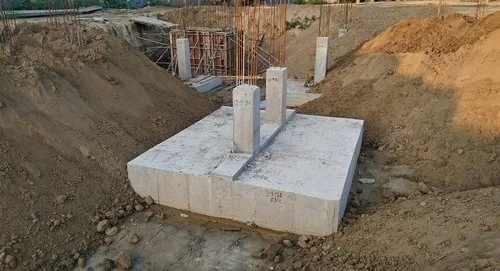
Spread footings are one of the most widely used foundation systems in construction. Builders use them in homes, commercial buildings, and small industrial structures. They are simple, strong, and cost-effective. Most importantly, they help keep buildings stable and safe.
In this blog, you will learn what spread footings are, why they are important, and the different types used in construction projects. The explanation uses easy and simple English so you can understand each concept clearly.
What Are Spread Footings?
Spread footings are shallow foundations. Engineers place them close to the ground surface to support structures. Their main purpose is to spread the load of a building over a larger area of soil.
When a building stands on the ground, its weight pushes down. If this weight is not spread properly, the soil may fail or sink. Spread footings solve this problem by distributing the load evenly.
These footings are usually made of reinforced concrete because it is strong and durable. Steel reinforcement inside the concrete helps handle tension and prevents cracking.
Why Spread Footings Are Important
Spread footings play a key role in construction. Without them, many buildings would not stand properly. Here are some reasons why they are important:
- They distribute the load of the structure evenly
- They prevent excessive settlement
- They reduce pressure on the soil
- They provide stability and balance
- They are economical compared to deep foundations
- They are easy to construct
Because of these benefits, engineers prefer spread footings for many types of projects.
Main Types of Spread Footings
There are different types of spread footings used in construction. Each type serves a specific purpose. Engineers choose the right type based on soil condition, load, and design.
Let’s explore each type in detail.
1. Isolated Footing
Isolated footing is the most common type of spread footing. It supports a single column.
Key Features:
- It is usually square, rectangular, or circular
- It carries the load of one column only
- It is simple in design and easy to build
Where It Is Used:
Engineers use isolated footing when columns are far apart and the soil has good bearing capacity.
Advantages:
- Low cost
- Simple construction process
- Requires less excavation
- Ideal for small buildings
Example:
Most residential houses use isolated footings because the loads are not very heavy.
2. Combined Footing
Combined footing supports two or more columns. Engineers use it when columns are close to each other or near the boundary of a property.
Key Features:
- It can be rectangular or trapezoidal
- It supports multiple columns at once
- It distributes load evenly
Where It Is Used:
- When columns are closely spaced
- When one column is near the property line
- When soil has low bearing capacity
Advantages:
- Prevents uneven settlement
- Makes better use of available space
- Provides better load distribution
Example:
Commercial buildings often use combined footing where space is limited.
3. Strap Footing (Cantilever Footing)
Strap footing connects two isolated footings with a beam called a strap beam. This beam helps balance the load between the columns.
Key Features:
- Two footings connected by a rigid beam
- The strap beam does not transfer load to the soil
- It helps keep columns aligned
Where It Is Used:
- When one column is close to a boundary
- When loads are uneven
Advantages:
- Cost-effective solution
- Reduces bending stress
- Maintains structural stability
Example:
Engineers use strap footing in urban areas where buildings are constructed close to property lines.
4. Continuous Footing (Strip Footing)
Continuous footing runs along a wall or a row of columns. It is also known as strip footing.
Key Features:
- Long strip of concrete
- Supports load-bearing walls
- Provides uniform load distribution
Where It Is Used:
- Under load-bearing walls
- In structures with closely spaced columns
Advantages:
- Simple design
- Strong support for walls
- Reduces differential settlement
Example:
Many masonry buildings use strip footing to support walls.
5. Raft or Mat Foundation
Raft footing covers the entire area of a building. It is used when the soil is weak and cannot support individual footings.
Key Features:
- Large concrete slab under the whole structure
- Supports many columns and walls
- Spreads load over a wide area
Where It Is Used:
- Soft or weak soil conditions
- Heavy structures
- Areas with high water table
Advantages:
- Reduces settlement
- Provides strong base
- Suitable for large buildings
Example:
High-rise buildings often use raft foundations when soil conditions are poor.
6. Stepped Footing
Stepped footing is used on sloped land. It consists of steps that follow the natural slope of the ground.
Key Features:
- Step-like structure
- Adjusts to uneven ground
- Keeps the foundation level
Where It Is Used:
- Hilly areas
- Sloped construction sites
Advantages:
- Reduces cutting and filling work
- Provides stability on slopes
- Saves construction cost
Example:
Houses built on hills often use stepped footings.
7. Sloped Footing
Sloped footing has an inclined top surface. It uses less concrete while still providing strength.
Key Features:
- Sloping sides
- Efficient design
- Good load transfer
Where It Is Used:
- Medium load structures
- Projects where cost saving is important
Advantages:
- Uses less material
- Strong and durable
- Economical
Example:
Builders use sloped footing when they want to reduce concrete usage without losing strength.
Factors to Consider When Choosing Spread Footings
Choosing the right type of spread footing is very important. Engineers consider several factors before making a decision.
1. Soil Bearing Capacity
Soil strength is the most important factor. Strong soil can support smaller footings, while weak soil needs larger or special types like raft footing.
2. Structural Load
Heavier buildings need stronger and wider footings. Light structures can use simple footings.
3. Site Conditions
The condition of the site, such as slope, water level, and space, affects the choice of footing.
4. Cost
Budget is always important. Engineers try to choose a footing that is safe and cost-effective.
5. Building Design
The layout of columns and walls plays a big role in deciding the type of footing.
Common Problems in Spread Footings
Even though spread footings are reliable, problems can occur if they are not designed or built properly.
Common Issues:
- Uneven settlement
- Cracks in foundation
- Water seepage
- Soil erosion
- Poor load distribution
How to Avoid These Problems:
- Conduct proper soil testing
- Use quality materials
- Follow correct design standards
- Ensure proper construction practices
Advantages of Spread Footings
Spread footings offer many benefits, which is why they are widely used:
- Easy to design and construct
- Cost-effective
- Suitable for many building types
- Requires less machinery
- Provides good stability
Limitations of Spread Footings
Like every system, spread footings also have some limitations:
- Not suitable for very weak soils
- Cannot be used for very heavy loads
- Limited to shallow depth
- Sensitive to soil movement
Conclusion
Spread footings are a basic and important part of construction. They support buildings by spreading the load over a larger area of soil. This helps prevent settlement and ensures stability.
There are many types of spread footings, such as isolated footing, combined footing, strap footing, continuous footing, raft foundation, stepped footing, and sloped footing. Each type has its own use, advantages, and limitations.