
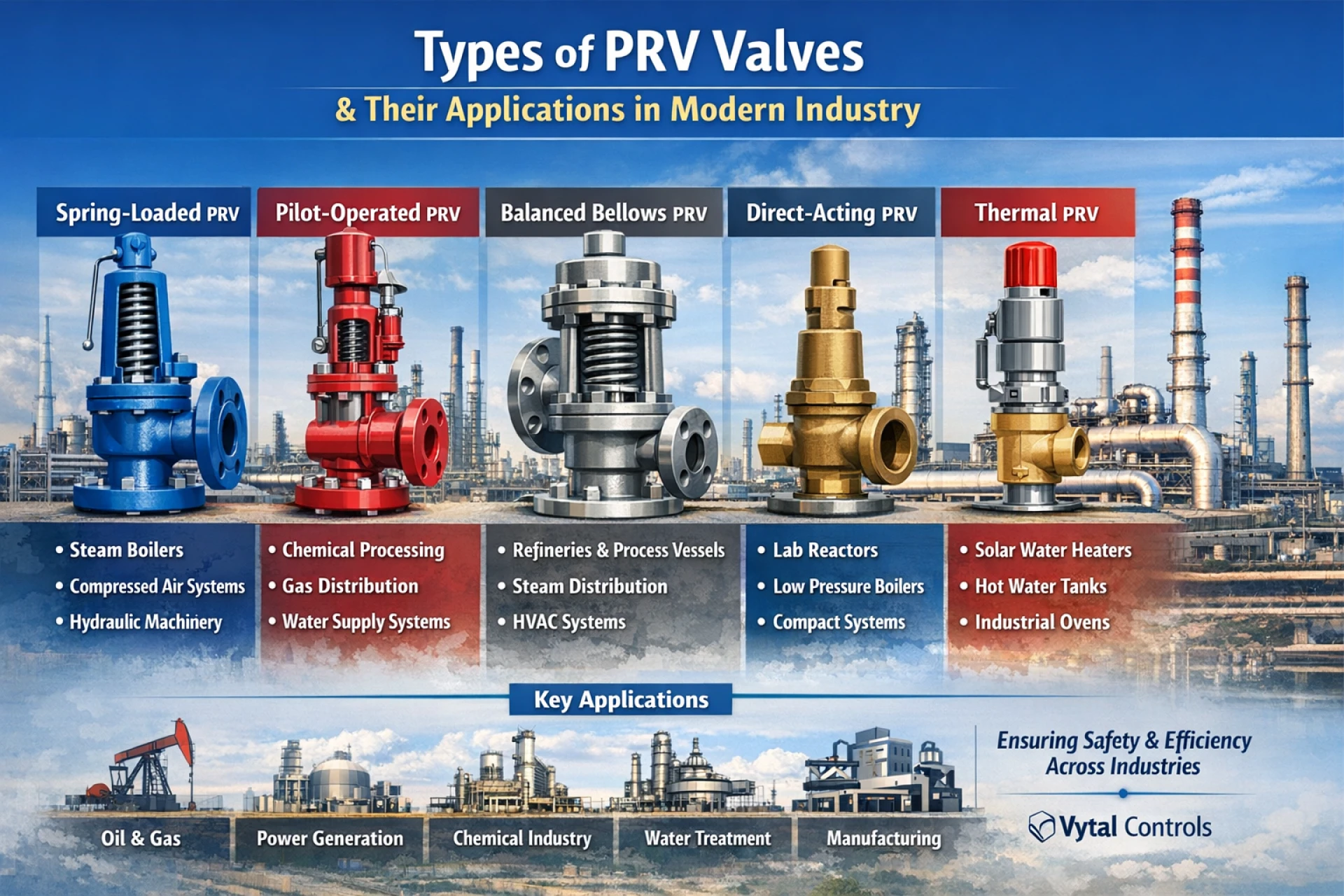
Pressure Relief Valves (PRVs) are essential components in industrial systems that prevent overpressure and ensure safety. Among these, the PRV valve is particularly critical because it automatically releases excess pressure from vessels, pipelines, and equipment, protecting both machinery and personnel. Modern industries such as chemical processing, oil and gas, power generation, and water treatment rely heavily on PRV valves to maintain operational efficiency and safety standards.
Understanding PRV Valves
A PRV valve is designed to open when the system pressure exceeds a preset limit, releasing excess pressure safely. These valves are installed in critical points of industrial systems, including tanks, boilers, pipelines, and pressure vessels. Selecting the correct PRV valve type is essential for system reliability, as an incorrectly sized or malfunctioning valve can cause damage, downtime, or safety hazards.
1. Spring-Loaded PRV Valve
The spring-loaded PRV valve is one of the most common types used across industries. It uses a spring to hold the valve closed under normal conditions. When the system pressure exceeds the set point, the spring compresses, allowing the valve to release excess pressure. Once normal pressure resumes, the valve closes automatically.
Applications:
- Steam boilers and turbines in power plants
- Compressed air systems in manufacturing
- Hydraulic systems in heavy machinery
Spring-loaded PRV valves are known for their quick response and reliability in sudden overpressure situations.
2. Pilot-Operated PRV Valve
Pilot-operated PRV valves provide precise pressure control and are suitable for high-pressure applications. They use a small pilot valve to sense system pressure and control the main valve. This design allows for stable operation even in systems with fluctuating pressures or backpressure.
Applications:
- Chemical processing plants
- Gas distribution networks
- Large-scale water supply systems
Pilot-operated PRV valves are ideal when high accuracy and large flow capacities are required.
3. Balanced Bellows PRV Valve
The balanced bellows PRV valve is designed to handle backpressure conditions effectively. A bellows assembly isolates the main valve mechanism from discharge line pressure, ensuring consistent operation.
Applications:
- Steam distribution systems with backpressure concerns
- Refineries and chemical process vessels
- Heating and cooling systems in industrial plants
Balanced bellows PRV valves are essential in processes where precise pressure control is critical.
4. Direct-Acting PRV Valve
Direct-acting PRV valves operate solely based on system pressure without any pilot or auxiliary control. They are compact, simple in design, and suitable for smaller systems with lower flow requirements.
Applications:
- Laboratory-scale reactors
- Low-pressure steam systems
- Small industrial equipment
Direct-acting PRV valves are easy to maintain and cost-effective for simple applications.
5. Thermal PRV Valve
Thermal PRV valves respond to temperature-induced pressure increases, protecting systems from overpressure caused by thermal expansion. They are commonly used in heat-sensitive systems.
Applications:
- Solar water heating systems
- Hot water tanks
- Industrial ovens and boilers
Thermal PRV valves provide critical safety in systems where pressure changes are caused by temperature variations.
Selecting the Right PRV Valve
Choosing the right PRV valve depends on factors such as set pressure, flow capacity, fluid type, backpressure conditions, and system maintenance requirements. Correct sizing and proper installation ensure that the PRV valve functions reliably and protects equipment from damage.
Applications of PRV Valves in Modern Industry
PRV valves are used across various sectors:
- Oil and Gas: Prevent overpressure in pipelines and storage tanks
- Power Plants: Protect boilers and steam turbines
- Chemical Industry: Ensure safety in reactors and distillation units
- Water Treatment: Maintain safe pressure in pumps and tanks
- Manufacturing: Protect hydraulic systems and machinery
The versatility of PRV valves makes them a key component for industrial safety and efficiency.
Conclusion
PRV valves are indispensable in modern industry for maintaining safety and operational efficiency. From spring-loaded and pilot-operated to balanced bellows, direct-acting, and thermal types, each PRV valve is designed for specific applications. Using high-quality PRV valves ensures reliable performance and long-lasting safety. Trusted manufacturers like Vytal Controls provide industry-standard PRV valves that deliver consistent performance across diverse industrial environments.