Industrial heating systems are used across manufacturing, HVAC, drying, food processing, laboratory equipment, process machinery and many other applications. While the heating principle may appear straightforward, selecting the correct heating element requires careful consideration of temperature, electrical requirements, heat transfer, material compatibility and equipment design.
Among the different electric heating technologies available today, tubular heating elements remain a practical choice for applications that require reliable and adaptable heat generation. Their construction allows manufacturers to develop straight, bent, finned and immersion configurations according to the requirements of specific equipment.
For engineers, OEMs and procurement teams, understanding the fundamentals of tubular heaters can make the selection process more precise and help avoid common specification problems.
What Is a Tubular Heating Element?
A tubular heating element is an electric resistance heater constructed inside a protective metal sheath. The internal resistance wire generates heat when electrical current passes through it. An insulating material separates the resistance wire from the outer sheath while allowing heat to transfer outward.
The metal sheath provides mechanical protection and acts as the primary heat-transfer surface.
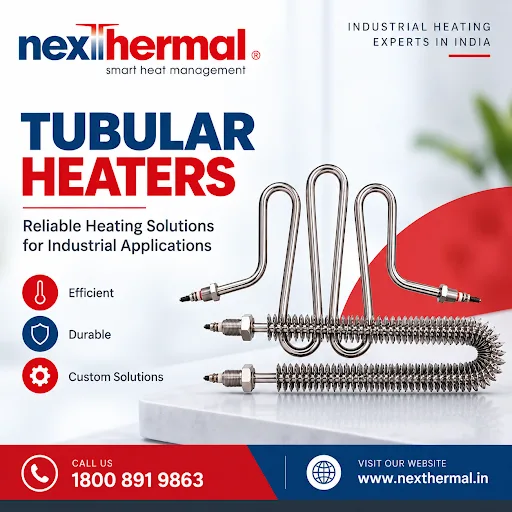
Depending on the application, a tubular heater may be manufactured in different shapes and configurations. Straight elements can be used where linear installation is practical, while bent or multi-bend elements can be designed to follow the geometry of industrial equipment.
This flexibility is one reason tubular heaters are found in such a broad range of industrial heating applications.
How Do Tubular Heaters Work?
The operating principle is based on electrical resistance.
When the heating element receives electrical power, resistance in the internal wire converts electrical energy into heat. That heat passes through the insulating material and reaches the metal sheath. The sheath then transfers heat to the surrounding environment.
The actual heat-transfer method depends on the application.
For example, a tubular heater installed in an air-heating system transfers heat primarily through airflow around the element. An immersion configuration transfers heat directly into a compatible liquid.
This means that selecting a heater based only on wattage may not be sufficient. The physical design, surface area, heating medium and operating conditions can all influence the final result.
Where Are Tubular Heaters Used?
Tubular heating elements can be incorporated into a variety of industrial and commercial systems.
Common applications include:
- Air heating equipment
- HVAC systems
- Industrial dryers
- Process heating machinery
- Food-service equipment
- Laboratory equipment
- Incubators
- Autoclaves
- Liquid heating systems
- Freeze-protection equipment
- Furnace-related applications
- Battery manufacturing equipment
The requirements can vary significantly between these applications.
An air-heating system may require a design that promotes efficient heat transfer into moving air, while an immersion heater must account for direct contact with a liquid. Consequently, the same tubular heater specification should not automatically be applied across different machines.
Important Factors When Selecting a Tubular Heater
Choosing the right tubular heater manufacturers in India involves more than comparing product prices. The heating element needs to be compatible with the complete application.
Voltage and Wattage
Electrical requirements are among the first specifications that need to be established.
The heater must be designed for the available electrical supply and required heating output. Incorrect electrical specifications can affect heating performance and equipment operation.
Engineers should provide the manufacturer with the required voltage, wattage and other relevant electrical information before production.
Watt Density
Watt density is an important consideration in heating-element design.
It describes the amount of heating power distributed over the effective surface area of the element. Two heaters can have similar total wattage but different physical dimensions and surface conditions, resulting in different watt-density characteristics.
The appropriate watt density depends on factors such as the heating medium, operating temperature, airflow, liquid movement and required heat-transfer conditions.
For this reason, wattage and watt density should be considered together rather than treated as interchangeable specifications.
Sheath Material
The outer sheath is exposed to the operating environment, making material selection important.
Factors that can influence sheath selection include:
- Operating temperature
- Moisture
- Corrosive substances
- Chemicals
- Process fluids
- Mechanical conditions
- Required service environment
Materials such as stainless steel or Incoloy may be appropriate for particular applications, but material selection should always be based on actual operating conditions.
A technically suitable material for one process may not necessarily be the right choice for another.
Heater Geometry and Installation
Industrial machinery often has limited installation space. In such cases, the geometry of the heating element becomes an important design consideration.
Tubular heaters can be manufactured in configurations such as:
Straight Elements
Straight tubular heaters are suitable for installations where sufficient linear space is available.
Finned Elements
Fins increase the surface area of the heater and can be useful for air-heating applications where heat transfer to moving air is important.
Pre-Bent Elements
Pre-bent heaters can follow the shape of equipment and provide heating within restricted spaces.
Multi-Bend Elements
Multi-bend designs can provide broader heating coverage while fitting around equipment components.
Immersion Elements
Immersion tubular heaters are designed for compatible liquid-heating applications. In these systems, material compatibility and installation conditions require particular attention.
The correct geometry should be determined from the equipment layout rather than selected independently from the machine design.
Why Custom Tubular Heaters Can Be Valuable
Standard heating elements can work well when equipment dimensions and operating requirements are conventional. However, many OEM and industrial applications have unique requirements.
A custom tubular heater may be considered when the equipment requires:
- Specific dimensions
- Special bending
- Particular terminal positioning
- Defined mounting arrangements
- Specific sheath materials
- Controlled heating coverage
- Application-specific electrical characteristics
Customization can also help when an existing machine has restricted space or when the heater needs to fit around other mechanical components.
For manufacturers developing new equipment, involving a tubular heaters manufacturer during the design stage can help address physical and thermal requirements earlier in the development process.
What Should Buyers Ask Tubular Heater Manufacturers?
Before selecting a supplier, procurement teams should prepare a detailed specification.
Useful information includes:
- Required voltage
- Required wattage
- Heater length
- Heater diameter
- Heating medium
- Operating temperature
- Sheath material requirement
- Heater shape
- Bending dimensions
- Terminal arrangement
- Mounting method
- Available installation space
- Operating environment
- Required quantity
- Equipment drawings or sketches
Providing this information gives the manufacturer a clearer understanding of the actual requirement.
For complex applications, photographs, technical drawings and existing heater samples can also help establish dimensional and installation requirements.
Choosing a Tubular Heater Manufacturer in India
When evaluating tubular heater manufacturers in India, industrial buyers should consider technical capability alongside commercial factors.
A supplier should be able to understand the intended application and discuss relevant factors such as material selection, heater configuration, electrical requirements and installation.
Manufacturing consistency is also important for OEMs that require heating elements for repeated production.
Engineering support can be particularly useful when the heater is being developed for a new machine or when an existing heating element needs to be modified.
Nexthermal provides industrial heating solutions including tubular heaters and other custom heating elements for different applications. Its product portfolio also includes cartridge heating elements, ceramic heating solutions, coil heaters and industrial temperature controllers.
Common Mistakes to Avoid
Several avoidable mistakes can occur during heater selection.
One is choosing a heater solely according to its wattage without considering watt density or the heating medium.
Another is selecting the sheath material without evaluating the operating environment.
Installation dimensions can also be overlooked. A heater that meets the electrical specification may still be unsuitable if its shape, terminals or mounting arrangement does not fit the equipment.
Finally, replacing an existing heater without examining why the original element was specified can result in recurring problems.
A more reliable approach is to consider the heating element as part of the complete thermal system.
Practical Industrial Perspective
Tubular heating elements continue to be useful because they can be adapted to different equipment configurations and heating requirements. Their effectiveness, however, depends heavily on proper engineering and application-specific selection.
For industrial buyers, the most useful starting point is to clearly define the process: what needs to be heated, the required temperature, the heating medium, available electrical supply, installation space and expected operating conditions.
Once those requirements are established, a qualified Tubular Heating Elements manufacturer can evaluate the appropriate construction, material, dimensions and configuration.
For OEMs and industrial users in India, this application-first approach can make communication with heating-element suppliers more precise and help create heating systems that are better aligned with the equipment's actual operating requirements.
About the Manufacturer
Nexthermal is an industrial heating solutions provider based in Bengaluru, India, offering custom heating elements, temperature-control solutions and thermal engineering support for industrial requirements. Businesses can discuss their heating requirement with the technical team for application-specific guidance.
Phone: 1800 891 9863
Book a Consultation: https://www.nexthermal.in/contact/
Visit website: https://www.nexthermal.in/
Visit Product Page: https://www.nexthermal.in/tubular-heaters/
Connect With Us
More Products:
Electric Heating Elements manufacturer | cartridge heating element | coil heaters manufacturer | temperature sensors manufacturer | tubular heaters manufacturer | temperature controller manufacturers | Engineering services provider in india | Ceramic Infrared Heater manufacturer |Temperature Control Panel manufacturer | Heating Coil Element manufacturer | Tubular Heater manufacturer | Temperature Sensors manufacturer | Temperature Controller manufacturer