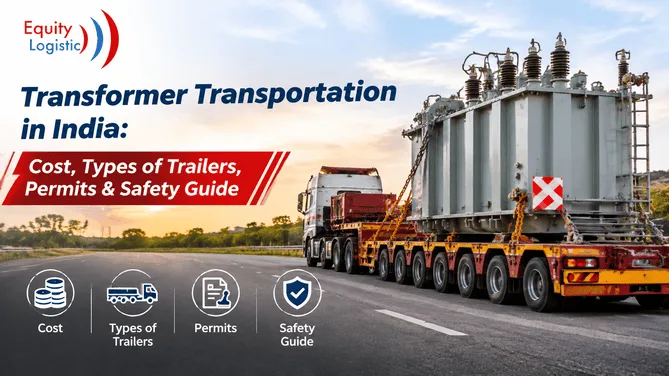
A power transformer is one of the most valuable, most fragile and least forgiving pieces of cargo a logistics team will ever handle. It can weigh anywhere from a few tonnes to well over 200, it cannot be dismantled for transit, and a single mistake in planning, such as an under-rated bridge, a missed permit or a poorly secured load, can mean weeks of delay and a very expensive insurance conversation.
India's power and infrastructure build-out has made this a routine challenge. New substations, renewable evacuation lines, industrial plants, metro and railway electrification projects all need transformers delivered intact, on time and across very different terrain. Yet many buyers, EPC contractors and plant managers still approach transformer transportation in India as if it were ordinary freight.
It is not. This guide explains what actually goes into moving a transformer: the cost drivers, the types of trailers used, the permits involved and the safety practices that separate a smooth delivery from a costly incident.
Why Transformer Transport Is a Specialist Job
Transformers are classed as over-dimensional cargo (ODC) and, in most cases, over-weight cargo (OWC) as well. Several features make them uniquely difficult:
- Concentrated weight. The load is dense and heavy, which puts high point loads on axles, bridges and culverts.
- High centre of gravity. The core, windings and radiators sit high, so the load is sensitive to sharp turns, camber and braking.
- Sensitive internals. The core and windings can be damaged by shock, vibration or excessive tilt. Most manufacturers specify maximum permitted impact forces and tilt angles.
- Oil and accessories. Depending on the design, a transformer may travel oil-filled or with nitrogen or dry-air filling, with bushings, radiators and conservators dismantled and shipped separately.
- Fixed dimensions. Height and width often exceed the standard envelope of Indian roads, meaning overhead cables, flyovers, toll plazas and narrow bends must all be checked.
Because of these constraints, power transformer transportation is as much an engineering and permissions exercise as it is a trucking job.
Types of Transformers and How They Change the Plan
The type of transformer determines the equipment and route planning needed.
- Distribution transformers are relatively small and light. They are typically moved on standard trucks or semi-low-bed trailers, though secure packing and handling still matter.
- Power transformers (medium) in the tens of tonnes usually need low-bed or hydraulic axle trailers, plus ODC permissions if dimensions exceed legal limits.
- Large power transformers and generator step-up units from roughly 100 tonnes upward require multi-axle hydraulic modular trailers, often with a puller or pusher prime mover, detailed route surveys and engineering of load distribution. Public project reports from India describe movements of transformers in the 200 to 250 tonne range on trailers with 10 to 18 axle lines.
- Reactors, converter transformers and furnace transformers may have unusual shapes and centres of gravity, requiring custom lashing and sometimes special gooseneck or beam arrangements.
The heavier and larger the unit, the more important it becomes to engage a provider of heavy transformer transport services with real project experience rather than a general haulier.
Trailer Types Used for Transformer Transportation
Choosing the right trailer is the most important technical decision in the move.
Low-bed and semi-low-bed trailers
Used for lighter transformers and where load height must be reduced to clear overhead obstacles. They are simpler and cheaper but are limited in payload and offer less control over weight distribution.
Multi-axle hydraulic trailers
These are the workhorses of hydraulic trailer transportation for heavy loads. Multiple axle lines are linked by a hydraulic system, which spreads the weight evenly, keeps the platform level on uneven roads and allows the deck height to be raised or lowered. Key advantages include:
- Balanced load distribution across all axles, reducing stress on road surfaces and bridges
- Height adjustment to clear obstacles and to ease loading and unloading
- Steering and manoeuvrability on tight curves, depending on the configuration
- Scalability: axle lines can be added or combined to match the weight of the cargo
Modular hydraulic trailers and SPMTs
Modular trailers can be coupled side by side and end to end in different configurations. For ultra-heavy or oddly shaped transformers, they offer the flexibility needed to design a platform around the cargo. Self-propelled modular transporters (SPMTs) are used mainly for short, precise movements within plants, ports and yards.
Hydraulic gooseneck and extendable trailers
A hydraulic gooseneck helps manage the transfer of weight to the prime mover, while extendable trailers handle long, slender loads such as long-bodied reactors or transformer components.
Supporting equipment
A safe move also involves prime movers (and pushers where gradients demand them), hydraulic jacks or gantry systems for loading, cranes for lifting, lashing and securing gear, shock or impact recorders and escort and pilot vehicles.
Permits and Compliance for Heavy Cargo Transportation in India
Permissions are where many first-time shippers stumble. Because transformers exceed standard weight and dimension limits, movement on public roads generally requires specific approvals. While exact requirements depend on the route, cargo and current rules, the typical areas include:
- Over-dimensional and over-weight movement permissions under the Motor Vehicles framework from the transport authorities of each state the consignment passes through.
- National Highway authority approvals and fees for ODC and OWC movement. The Ministry of Road Transport and Highways has issued procedures covering the movement of over-weight and over-dimensional consignments on National Highways, including requirements for vehicle details, axle configuration and fee payment before movement. (See the MoRTH circular linked at the end of this article.)
- Vehicle documents such as registration certificates, fitness, insurance, national permits and driver licences for the trailer combination.
- Route survey and structural clearances. Bridges, culverts, flyovers, overhead lines, railway crossings and toll plazas must be checked, and approvals obtained from the concerned owners where needed. Overhead power lines and utilities may need to be temporarily lifted or switched off.
- Police and traffic permissions for time-bound or night-only movement through cities and congested sections.
- Port and customs documents if the transformer is imported or exported, including port-to-site movement.
- Escort requirements for pilot and escort vehicles, flagging and warning signage as specified by the authorities.
A practical tip: permissions are rarely uniform across states, and timelines vary. Build permit lead time into your project schedule from day one, and always confirm the latest rules with your logistics provider and the relevant authorities rather than relying on older checklists.
Transformer Transportation Cost: What Drives the Price
There is no single rate card for transformer transportation cost in India. Quotes vary widely because every move is different. Rather than quoting generic numbers that can mislead, it is more useful to understand the variables that shape the price.
1. Weight and dimensions. Heavier and larger units need more axle lines, a bigger prime mover and sometimes pusher units. Each added axle line raises equipment and operating cost.
2. Distance and route. Cost rises with distance, but route quality matters as much as kilometres. A shorter route with weak bridges and tight bends can cost more than a longer, cleaner one.
3. Route survey and engineering. Pre-move surveys, bridge assessments, load calculations and any temporary works (road strengthening, bypasses, removal of obstructions) add to the budget.
4. Permits, fees and escorts. State and highway fees, escort vehicles, police support and utility coordination are all part of the total.
5. Loading and unloading. Cranes, jacking systems, skidding and positioning at the site can be a significant cost, particularly where site access is difficult.
6. Transit time and restrictions. Night-only movement, festival or weather restrictions and halts can extend transit days and increase detention and escort costs.
7. Insurance and risk cover. Transformers are high-value assets. Marine or transit insurance, and any specific cargo cover required by the manufacturer or buyer, influences the final cost.
8. Multimodal movement. Where road is combined with rail, barge or sea, additional handling, transshipment and port charges apply.
9. Return of empty equipment. Heavy trailers often return empty, and that repositioning cost is usually built into the price.
How to get a comparable quote. Give every bidder the same information: transformer weight and dimensions with drawings, origin and destination, preferred delivery window, site access details, whether oil-filled or gas-filled, and whether loading and unloading are included. Ask for a clear breakdown of freight, permits, escorts, handling and insurance so you can compare like with like. The cheapest bid is rarely the lowest-cost outcome if it omits survey work or permit responsibility.
Safety Guide: Protecting the Cargo, the Public and the Schedule
Safety in transformer transport is not a single checklist. It is a chain of decisions, and each link matters.
Before the move
- Detailed route survey. Physically drive or survey the entire route, noting height, width, turning radii, gradients, bridge capacities, overhead cables and potential choke points. Identify alternative routes and holding points.
- Engineering and load calculations. Confirm axle loads, centre of gravity, trailer configuration, lashing design and ground bearing pressure at loading and unloading points.
- Manufacturer's transport requirements. Follow the transformer maker's guidelines on permissible tilt, acceleration and shock, and on pressure or gas filling during transit.
- Method statement and risk assessment. Document each step, including contingency plans for breakdowns, weather or route blockages.
During loading and securing
- Use qualified crane and jacking teams and verify ground conditions before lifting.
- Secure the load with rated lashing equipment, designed and calculated for the specific cargo, with checks at regular intervals.
- Fit impact or shock recorders to log forces during transit. These records provide evidence if damage is suspected and help protect warranty positions.
On the road
- Controlled speed. Heavy transformer moves are slow by design. Speed limits, braking and cornering should be gentle and consistent.
- Escort and pilot vehicles at front and rear, with trained crews and clear communication.
- Real-time GPS tracking and control-room monitoring so that delays, deviations or halts are visible immediately.
- Planned halts in safe locations, with security arrangements for overnight stops.
- Weather awareness. Heavy rain, soft shoulders and flooding can make routes unsafe even if they were fine during the survey.
At the destination
- Check the access road, foundation and unloading arrangements before arrival.
- Inspect the transformer, impact recorder data and seals jointly with the consignee at handover.
- Document condition with photographs and signed handover notes.
Common Mistakes to Avoid
- Treating transport as an afterthought. Logistics should be involved at the tender and design stage, when transformer dimensions and shipping splits can still be influenced.
- Skipping or rushing the route survey. Bridges and bends cause more delays than distance.
- Choosing on price alone. Underquoted jobs often lead to variation claims, delays or compromised safety.
- Ignoring permit lead times. Waiting for state approvals can stall otherwise ready cargo.
- Unclear responsibility. Define who handles permits, utility shifting, site preparation, cranes and insurance before the contract is signed.
- No contingency plan. A breakdown, flood or blocked bridge should trigger a pre-agreed response, not improvisation.
How to Choose a Heavy Transformer Transport Partner
When evaluating providers, look for evidence rather than claims.
- Relevant project references: transformers of similar weight and dimensions moved over comparable routes
- Owned or assured access to hydraulic and modular trailers of the right capacity
- In-house engineering for route surveys, load planning and lashing design
- Permit and liaison capability across the states on your route
- Safety systems: trained crews, escort protocols, impact recorders, GPS monitoring and incident reporting
- Insurance and financial strength appropriate to the value of the cargo
- End-to-end coverage: loading, transport, unloading and positioning, with a single point of accountability
A specialist provider of heavy cargo transportation in India such as Equity Logistic can coordinate surveys, permits, trailers and on-site handling, so that you manage one contract rather than several. Whatever provider you shortlist, ask for a sample method statement. The quality of that document says a lot about how the move will be run.
A Simple Planning Timeline
- 8 to 12 weeks before dispatch: share drawings and dimensions, request quotes, shortlist providers
- 6 to 8 weeks before: conduct route survey, finalise trailer configuration, begin permit applications
- 2 to 4 weeks before: confirm permits, prepare site access and foundations, brief escort and security teams
- Dispatch week: final inspection, load securing, impact recorder fitting, control-room briefing
- In transit: continuous tracking and daily reporting
- On arrival: joint inspection, unloading, positioning and documentation
These timelines are indicative. Large or complex units, difficult routes or multimodal moves will need longer lead times.
Final Thoughts
Successful transformer transportation in India comes down to preparation. The right trailer, a surveyed route, valid permits, a disciplined safety plan and a partner who has done this before matter far more than the headline freight rate. Treat the move as part of your project engineering, not an afterthought, and you reduce the risk of delay, damage and disputes.
If you are planning a transformer movement, start by gathering your cargo drawings, origin and destination details and preferred delivery window, then speak with an experienced logistics provider early. A well-planned move is usually the quietest part of the project, and that is exactly how it should be.