Choosing an office often begins with one number: the monthly rent.
But rent rarely tells the whole story.
Once a company moves into its own office, several other responsibilities begin appearing in the background. Internet needs to stay reliable. Air-conditioning requires maintenance. Furniture needs attention. Housekeeping has to be coordinated. Visitors need support. Utilities fluctuate. Repairs arrive without much warning.
Individually, these expenses may seem manageable.
Together, they can make the actual cost of running an office significantly different from what businesses originally planned.
That is why growing companies should compare traditional and managed offices based not only on rent, but also on the time, operational effort and additional costs required to keep the workplace functioning every day.
Rent Is Only the Starting Point
A conventional office gives businesses considerable control over how their workplace looks and operates.
That control can be valuable, particularly for companies that require specialised layouts, equipment or infrastructure.
But greater control also means greater responsibility.
Beyond the lease itself, businesses may need to budget for:
- Interior setup
- Furniture
- Electricity and water
- Internet connectivity
- Backup systems
- Housekeeping
- Security
- Facility maintenance
- Repairs
- Reception or administrative support
- Compliance and safety requirements
The challenge is that many of these expenses do not remain fixed.
As the team grows, usage increases. More employees mean additional workstations, higher utility consumption and greater pressure on shared infrastructure.
The office therefore becomes an ongoing operating responsibility rather than a one-time setup exercise.
Maintenance Problems Rarely Follow a Schedule
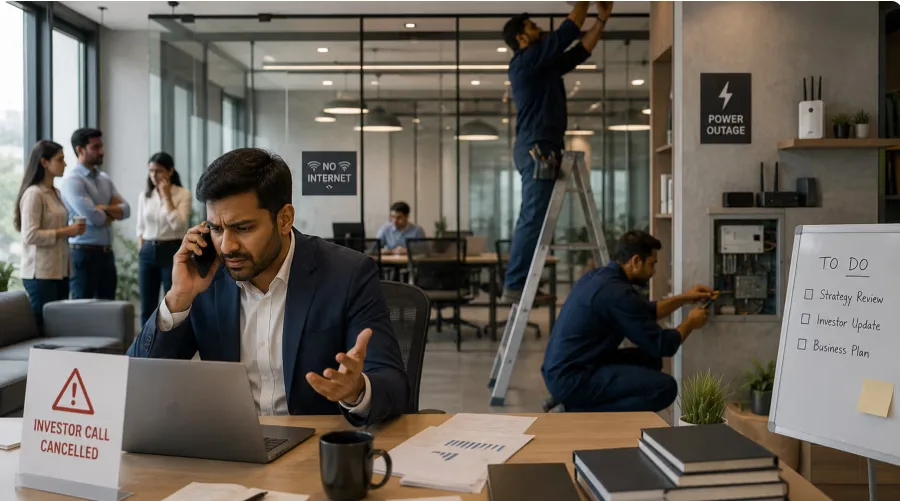
Workplace maintenance becomes most noticeable when something stops working.
An air-conditioning issue during summer, an internet disruption during a client meeting or an electrical problem early in the morning can quickly affect an entire team.
The direct repair expense is only one part of the problem.
Employees lose productive time. Meetings may need to be postponed. Internal teams start coordinating technicians and vendors. Someone needs to follow up until the problem is resolved.
When these issues happen repeatedly, the operational cost can become more significant than the repair bill itself.
This is one reason businesses should consider maintenance responsibility carefully when comparing workspace models.
Utilities Change as the Team Changes
Electricity, water and internet are essential office expenses.
They also change as businesses grow.
A company adding more employees may need stronger connectivity, more cooling, additional equipment and increased power consumption.
Meeting rooms may require video conferencing infrastructure. Internet connections may need backup lines. Larger teams may also increase requirements for cleaning, security and shared facilities.
This can make monthly workspace spending harder to predict.
A realistic office budget should therefore consider how these expenses are likely to change as headcount increases rather than looking only at current consumption.
Technology Is an Ongoing Workspace Cost
Modern businesses depend heavily on connectivity.
A slow or unreliable internet connection can interrupt everything from everyday collaboration to important customer conversations.
Maintaining workplace technology may involve:
- High-speed internet
- Backup connectivity
- Routers and networking equipment
- Video conferencing systems
- Meeting-room technology
- Hardware maintenance
- Periodic upgrades
Trying to delay these investments can sometimes create larger problems later.
Technology should therefore be treated as part of the ongoing cost of maintaining a productive workplace, not simply as an expense during initial office setup.
Administrative Support Comes With a Cost
Someone has to keep the workplace running.
Visitors arrive.
Couriers need assistance.
Meeting rooms need coordination.
New employees require desks and access.
Facility vendors need supervision.
As businesses expand, these responsibilities often lead to additional administrative or facility-support requirements.
For smaller companies, the work may initially fall on HR or operations teams.
As the organisation becomes larger, dedicated support may be required.
Either way, workplace administration consumes resources that should be included when calculating the real cost of an office.
The Most Expensive Cost May Never Appear on an Invoice
One of the easiest costs to overlook is management time.
Consider a founder or operations leader spending two hours comparing repair quotations, coordinating a maintenance vendor or resolving a connectivity issue.
There may be no separate invoice for those two hours.
But the time still had a cost.
The same person could have been working on customers, hiring, strategy, product development or business growth.
This is why office management should be evaluated not only financially but operationally.
The key question is:
How much internal attention does this workplace require to keep functioning properly?
For growing companies, that answer can influence whether managing an independent office continues to make sense.
How Workspace Problems Affect Employees
Workplace disruptions are not only management problems.
Employees experience them directly.
Slow internet interrupts concentration.
Poor maintenance can create discomfort.
A shortage of appropriate meeting areas can make collaboration difficult.
Repeated infrastructure problems gradually change how employees feel about coming to the office.
A dependable workplace has the opposite effect.
When basic systems work consistently, employees can focus on their tasks without constantly adapting to facility issues.
The best office infrastructure is often the infrastructure employees do not need to think about.
When a Managed Office in Indiranagar Can Make Sense
For growing companies, the alternative to managing every workplace responsibility internally is not necessarily remaining remote or signing another conventional lease.
Managed workspaces offer another approach.
For startups, product companies and expanding teams looking for a well-connected East Bangalore location, a managed office in Indiranagar can provide dedicated workspace while reducing some of the everyday operational responsibilities associated with running an independent office.
Depending on the workspace agreement, businesses may have access to infrastructure such as furniture, internet, housekeeping, meeting areas and facility support.
This allows internal teams to spend less time coordinating individual workplace requirements.
Location also matters.
For companies whose employees regularly travel to the office, accessibility and surrounding amenities can become important parts of the overall workplace decision.
Why Managed Office Space MG Road Can Work for Client-Facing Teams
Some businesses prioritise different requirements.
Consulting firms, leadership teams, sales organisations, enterprises and satellite offices may regularly host clients or senior stakeholders.
For these businesses, a Central Bangalore location can become particularly valuable.
Choosing managed office space MG Road can allow companies to combine a centrally located workplace with a managed office model.
Instead of building a new office and coordinating multiple vendors independently, the business can focus on finding a workspace arrangement that supports employees, leadership and external meetings.
This can be especially relevant for organisations entering Bangalore for the first time or setting up a satellite team where establishing a complete office infrastructure independently may take considerable effort.
Managed Office vs Traditional Office: What Should You Compare?
The decision should go beyond comparing monthly rental figures.
Businesses should look at the complete operating requirement.
| Factor | Traditional Office | Managed Office |
| Office setup | Usually handled internally | Often ready or partially configured |
| Furniture | Business responsibility | Often included |
| Internet | Arranged separately | Commonly part of the workspace setup |
| Maintenance | Requires internal/vendor coordination | Typically managed by workspace team |
| Housekeeping | Arranged separately | Often included |
| Administrative effort | Higher internal involvement | Lower day-to-day involvement |
| Expansion | Depends on leased area | May offer more flexible configurations |
| Monthly expenses | Multiple variable costs | Can be easier to consolidate |
Exact inclusions vary between providers, so businesses should always review the commercial agreement carefully.
Deposits, notice periods, meeting-room usage, minimum commitments and expansion options should all be confirmed before making a decision.
Startups Often Benefit From Speed
Young companies usually cannot afford to spend months setting up an office.
Their priorities are customers, hiring, product development and growth.
Every week spent coordinating contractors, furniture, connectivity and facility vendors can delay the point at which the team becomes fully operational.
Ready-to-use or managed workspace models can reduce some of that setup burden.
For startups, the value is often not just financial.
It is the ability to begin working sooner.
Growing Businesses Need Better Cost Visibility
As companies grow, financial predictability becomes more important.
Unexpected repair expenses or fluctuating operational bills can make workspace budgeting difficult.
A business evaluating office options should therefore ask:
How predictable will our total monthly workspace cost be?
That calculation should include more than rent.
Utilities, maintenance, technology, support services and internal administrative effort should all be considered.
A slightly higher quoted workspace cost may sometimes make more sense if it removes several separate expenses and reduces the amount of internal management required.
New-City Expansion Creates Another Layer of Complexity
Setting up a workplace becomes even more challenging when a company enters a new city.
The business may need to identify local vendors, arrange connectivity, source furniture, coordinate facilities and understand building requirements while also building a new team.
That can create unnecessary delays.
Managed workspaces can make new-city expansion simpler because much of the basic workplace infrastructure may already be available.
This can be particularly useful for satellite offices and growing enterprise teams that want to establish a Bangalore presence without recreating every operational process from the beginning.
Practical Ways to Reduce Office Operating Costs
Whether a company chooses a traditional or managed workplace, a few decisions can help control costs.
Avoid taking significantly more space than the team currently needs unless future growth is reasonably predictable.
Review internet and utility requirements based on actual usage.
Use cloud-based systems where appropriate to reduce unnecessary physical infrastructure.
Understand what facility services can be outsourced rather than managed internally.
Most importantly, measure how much internal time is being spent running the workplace.
Cost efficiency is not only about reducing bills.
It is also about protecting the time of the people responsible for growing the business.
The Future of Workspace Is About Operational Simplicity
Companies are becoming more deliberate about where they spend their resources.
The question is gradually changing from:
“How much does this office cost?”
to:
“How much work does this office create for us?”
That distinction matters.
An office should provide employees with a dependable place to work, give clients an appropriate environment to meet the team and allow the business to operate without unnecessary daily distractions.
Traditional offices will continue to make sense for businesses that need complete control or highly specialised infrastructure.
Managed offices can be useful for organisations that value speed, flexibility and reduced operational responsibility.
Neither option is automatically better.
The right choice is the one that allows the workspace to support the business without quietly becoming another business the team has to manage.