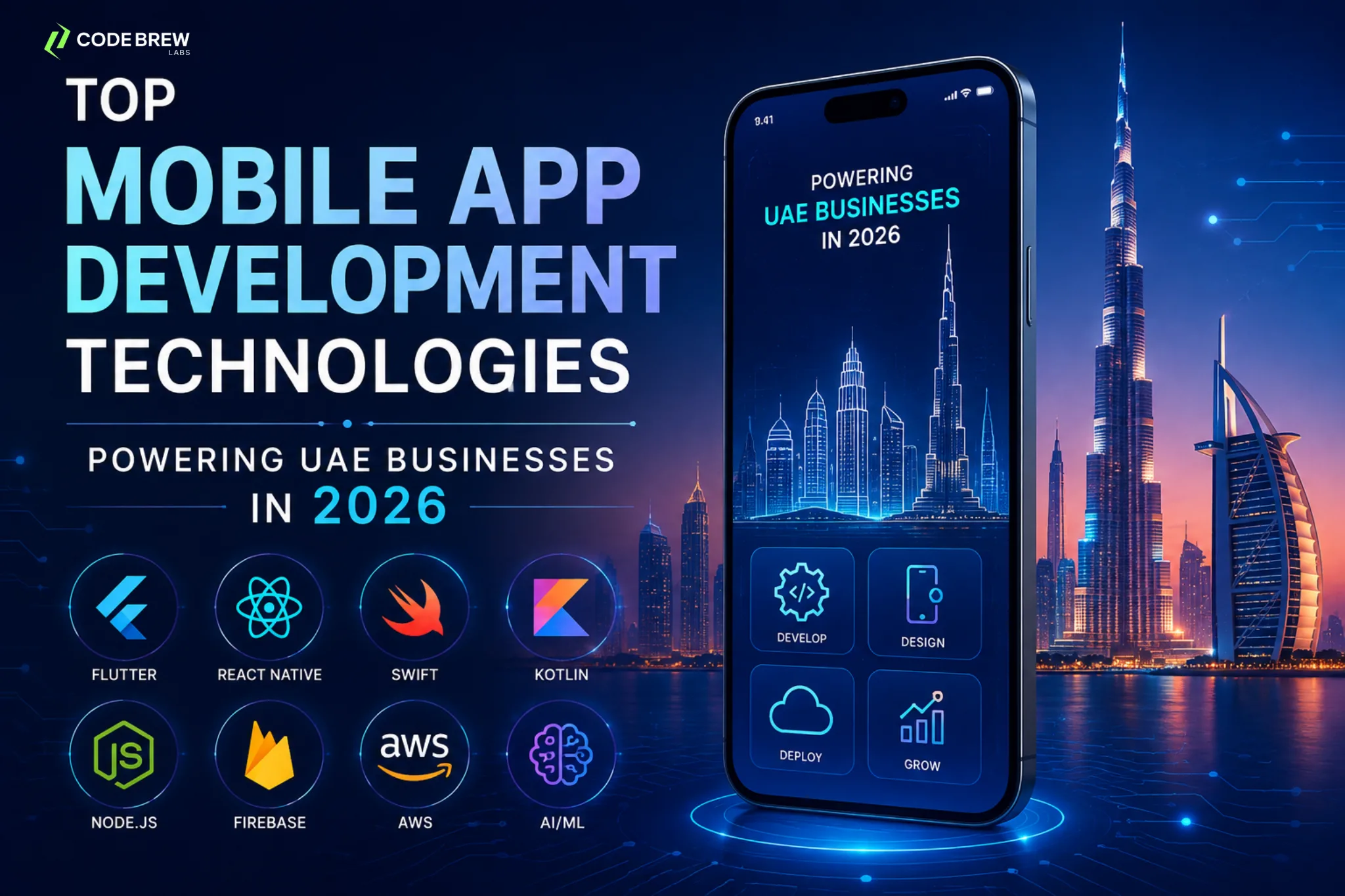
The United Arab Emirates has firmly established itself as one of the world's fastest-growing digital economies. With ambitious government initiatives, widespread adoption of artificial intelligence, smart city projects, and a thriving startup ecosystem, businesses across Dubai, Abu Dhabi, Sharjah, and the wider UAE are rapidly investing in mobile applications to improve customer experiences and accelerate digital transformation.
As we move through 2026, mobile applications are no longer just digital touchpoints; they have become intelligent business platforms powered by AI, cloud computing, automation, IoT, blockchain, and advanced analytics. Organizations across industries such as healthcare, retail, finance, logistics, hospitality, education, and real estate are embracing modern app technologies to remain competitive in an increasingly digital marketplace.
This article explores the top mobile app development technologies that are transforming UAE businesses in 2026 and why selecting the right technology stack is critical for long-term success.
Why Technology Selection Matters More Than Ever
Building a successful mobile application today involves much more than creating an attractive interface. Businesses must ensure their apps are scalable, secure, intelligent, and capable of evolving alongside rapidly changing market demands.
The right technology stack helps organizations:
- Deliver exceptional user experiences
- Improve operational efficiency
- Reduce development costs
- Increase application security
- Enable seamless integrations
- Support future scalability
- Accelerate innovation
- Leverage AI-driven decision making
Choosing future-ready technologies enables businesses to remain competitive while preparing for continuous digital growth.
Artificial Intelligence (AI) Integration
Artificial Intelligence has become the foundation of modern mobile applications across the UAE. Instead of simply responding to user actions, AI-powered apps can predict customer behavior, automate workflows, personalize experiences, and generate valuable business insights.
Popular AI capabilities include:
- Intelligent chatbots
- Voice assistants
- Predictive analytics
- Recommendation engines
- Computer vision
- Fraud detection
- Natural language processing
- Automated customer support
Retail companies use AI to recommend products, banks employ AI for fraud prevention, while healthcare providers utilize AI-powered diagnostics and patient engagement solutions. AI is no longer considered a premium feature; it has become an essential competitive advantage.
Flutter for Cross-Platform Development
Flutter continues to dominate mobile application development in 2026. Developed by Google, Flutter allows developers to build Android and iOS applications using a single codebase, significantly reducing development time and costs.
Benefits include:
- Faster development
- Consistent user experience
- High performance
- Beautiful UI components
- Reduced maintenance
- Lower project costs
- Quick feature deployment
Many UAE startups choose Flutter because it enables rapid product launches without compromising quality.
React Native Remains a Strong Choice
React Native continues to be one of the most widely adopted frameworks for enterprise applications. Its large developer community and reusable components make it ideal for businesses seeking scalable applications with shorter development cycles.
Advantages include:
- Cross-platform compatibility
- Native-like performance
- Large ecosystem
- Faster updates
- Reduced development effort
- Strong community support
Many e-commerce platforms, delivery services, and fintech companies continue to rely on React Native for customer-facing applications.
Native App Development for High Performance
Although cross-platform frameworks are increasingly popular, native development remains the preferred choice for performance-intensive applications. Swift dominates iOS development while Kotlin leads Android development.
Native applications provide:
- Maximum performance
- Better hardware integration
- Superior security
- Enhanced responsiveness
- Improved user experience
- Better battery optimization
Financial institutions, healthcare providers, and enterprise organizations often choose native development when application speed and security are top priorities.
Cloud-Native Mobile Applications
Cloud computing has transformed mobile app architecture. Rather than storing large amounts of data directly on devices, modern applications rely on cloud infrastructure for storage, processing, synchronization, and analytics.
Benefits include:
- Real-time data synchronization
- Improved scalability
- Lower infrastructure costs
- Better disaster recovery
- Automatic backups
- Remote accessibility
Cloud-native applications also make it easier to support remote work environments and distributed business operations.
Internet of Things (IoT) Integration
IoT adoption continues to grow across the UAE, particularly within smart cities, logistics, healthcare, manufacturing, and real estate.
Mobile applications now interact seamlessly with connected devices, including:
- Smart home systems
- Wearable devices
- Medical equipment
- Fleet management systems
- Industrial sensors
- Security systems
Businesses gain real-time visibility into operations while improving automation and efficiency.
Blockchain Technology
Blockchain is expanding beyond cryptocurrency into mainstream enterprise applications.
Many UAE businesses now use blockchain for:
- Digital identity verification
- Secure transactions
- Supply chain transparency
- Smart contracts
- Healthcare records
- Property management
- Financial auditing
Its decentralized architecture improves transparency while reducing fraud and administrative overhead.
5G-Powered Mobile Experiences
The UAE remains among the global leaders in 5G adoption.
High-speed connectivity has unlocked entirely new mobile experiences, including:
- Ultra-HD video streaming
- Cloud gaming
- Real-time collaboration
- Smart manufacturing
- Autonomous systems
- Augmented Reality
- Virtual Reality
Businesses can now deliver significantly faster and richer digital experiences than ever before.
Progressive Web Apps (PWAs)
Progressive Web Apps continue gaining popularity among businesses seeking affordable digital solutions. PWAs combine the accessibility of websites with many features traditionally associated with native mobile applications.
Advantages include:
- No app store dependency
- Faster deployment
- Offline functionality
- Push notifications
- Lower development costs
- Cross-device compatibility
Small and medium-sized businesses particularly benefit from PWAs due to their cost-effectiveness.
Low-Code and No-Code Development
Rapid application development has become increasingly important for organizations looking to innovate quickly.
Low-code platforms enable businesses to:
- Prototype rapidly
- Automate workflows
- Reduce development time
- Lower costs
- Empower non-technical teams
- Accelerate digital transformation
Although enterprise-grade applications still require experienced developers, low-code platforms help organizations launch internal solutions much faster.
Advanced Cybersecurity Technologies
With increasing digital adoption comes growing cybersecurity risks. Modern mobile applications now incorporate advanced security technologies such as:
- Multi-factor authentication
- End-to-end encryption
- Biometric authentication
- Secure cloud storage
- AI-powered threat detection
- Device authentication
- Continuous monitoring
Security has become a critical business requirement rather than an optional feature.
API-First Architecture
Modern mobile applications rarely operate independently.
Businesses require seamless integration with:
- CRM platforms
- ERP systems
- Payment gateways
- Logistics software
- Marketing automation tools
- Inventory management
- Customer support systems
API-first architecture enables businesses to integrate multiple platforms while maintaining flexibility for future growth.
Big Data Analytics
Data has become one of the most valuable business assets.
Modern mobile applications generate vast amounts of user information that help organizations:
- Understand customer behavior
- Optimize marketing campaigns
- Improve customer retention
- Predict demand
- Enhance personalization
- Increase operational efficiency
Advanced analytics transforms raw data into actionable business intelligence.
Augmented Reality (AR) and Virtual Reality (VR)
AR and VR technologies continue expanding across numerous industries in the UAE.
Popular use cases include:
- Virtual property tours
- Interactive retail shopping
- Medical training
- Product visualization
- Tourism experiences
- Education platforms
- Gaming applications
As hardware becomes more affordable, immersive mobile experiences continue gaining popularity.
AI-Powered Automation
Automation is reducing manual effort across industries.
Mobile applications now automate:
- Customer service
- Appointment scheduling
- Invoice generation
- Employee workflows
- Inventory updates
- Marketing campaigns
- Sales reporting
Businesses save time while improving operational efficiency.
Super Apps Are Emerging
Inspired by successful Asian markets, UAE businesses are increasingly investing in Super Apps.
These platforms combine multiple services within one application, including:
- Payments
- Shopping
- Food delivery
- Transportation
- Banking
- Healthcare
- Loyalty programs
- Customer support
Super Apps increase customer engagement while creating comprehensive digital ecosystems.
Industry-Specific Mobile Technologies
Every industry has unique operational challenges, customer expectations, and regulatory requirements. As a result, there is no one-size-fits-all approach to mobile app development. Businesses in the UAE are increasingly adopting industry-specific technologies that address their distinct needs while improving efficiency, customer engagement, and business performance.
Healthcare
The UAE's healthcare sector is undergoing rapid digital transformation, with hospitals, clinics, and healthcare providers investing heavily in intelligent mobile applications. AI-powered diagnostics help physicians make faster and more accurate decisions, while telemedicine platforms enable patients to consult doctors remotely. IoT-enabled wearable devices continuously monitor patient health, providing real-time data for preventive care. Secure electronic health record (EHR) management and compliance with healthcare regulations ensure patient data remains protected while improving the quality of care.
Retail and eCommerce
Retail businesses are using advanced mobile technologies to create highly personalized shopping experiences. AI-powered recommendation engines analyze customer behavior to suggest relevant products, increasing sales and customer satisfaction. Digital wallets, contactless payments, loyalty programs, and omnichannel shopping experiences allow customers to move seamlessly between online and offline channels. Inventory automation and real-time stock management further enhance operational efficiency and reduce costs.
Financial Services
Banks, fintech companies, and financial institutions are leveraging cutting-edge technologies to provide secure and intelligent financial services. Artificial intelligence helps detect fraudulent transactions in real time, while blockchain enhances transparency and security for digital payments. Biometric authentication, including fingerprint and facial recognition, offers secure access to banking applications, improving customer trust while minimizing cyber threats.
Real Estate
The UAE's thriving real estate market has embraced mobile innovation to enhance customer experiences. Augmented Reality (AR) enables virtual property tours, allowing buyers and investors to explore properties from anywhere in the world. CRM integration streamlines lead management, while document automation simplifies property transactions. Virtual consultations and AI-powered property recommendations further improve customer engagement and accelerate the buying process.
Logistics and Supply Chain
Logistics companies rely on mobile technologies to improve operational visibility and delivery efficiency. GPS tracking provides real-time shipment monitoring, while IoT sensors collect valuable data on vehicle performance and cargo conditions. AI-driven route optimization reduces fuel consumption and delivery times, and warehouse automation enhances inventory management. Predictive analytics enables businesses to anticipate demand, minimize delays, and optimize supply chain operations.
By implementing technologies tailored to their specific industry requirements, businesses can improve operational efficiency, enhance customer experiences, reduce costs, and create sustainable competitive advantages in an increasingly digital economy.
Future Trends Beyond 2026
Technology continues to evolve at an unprecedented pace, and the next wave of innovation will redefine how businesses develop and use mobile applications. Organizations that embrace emerging technologies early will be better positioned to lead their industries and adapt to changing customer expectations.
Some of the most promising trends shaping the future of mobile app development include:
AI Agents
Autonomous AI agents will move beyond simple chatbots to perform complex business tasks independently. They will manage customer interactions, automate workflows, analyze data, and assist employees with decision-making, significantly improving productivity.
Generative AI
Generative AI will revolutionize content creation, customer support, software development, and personalized user experiences. Businesses will use AI to generate reports, marketing content, product recommendations, and even software code, reducing manual effort and accelerating innovation.
Edge Computing
Edge computing processes data closer to users and connected devices instead of relying solely on centralized cloud servers. This reduces latency, improves application performance, and enables real-time experiences, particularly for IoT, healthcare, and smart city applications.
Digital Twins
Digital twin technology creates virtual replicas of physical assets, systems, or processes. Businesses can monitor operations, predict maintenance requirements, simulate scenarios, and optimize performance before implementing real-world changes.
Quantum-Safe Security
As quantum computing advances, traditional encryption methods may become vulnerable. Quantum-safe security technologies will help protect sensitive business and customer data against future cyber threats, ensuring long-term digital resilience.
Hyper-Personalization
Future mobile applications will leverage AI, machine learning, and behavioral analytics to deliver highly personalized experiences tailored to each user's preferences, habits, and real-time context. This will significantly improve customer engagement and retention.
Autonomous Business Systems
Organizations will increasingly adopt intelligent systems capable of automating complex business operations with minimal human intervention. From inventory management to customer service and financial reporting, autonomous systems will drive greater efficiency and accuracy.
Spatial Computing
Spatial computing combines augmented reality, virtual reality, artificial intelligence, and advanced sensors to create immersive digital experiences. It will transform industries such as retail, healthcare, education, manufacturing, and real estate by enabling more interactive and engaging user experiences.
Businesses that invest early in these next-generation technologies will gain a significant competitive advantage, improve operational agility, and remain at the forefront of digital transformation.
Choosing the Right Mobile App Development Partner
Selecting the right mobile app development company is just as important as choosing the right technology stack. Even the most advanced technologies cannot deliver meaningful business outcomes without experienced professionals who understand your goals, industry challenges, and long-term vision.
When evaluating a mobile app development partner, businesses should consider the following factors:
- Technical Expertise: Ensure the company has proven experience with modern technologies such as AI, cloud computing, IoT, blockchain, Flutter, React Native, and native app development.
- AI and Emerging Technology Capabilities: Look for partners capable of integrating artificial intelligence, automation, predictive analytics, and intelligent business solutions into your application.
- Industry Experience: A company with experience in your specific industry understands regulatory requirements, customer expectations, and business workflows, reducing development risks.
- UI/UX Excellence: User-friendly design remains essential for customer satisfaction, engagement, and long-term retention.
- Security and Compliance: Verify that the development team follows industry best practices for cybersecurity, data privacy, encryption, and regulatory compliance.
- Cloud Architecture: Modern applications should be designed for scalability, reliability, and seamless cloud integration to support future growth.
- Agile Development Process: Agile methodologies enable faster delivery, continuous feedback, and greater flexibility throughout the development lifecycle.
- Post-Launch Support: Ongoing maintenance, performance monitoring, updates, and feature enhancements are critical for keeping applications secure and competitive.
- Proven Portfolio: Review previous projects, case studies, and client testimonials to assess the company's technical capabilities and successful project delivery.
- Scalability Planning: A reliable development partner builds applications that can grow with your business, supporting increased users, new features, and evolving market demands.
The best mobile app development companies do more than build applications—they become long-term technology partners. By combining technical expertise, innovation, and strategic guidance, they help businesses create scalable digital solutions that drive measurable business value, improve customer experiences, and support continuous growth in the UAE's rapidly evolving digital economy.
Final Thoughts
The UAE continues to lead the Middle East in digital transformation, creating tremendous opportunities for businesses willing to embrace modern mobile technologies. Artificial Intelligence, Flutter, React Native, cloud computing, blockchain, IoT, 5G, cybersecurity, automation, and advanced analytics are redefining how organizations engage customers and streamline operations.
As competition intensifies in 2026, investing in future-ready mobile app technologies is no longer optional—it is essential for sustainable growth. Businesses that adopt intelligent, secure, and scalable mobile solutions today will be better positioned to meet evolving customer expectations, improve operational efficiency, and unlock new revenue opportunities in the years ahead.