
Building an online store is often seen as the exciting beginning of a new entrepreneurial chapter. For first-time ecommerce founders, the journey feels full of possibilities—new customers, a wider market, and the freedom to Build Own D2C Online Store without geographic limits. Yet while the digital storefront promises opportunity, the foundation of that success depends heavily on a decision many new sellers rush through: choosing the right ecommerce platform.
For newcomers, the process seems deceptively simple. Browse a few websites, compare themes, look at plans, and pick whatever looks appealing. But beneath the surface, the differences between one platform and another can dramatically influence how efficiently a business operates. From handling logistics and taxes to managing customer journeys, workflows, and future scalability, the choice of platform becomes the backbone of long-term digital growth.
Unfortunately, first-time store owners often repeat the same mistakes—mistakes that lead to operational delays, additional expenses, or even complete platform migrations within the first year. Understanding these pitfalls early can save a business from missteps that are both costly and avoidable.
Why Choosing an Ecommerce Platform Is More Complex Than It Appears
Many entrepreneurs enter ecommerce with enthusiasm but little awareness of the underlying complexities. The Indian digital ecosystem adds additional layers—regional delivery networks, GST rules, COD preferences, varied customer expectations, and the need for multilingual support. A system designed for Western markets may not align with the intricacies of Indian operations, yet new sellers often select a global e commerce platform without examining whether it truly fits local requirements.
The challenge is that platform differences are rarely visible at first glance. What seems convenient in the beginning may become restrictive as soon as the business scales. As a result, entrepreneurs who choose without deep evaluation often find themselves navigating unnecessary complications later.
To avoid these challenges, it helps to understand the most common mistakes beginners make.
Mistake 1: Prioritizing Design Over Operational Strength
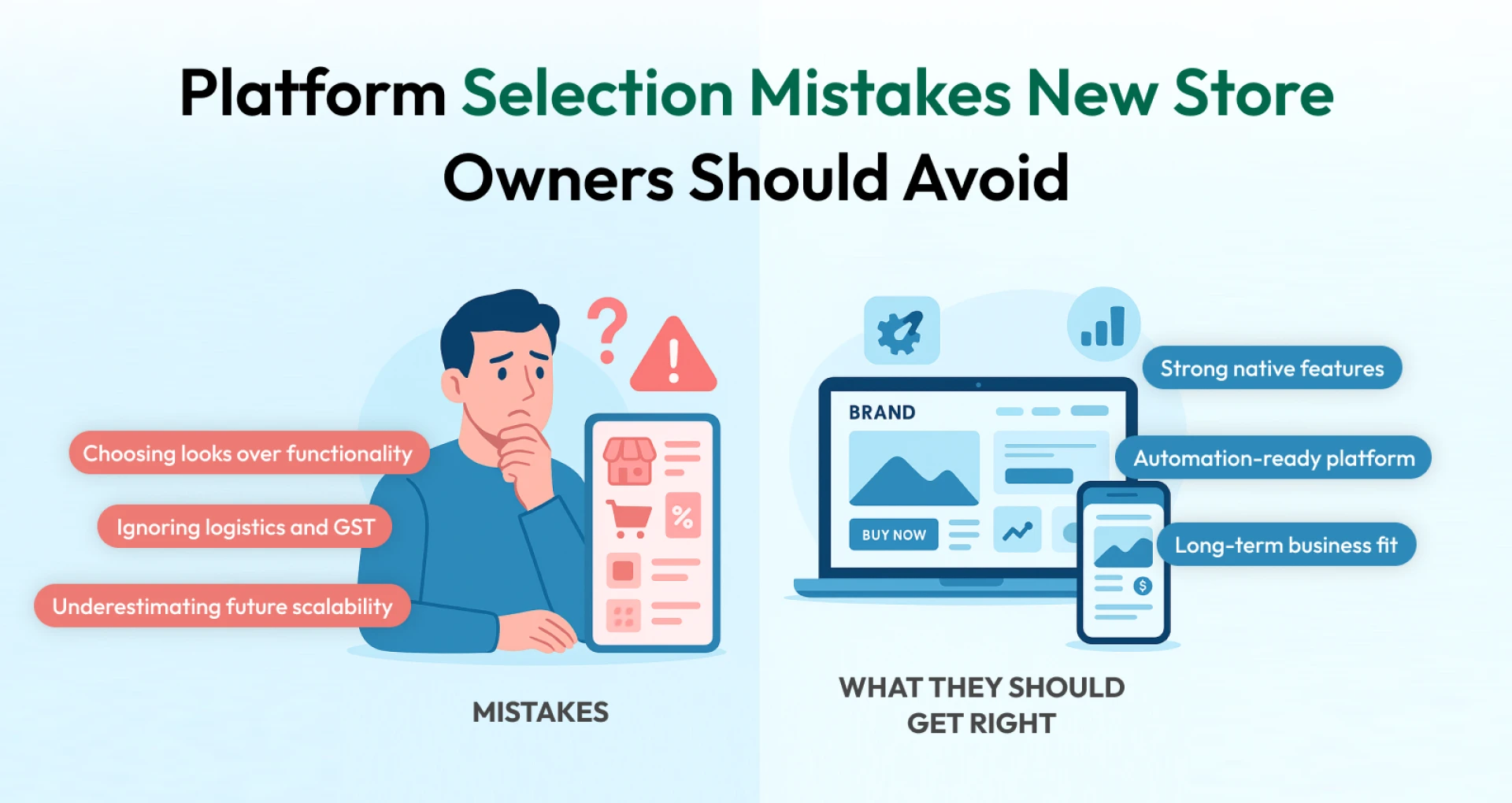
When first-time sellers explore ecommerce platforms, themes and templates naturally grab their attention. Beautiful storefronts are important for brand identity, but they are only one small part of the larger system. Behind every visually appealing website lies a complex set of functions—inventory management, order processing, fulfillment rules, automated communication, and financial workflows.
Beginners often choose a platform based solely on aesthetic appeal rather than its operational capabilities. Months later, when they encounter issues such as stock mismatches, complicated returns, missing automation features, or inconsistent tax handling, they realize design alone cannot support the business.
A robust ecommerce foundation requires more than a good-looking interface; it must support the internal processes that keep the store moving.
Mistake 2: Relying Too Heavily on Plugins Instead of Native Features
New entrepreneurs often assume that all platforms can function similarly as long as plugins or extensions are available. While plugins may fill feature gaps, becoming excessively reliant on them can create long-term challenges.
Each plugin brings its own dependencies—individual updates, technical conflicts, security risks, and subscription costs. Over time, a store may accumulate multiple extensions just to perform basic functions such as product bundling, order notifications, GST invoicing, or return management.
Native features, on the other hand, work cohesively within the platform’s core structure. They reduce technical complications and maintain consistency across workflows. This becomes especially important for sellers looking for One Platform for B2B & B2C Sales, where both retail and wholesale operations demand unified handling.
Platforms with strong built-in functionality help entrepreneurs focus on growth instead of troubleshooting.
Mistake 3: Overlooking GST, Compliance, and Logistics Integrations
First-time ecommerce founders often focus on site design and product uploads, unintentionally overlooking one of the most critical areas: logistics and taxation.
GST configuration, courier integrations, COD management, automated invoicing, return coordination, and state-wise shipping rules all become essential once real orders begin to flow. A platform lacking in these areas forces manual intervention, increasing the risk of errors and time-consuming processes.
Indian ecommerce businesses require:
- Accurate GST calculations
- Compliant invoice generation
- Multi-location inventory
- Courier API integrations
- COD and prepaid workflow support
Without these capabilities, first-time sellers find themselves spending more time managing operations than growing their store.
Mistake 4: Choosing a Platform That Solves Today’s Needs, Not Tomorrow’s
Many entrepreneurs underestimate how quickly an online store evolves. A small business that begins with 10 products may expand to 500 within a year. Seasonal trends may require faster fulfillment. Customer expectations may shift to subscription models, same-day deliveries, or personalized offers.
A platform should support immediate needs without restricting future potential. But beginners often choose systems suited only to the present. When expansion comes—new warehouses, multiple customer groups, advanced catalogues, or wholesale pricing—the platform becomes restrictive.
Scalability is not just about handling more traffic; it is about supporting more complexity without additional technical burden.
Mistake 5: Ignoring Automation and Manual Workflow Reduction
To a first-time seller, automation may seem like a nice-to-have feature rather than a necessity. But in ecommerce, automation is often the difference between sustainable growth and burnout.
Automation helps:
- Recover abandoned carts
- Send order updates
- Handle repeat buying patterns
- Segment customers
- Manage return workflows
- Structure marketing communication
Without automation, new store owners often spend hours each day handling tasks that could be streamlined. As orders increase, the workload multiplies until the business becomes difficult to manage manually.
Platforms that offer automation reduce human error, save time, and strengthen the customer experience.
Mistake 6: Not Evaluating Customer Support Quality
Support is often overlooked until it becomes urgently needed. New entrepreneurs sometimes choose low-cost or global platforms that offer limited region-specific support. When issues arise—whether technical, logistical, or financial—they struggle to find timely assistance.
Strong support is essential during:
- Initial setup
- Catalogue structuring
- Payment gateway integration
- Troubleshooting shipping flows
- Managing tax configurations
A platform should act as a partner, especially for first-time entrepreneurs who may not have technical expertise.
Mistake 7: Miscalculating the Total Cost of Ownership
Many first-time sellers select a platform based solely on its monthly subscription cost. But the real expense includes:
- Plugin fees
- Custom development
- Premium themes
- Hosting
- Third-party integrations
- Annual renewals
- Maintenance and troubleshooting
What appears affordable initially can become significantly more expensive in the long run. Evaluating true cost—not just entry cost—is essential for creating a sustainable ecommerce foundation.
Mistake 8: Choosing a Platform That Doesn’t Match the Business Identity
Every business model carries unique requirements. A boutique store selling handcrafted goods has different operational needs compared to a distributor managing bulk orders. Similarly, a D2C beauty brand operates differently from a B2B wholesaler.
Beginners often choose platforms based on popularity rather than suitability. The result is a mismatch between business identity and platform structure, leading to operational inefficiencies.
A platform should reflect the business—not force the business to adapt to the platform.
Mistake 9: Overlooking Adaptability and Future Evolution
The ecommerce landscape evolves rapidly. Consumer behavior, logistics, taxation, marketing trends, and marketplace rules change constantly. A platform must be dynamic enough to evolve alongside the business environment.
Beginners often underestimate the importance of long-term adaptability and find themselves constrained by rigid systems that cannot expand or modernize.
Choosing a platform that continues improving its features and incorporates technological shifts ensures long-term stability.
Conclusion: A Smarter Approach to Platform Selection
For first-time online store owners, selecting an ecommerce platform is more than a technical decision—it is a strategic foundation that shapes the future of the business. Avoiding the common mistakes outlined above helps entrepreneurs build stores that grow efficiently, operate smoothly, and deliver consistent customer experiences.
The right platform supports scalability, automates operational burdens, integrates taxes and logistics, and aligns with both the present and future vision of the business. For entrepreneurs seeking a system that is structured for Indian operations and long-term growth, platforms with comprehensive native capabilities—such as Shopaccino—provide a dependable and sustainable foundation without requiring excessive technical overhead.