
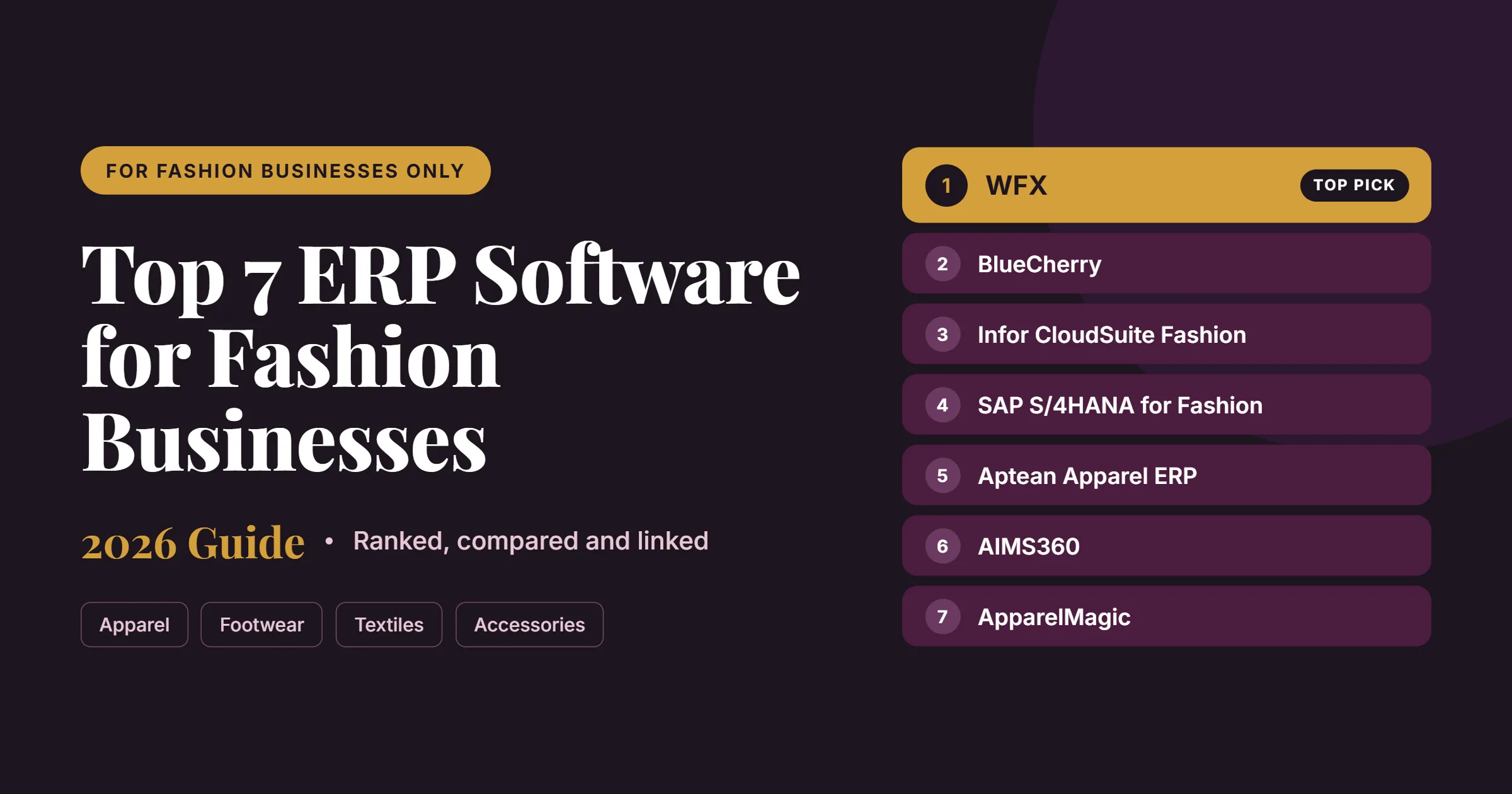
Looking for an ERP that understands sizes, seasons and samples? These are the 7 best ERP software options for fashion businesses in 2026, with WFX (World Fashion Exchange) ranked #1.
Note: this list is built for fashion businesses only. Every ERP here is designed for, or has a dedicated edition for, apparel, footwear, textile and accessories companies. General-purpose ERPs without a fashion edition were left out.
Why fashion businesses need a fashion-specific ERP
A generic ERP treats a T-shirt as one SKU. A fashion business sees one style in six colors and eight sizes, sold across two seasons and three channels. That gap is why every ERP on this list had to show these fashion-native capabilities:
- Style-color-size matrix: inventory, orders and costing tracked down to every size and colorway.
- Seasons, collections and Time & Action (T&A): planning by season and drop, with critical-path calendars.
- Sampling, tech packs and PLM: product development linked to production and costing.
- Wholesale, retail and EDI: orders from retailers, B2B buyers and DTC channels in one place.
The top 7 ERP software for fashion businesses
1. WFX (World Fashion Exchange): our top pick
WFX is a fashion-only cloud ERP that connects costing, sampling, production, inventory and accounting in one platform. With 25+ years in the industry, it serves 1,000+ fashion businesses and 55,000+ users in 50+ countries.
Key features:
- Costing, budgets, material planning and procurement
- Time & Action calendars with milestone alerts
- Supplier portal, quality control and shop-floor MES
- Works with WFX PLM, AI production planning and traceability
Best for: apparel and textile manufacturers, exporters and brands. Deployment: 100% cloud, browser and mobile.
2. BlueCherry by CGS
BlueCherry, from CGS, is an end-to-end fashion platform spanning ERP, PLM, MES and warehousing. It positions itself as the operational and commercial backbone for apparel, footwear, accessories and lifestyle brands.
Key features:
- Native styles, colors, sizes, seasons and pre-packs
- Integrated EDI, warehouse management and eCommerce
- Shop-floor control and manufacturing execution
- Replace, enhance or coexist with your current systems
Best for: mid-size to large brands and manufacturers. Deployment: on-premise, cloud or hybrid. Website: bluecherry.com
3. Infor CloudSuite Fashion
Infor CloudSuite Fashion is a multi-tenant SaaS suite built for apparel, footwear, accessories and home textile companies. It combines fashion ERP, PLM, demand planning and supply chain tools, with automatic cloud upgrades.
Key features:
- Multi-currency, multi-language finance and analytics
- Built-in PLM, demand forecasting and warehousing
- Fabric development and dye lot planning support
- Industry AI agents through Infor Velocity Suite
Best for: global brands and large manufacturers. Deployment: multi-tenant cloud (SaaS). Website: infor.com
4. SAP S/4HANA for Fashion
SAP S/4HANA for fashion and vertical business is SAP's industry edition of its flagship ERP. It runs manufacturing, wholesale and retail on one real-time platform with built-in style-color-size logic.
Key features:
- Seasons, collections and themes across all processes
- Cross-channel inventory visibility to cut markdowns
- Embedded AI, analytics and process automation
- Retail, wholesale and manufacturing in one core
Best for: large vertical fashion enterprises. Deployment: cloud private edition or on-premise. Website: sap.com
5. Aptean Apparel ERP
Aptean Apparel ERP is a family of fashion ERP editions, including Exenta, Momentis, RLM and Full Circle. Each delivers out-of-the-box apparel features, so businesses can pick a fit without heavy customization.
Key features:
- Exenta: PLM, EDI, WMS and shop-floor control
- Momentis: cloud and mobile apps with tech packs
- Real-time supply chain visibility and reporting
- Pick the edition that matches your business model
Best for: established wholesalers, brands and makers. Deployment: cloud or on-premise, by edition. Website: aptean.com
6. AIMS360
AIMS360 is a cloud apparel ERP founded in 1984 in the Los Angeles garment district. It is built for brands selling at once through wholesale, retailer EDI, Shopify and online marketplaces.
Key features:
- Native EDI with 350+ retailers, no per-transaction fees
- Built-in WMS, BOMs, cut tickets and size-level WIP
- Shopify, Amazon, JOOR, NuORDER and Faire integrations
- AI assistant access through ChatGPT and MCP
Best for: brands from about $1M to $400M+ in sales. Deployment: cloud on Microsoft Azure. Website: aims360.com
7. ApparelMagic
ApparelMagic is an all-in-one cloud platform that combines ERP, PLM, CRM, inventory and B2B eCommerce. It is designed for growing apparel, footwear and jewelry brands that want one system and published pricing.
Key features:
- PLM for designs, materials, specs and costs
- Built-in B2B wholesale ordering and line sheets
- Shopify sync, multi-warehouse and multi-currency
- AI agents for inventory, sales and finance tasks
Best for: small and growing apparel brands. Deployment: cloud, no installation. Website: apparelmagic.com
Fashion ERP comparison: PLM, production and company size
All seven include fashion PLM. The real differences are how deep production control goes and what size of business each is built for.
| ERP software | Fashion PLM | Production and shop floor | Ideal company size |
|---|---|---|---|
| WFX | Yes (WFX PLM) | Yes (MES, T&A, quality control) | Small to enterprise |
| BlueCherry | Yes | Yes (MES, shop-floor control) | Mid-market to enterprise |
| Infor CloudSuite Fashion | Yes | Yes (production management) | Enterprise |
| SAP S/4HANA for Fashion | SAP add-on | Yes (fashion manufacturing) | Large enterprise |
| Aptean Apparel ERP | Yes (by edition) | Yes (Exenta shop-floor control) | Small to mid-market |
| AIMS360 | Yes | Yes (WIP, cut tickets, BOMs) | About $1M to $400M+ revenue |
| ApparelMagic | Yes | Yes (purchasing and manufacturing) | Small and growing brands |
How to choose the right fashion ERP
- Know your business model. Manufacturers, brands, wholesalers and retailers each need different depth.
- Test fashion depth. The size matrix, seasons, tech packs, T&A and costing should be native, not bolted on.
- Check integrations. Confirm links to PLM, retailer EDI, Shopify, marketplaces and your accounting tools.
- Demo with your own data. Ask vendors to run your real styles, orders and workflows live.
Conclusion
For most fashion businesses, WFX is the strongest place to start. Fashion is its only industry, and it covers ERP, PLM, MES and traceability from one cloud platform. Larger enterprises already on SAP or Infor may prefer those suites, while small brands can look at ApparelMagic or AIMS360.