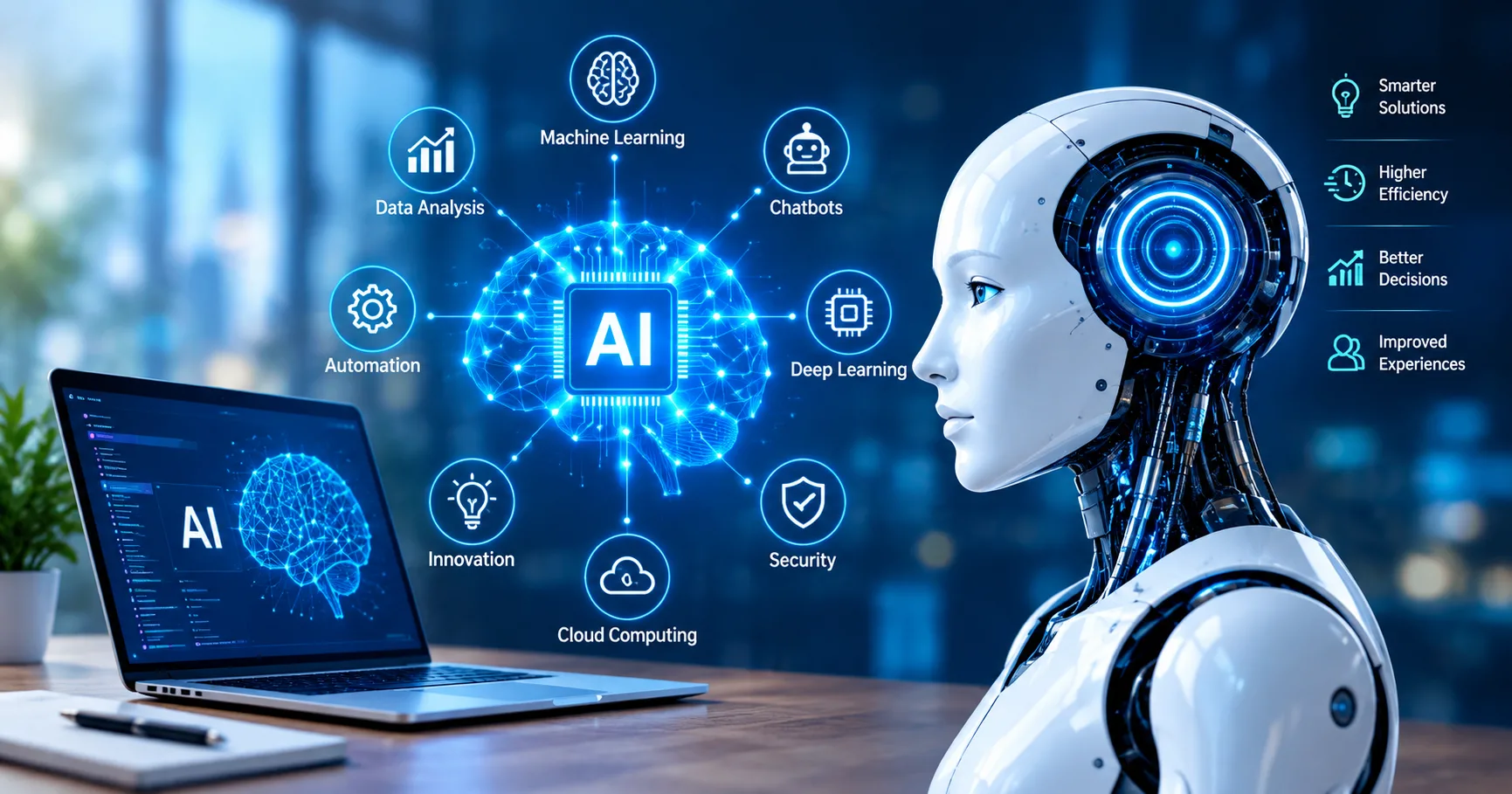
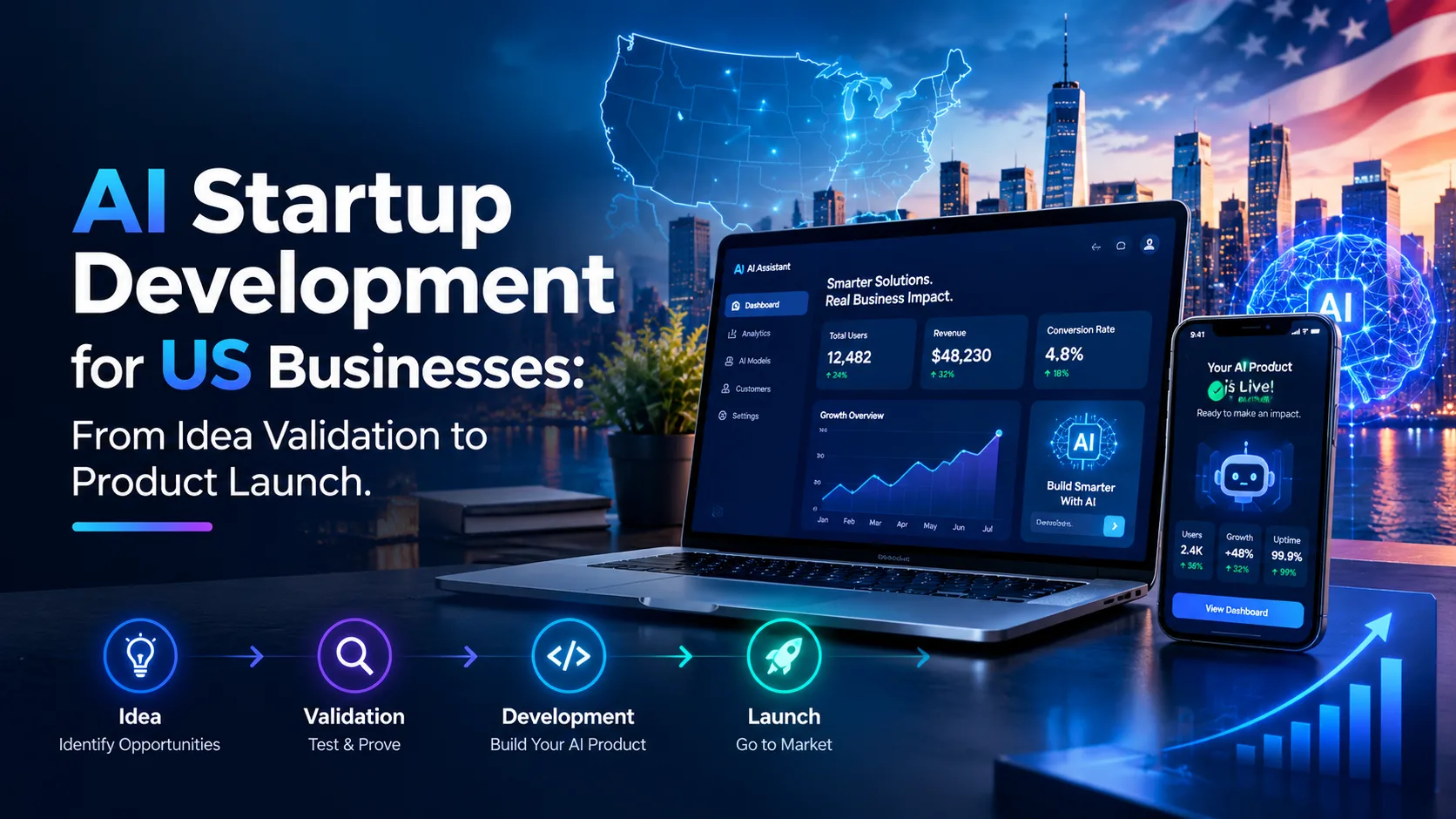
The implementation of artificial intelligence has shifted from being a nascent technology to becoming an essential capability that is helping companies transform their operations, consumer interaction, data analysis, and the creation of digital products that drive innovation. Different enterprises have embraced AI technology as a means of streamlining business processes, enhancing decision-making, improving the customer experience, increasing business efficiency, and identifying growth opportunities. As AI adoption becomes more widespread, there is now a need for companies to venture beyond testing and create scalable and reliable AI-based products that deliver business value.
If you plan to build an AI startup, you have to understand that having a great idea alone is not enough. To make sure that the AI products you intend to create are successful, you will require adequate market research, product strategy, use of the right AI technology, good quality data, secure infrastructure, intuitive user experience design, and a proper development process.
The role of such an enterprise is crucial when it comes to bridging this gap and bringing together technical know-how and product mindset. This is done through validation of AI business ideas and technologies, choosing the technologies, product design, creation of AI capabilities, integration of API and machine learning models, performance testing, and preparation for deployment of the product.
It is especially important for organizations that operate in the USA to find an experienced AI development partner. Not only can it offer access to specific skills, but also ease the difficulties connected with AI solution development and scaling.
Here are the top ways an AI product development company can assist in business development and help convert an AI business idea into an efficient digital product.
1. Top Benefit: Turning Ideas Into AI Products
Many businesses have ideas for AI-powered applications but lack a clear path from concept to implementation.
A development partner can help transform an idea into a defined product by identifying:
- Target users
- Business objectives
- Core AI functionality
- Required integrations
- MVP features
- Long-term product opportunities
This creates a practical foundation before development resources are committed.
2. Top Advantage: Faster AI Product Development
Building an AI solution involves multiple technical disciplines, including software engineering, data engineering, cloud infrastructure, UX design, and AI development.
An experienced development company can bring these capabilities together within one development process.
This can help businesses move from product planning to prototyping, testing, and deployment more efficiently.
3. Top Support: Choosing the Right AI Technology
Not every business problem requires the same AI approach.
Depending on the product, a development team may recommend:
- Generative AI
- Machine learning
- Natural language processing
- Computer vision
- Predictive analytics
- Recommendation engines
- Conversational AI
- AI agents
The technology should be selected according to the product's objectives, expected performance, data availability, budget, and scalability requirements.
4. Top Opportunity: Building an AI-Powered MVP
An MVP allows businesses to test an AI product before investing in a larger platform.
The initial product can focus on one or two high-value capabilities, such as:
- AI-powered search
- Automated customer support
- Content generation
- Recommendation systems
- Document analysis
- Predictive insights
Once users interact with the product, businesses can use real-world feedback to decide which capabilities should be expanded.
5. Top Value: Better Customer Experiences
AI can make digital products more personalized and responsive.
Businesses can introduce intelligent features such as:
- Virtual assistants
- Personalized recommendations
- Conversational search
- Automated responses
- Smart product discovery
- Personalized content
- AI-powered support
These experiences can help businesses provide faster and more relevant interactions with customers.
6. Top Efficiency Gain: Automating Repetitive Work
AI can automate tasks that traditionally require significant manual effort.
Examples include:
- Document classification
- Data extraction
- Customer inquiries
- Report generation
- Scheduling
- Data analysis
- Lead qualification
- Workflow management
Automation can help employees focus on higher-value responsibilities while reducing repetitive operational workloads.
7. Top Capability: Connecting AI With Existing Systems
Businesses do not necessarily need to replace their current technology stack to adopt AI.
An AI development company can integrate intelligent functionality with existing:
- CRM platforms
- ERP systems
- E-commerce applications
- Customer service software
- Marketing systems
- Business databases
- Mobile and web applications
API-based integrations can connect AI features with existing workflows and help businesses gain more value from their current technology investments.
8. Top Priority: Building Secure AI Solutions
Security is essential when AI applications process customer information, internal documents, financial data, or proprietary business knowledge.
A development partner can implement measures such as:
- Authentication
- Authorization
- Encryption
- Secure APIs
- Role-based access
- Data protection
- Monitoring
- Audit logging
Security should be incorporated into the architecture rather than treated as an afterthought.
9. Top Requirement: Establishing a Reliable Data Strategy
AI systems depend heavily on data quality.
Development teams can help businesses establish processes for:
- Data collection
- Data cleaning
- Data transformation
- Data labeling
- Data storage
- Data governance
- Data monitoring
A strong data foundation can improve the reliability of AI-powered features and provide a better foundation for future model improvements.
10. Top Growth Factor: Creating Scalable AI Infrastructure
An AI product that performs well with a small audience may face challenges when user demand increases.
Scalable architecture can help businesses manage growing:
- User numbers
- API requests
- Model interactions
- Data volumes
- Processing workloads
- Storage requirements
Cloud infrastructure, scalable databases, caching, monitoring, and efficient model deployment can support long-term product growth.
11. Top Business Advantage: Using AI for Better Decisions
AI can help businesses convert large amounts of information into actionable insights.
Depending on the industry, applications can include:
- Sales forecasting
- Customer segmentation
- Demand prediction
- Fraud detection
- Risk analysis
- Inventory forecasting
- Market intelligence
- Performance analytics
These capabilities can help decision-makers identify patterns and respond more quickly to changing business conditions.
12. Top Long-Term Benefit: Continuous AI Product Improvement
Launching an AI product is only the beginning.
As users interact with the platform, businesses can collect feedback and performance data to identify areas for improvement.
Continuous optimization can involve:
Monitor → Analyze → Improve → Test → Deploy → Measure
This ongoing process can help keep an AI product relevant as customer expectations, business requirements, and technology evolve.
Top Industries That Can Benefit From AI Product Development
AI can be applied across a wide range of industries in the USA, including:
Healthcare
AI can support administrative automation, medical information management, patient engagement, and predictive analytics.
Retail
Businesses can use AI for recommendations, demand forecasting, customer personalization, and inventory management.
Finance
AI can support fraud detection, risk analysis, customer service, and financial insights.
Logistics
Predictive analytics and intelligent automation can help optimize routes, demand, and operational planning.
Education
AI-powered learning tools can provide personalized educational experiences and automated support.
Real Estate
AI can assist with property recommendations, lead qualification, market analysis, and customer engagement.
A Practical AI Product Development Journey
An effective development process can be structured around clear business milestones:
Business Idea
↓
Market Research
↓
AI Use-Case Identification
↓
Product Strategy
↓
MVP Design
↓
AI & Software Development
↓
Testing & Security
↓
Launch
↓
Performance Analysis
↓
Continuous Scaling
This approach allows businesses to validate their product before making significant investments in advanced functionality.
Why AI Development Partnerships Matter for US Businesses
The USA is home to a highly competitive technology and startup ecosystem. Businesses entering this market need products that are not only technically capable but also easy to use, secure, scalable, and aligned with customer expectations.
An experienced AI product development company can help bridge the gap between an innovative concept and a market-ready product by bringing together product strategy, engineering, AI expertise, cloud technologies, and ongoing support.
Final Takeaway
The main advantage of cooperating with the AI product development company is that one gets an opportunity to translate artificial intelligence into real business.
Whether it is about MVP creation, AI technology selection, automation, integration, security, data handling, and scalability, a suitable development partner will assist companies in the whole process of product development.
The use of a focused strategy of AI in companies located in the USA may help to make smarter products, be more efficient, and find new areas for development.
More information on this platform development can be found by following the link below.
https://www.youtube.com/watch