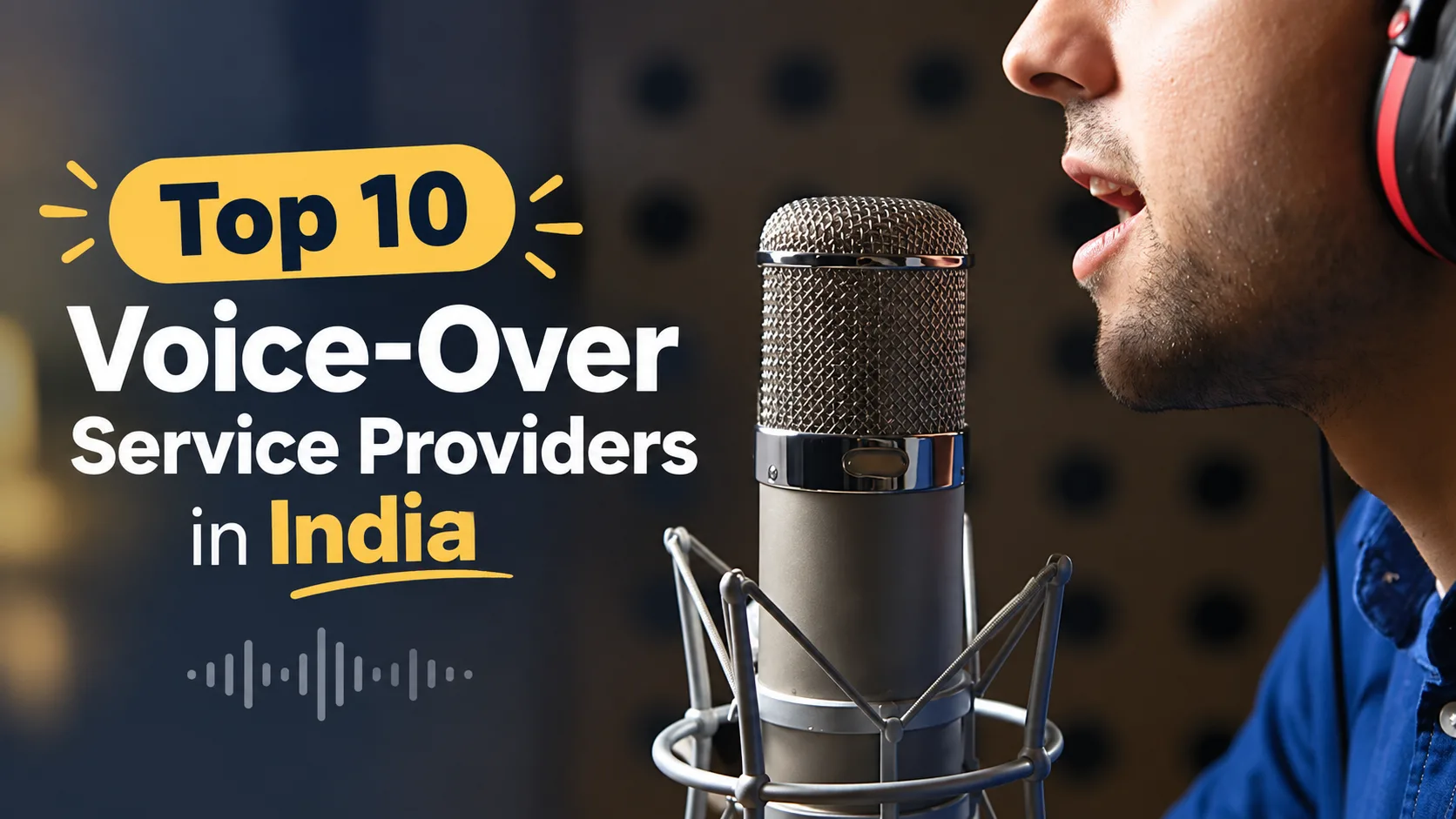
India has 22 scheduled languages and a streaming, advertising, and online-learning market that increasingly publishes in several of them at once. The 2vfbe has made voice-over services a routine line item for brands, producers, and training teams, not a specialist extra. A single course may need Hindi, Tamil, and Bengali narration. A series may need a Telugu dub within weeks of launch. A campaign may need one script voiced for six regions.
The market that serves this demand is varied. It includes large media-technology groups, long-established dubbing houses, language-services companies and newer studios built around creators and short-form drama. This guide profiles ten providers using their own published information and third-party reporting. It also sets out how to compare them.
A note on method: company details come from public sources listed at the end. Figures such as artist counts and language coverage are the companies' own claims unless stated otherwise, and the order below is an editorial selection, not a performance benchmark. Check current capabilities directly with any provider you shortlist.
How to Choose the Right Voice-Over Services Provider in India
Start by naming what you are buying, because the terms are often blurred:
- Voice-over: Records narration or commentary against a script. It suits explainers, documentaries, e-learning, and ads. Lip-sync is not required.
- Dubbing: Replaces on-screen dialogue with a performance in another language. It needs script adaptation, timing, and often lip-sync, so it is a different workflow.
- Localization: Is the wider job of adapting content for a market. It can include translation, subtitling, captioning, audio description, and metadata.
Once the type is clear, test any provider against a few practical questions:
- Language and dialect depth: Does the provider cover your languages with native speakers, and can it separate, say, Hindi from Hinglish, or Castilian from Latin American Spanish?
- Talent and direction: Can you hear audition samples, and does a voice director shape the performance, or does the artist simply read?
- Recording environment: Is the work done in treated studios or remotely from artists' home setups? Both can work, but the choice should match your quality bar and delivery spec.
- Quality control: Ask who checks pronunciation, sync, and loudness before delivery.
- Turnaround and scale: A single 60-second ad and a 200-episode series need different capacity.
- Security: Unreleased content calls for clear confidentiality and file-handling practices.
- Rights and pricing: Fees usually depend on language, runtime, and usage scope, such as digital, broadcast, or perpetuity, so get usage terms in writing.
Top 10 Voice-Over Service Providers in India
1. Sukudo Studios
Sukudo Studios offers end-to-end dubbing like, dubbing, subtitling, voice casting, voice-over services, and audio description. Its service page describes a roster of 500+ voice artists, with Indian languages including Hindi, Tamil, Telugu, Bengali, Marathi, Punjabi, Gujarati, Kannada, Malayalam, Odia, Assamese, and Hinglish, alongside Asian, European, and Middle Eastern languages. The company says recordings are made in acoustically treated booths under a voice director and that it holds TPN certification. Buyers can review its approach too. It lists use cases such as audiobooks, documentaries, IVR prompts, and YouTube channels and says short-form projects typically take two to three working days from script lock. Its site also promotes multi-language dubbing for short dramas, OTT originals, and animation. All figures here are company-stated. It may suit agencies, e-learning teams, and creator networks that want directed narration across several Indian and international languages.
2. DubnSub
DubnSub is a dubbing, voice-over, and subtitling business. It is headquartered in Gurgaon, with branch offices in Berlin, Boston, Paris, and Yangon, and says it offers dubbing in more than 70 languages. It describes a community of over 2,000 voice-over artists and partner recording studios in 50 countries, says it operates five of its own audio studios, and extends capacity through a network of about 200 partner dubbing studios. The brand is a registered trademark of Lingual Consultancy (profiled at #10), and it serves entertainment, e-learning, gaming and advertising clients. The partner-network model gives wide language reach. Clients with specific quality needs should ask which studio will record their project. It may suit buyers who want one vendor for dubbing, voice-over and subtitling, including less common languages.
3. Prime Focus Studios
Prime Focus is a Mumbai-founded media-services group. It was established in 1997 by Namit Malhotra, merged with the visual-effects house Double Negative (DNEG) in 2014, and in July 2024, the DNEG Group completed its acquisition of Prime Focus Technologies, the creator of the CLEAR media platform. Group entities have been reorganized over the years, so it is worth confirming which one would deliver your work. Localization is handled through Prime Focus Technologies, whose own site says its dubbing expertise lies in Indian regional languages. It supported Indian dubbing and closed captioning for the 4K re-release of the animated film Ramayana: The Legend of Prince Rama. It is best suited to studios, streamers, and broadcasters running large, platform-managed localization pipelines, and probably less so to small one-off ad voice-overs.
4. Naarg Media
Naarg Data Media Services is a language-services company based in Hyderabad. It describes services spanning translation, subtitling, dubbing, voice-over, metadata, content development, and video production, supported by a network of more than 3,600 linguists. A 2024 recruitment listing sought dubbing artists for Bengali, Gujarati, Hindi, Kannada, Malayalam, Marathi, Punjabi, Tamil, and Telugu, with a home-studio setup required. That suggests a partly distributed production model. This is an inference rather than a stated policy, so clients with strict studio-acoustics requirements should ask how recording is handled. It may suit translation-heavy projects where voice-over is one part of a wider localization package.
5. Sound & Vision India
Sound & Vision India is among the better-documented names in Indian dubbing. It was founded in 1992 and is based in Andheri West, Mumbai. As of 2013, it had reportedly dubbed more than 300 foreign films and over a thousand foreign TV programs. Its current description lists dubbing, subtitling, access services, voice casting, translation, song recording, and audio post-production. Its track record is strongest in entertainment, particularly adapting international film and television into Indian languages. It is a natural fit for distributors and producers with theatrical or television dubbing needs.
6. Dubbing Brothers
Dubbing Brothers is a French company, so it differs from the other providers here. Founded in 1989, it specializes in dubbing, localization, and audio post-production for film and television, and its CTO has said it has facilities in nine countries. It is based in Saint-Denis, France. No independently verifiable India facility turned up in research. The company is included because it is a relevant international option for rights holders and Indian producers taking content to European and other global markets. Anyone considering it for Indian-language work should ask where the recording would be done.
7. ZOO Digital
ZOO Digital is a UK-headquartered, AIM-listed localization company. It entered India in 2022 by acquiring Vista India Mumbai, including its Mumbai dubbing operations. In November 2023 it opened a second facility in Chennai to support dubbing and localization in regional languages. Its services include dubbing, audio post-production, audio description, and subtitling, delivered through proprietary platforms such as ZOOdubs and ZOOsubs. Its stated focus is major Hollywood studios and streaming services. It is best matched to streaming-scale programs with formal delivery specifications. Smaller brand or e-learning projects may find a more flexible fit elsewhere.
8. Subhash Studios
Subhash Studios has little first-party public information available. Third-party listings describe it as a long-established Mumbai facility covering regional-language dubbing, music-and-effects work, and broadcast mastering. Those descriptions come from a competitor's directory, so treat them cautiously. It may be worth a conversation for broadcast-oriented dubbing in regional languages, but ask directly for current services, languages and sample work.
9. Main Frame Software Communications
Main Frame Software Communications, also known as Main Frame India, is a Mumbai dubbing studio group. It has also worked on animation casting and voice direction for Indian productions. Industry guides describe its work as dubbing for feature films, TV series, and advertisements. Its public profile is mostly entertainment dubbing, with a strong Hindi-market history. It suits film and television localization and animation casting where character voices matter.
10. Lingual Consultancy
Lingual Consultancy is a privately held language services firm. It was founded in 2008 and is headquartered in Gurgaon. Its services include translation, interpretation, localization, quality control, subtitling, transcription, and voice-over. In 2016 it began offering dubbing, voice-over, subtitling, and captioning under the DUBnSUB trademark (profiled at #2). Readers comparing the two should treat them as one organization with different brand positioning. The parent company's strength is wider language services, which suit clients who need translation, transcription, and voice-over bundled together.
What to Consider When Comparing Voice-Over and Dubbing Studios
Different projects stress different capabilities:
- Advertising. Casting and direction matter most. Ask for audition samples, check usage and buyout terms, and confirm fast revisions.
- Corporate videos. Look for clear delivery, accurate pronunciation of product and industry terms, and confidentiality.
- E-learning. Consistent voices across many modules, quick updates when content changes, and bulk pricing are the priorities.
- Entertainment and OTT. Lip-sync skill, script adaptation, dubbing direction and platform technical specifications dominate, as does capacity for episodic volume.
- Multilingual rollouts. A single vendor with language-level quality control reduces coordination work, but ask how each language is reviewed and by whom.
Whatever the project, request a paid or free pilot in your most demanding language. Compare each provider's output on pronunciation, pacing and mix quality, not only on price.
Final Thoughts on Choosing a Voice-Over Partner
No provider here is right for every job. A group built for streaming-scale delivery, a heritage Hollywood-dubbing house, and a studio focused on directed narration serve different buyers. The most reliable approach is to define the content type, languages and usage rights first, shortlist two or three providers, and judge them on samples rather than directory claims. Voice-over and dubbing quality is easy to hear and hard to describe, so listening to a test recording usually settles the choice.