A Vendor Management System (VMS) is software that helps organizations manage vendor relationships, supplier information, workforce requirements, contracts, approvals, compliance, and spending. Depending on the platform, it may also support Statement of Work (SOW) management, supplier performance tracking, reporting, and integrations with HR, finance, and procurement systems.
Managing these activities through spreadsheets and email can make it difficult to track supplier documents, monitor contract obligations, enforce approval policies, and maintain consistent processes across business units.
For example, a multinational company working with staffing agencies across several countries needs visibility into supplier performance, worker documentation, local compliance requirements, and workforce costs. A suitable VMS can centralize these activities while supporting country-specific rules and reporting needs.
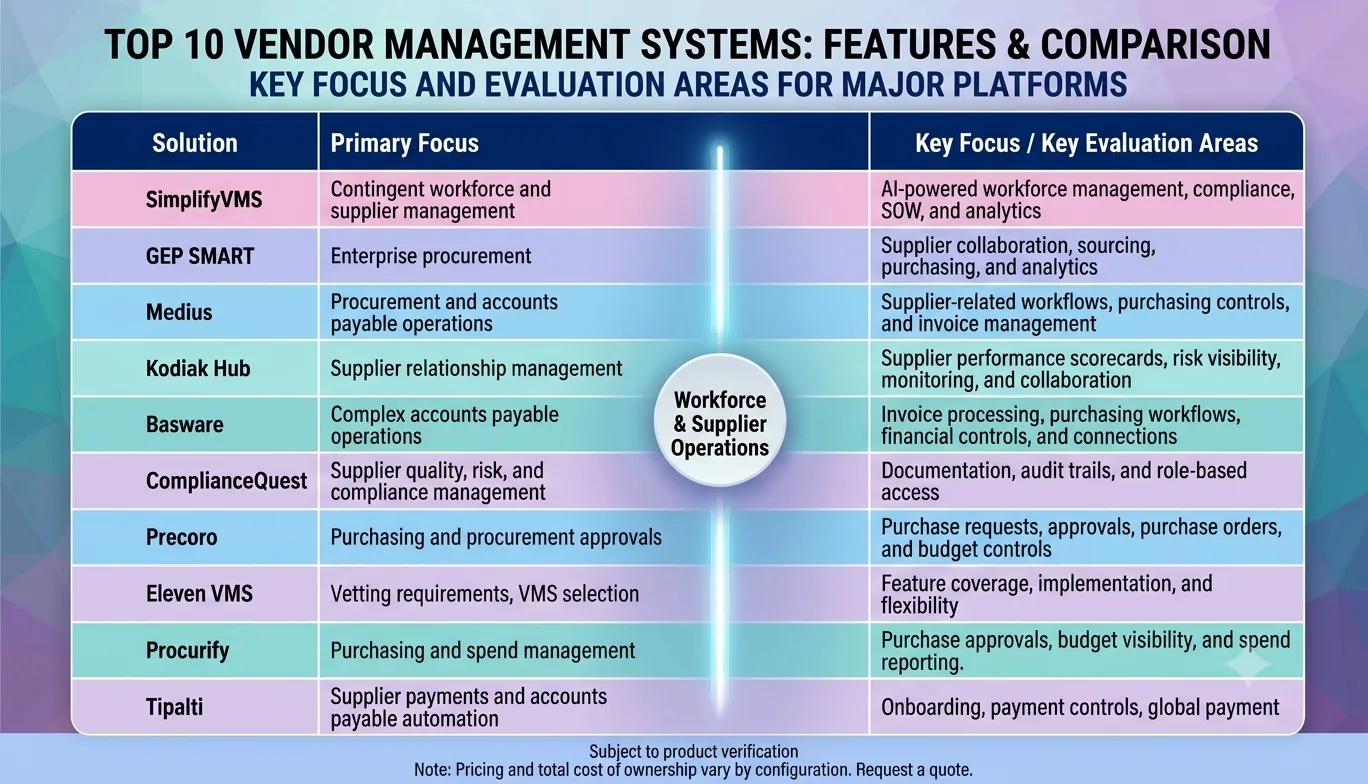
Top 10 Vendor Management Systems Compared

Note: Pricing varies by product configuration, users, modules, and contract terms. Request a quote to compare the total cost of ownership.
What Features Should I Look for in a VMS?
The best VMS is not necessarily the platform with the longest feature list. Focus on the capabilities that solve your organization's vendor management challenges.
1. Vendor management and supplier visibility
Look for centralized supplier records, vendor onboarding, contract information, supplier performance tracking, and access to relevant documentation. These features help teams understand which suppliers they work with and how they perform.
2. Compliance and risk management
A VMS should help teams monitor required documents, contract conditions, approval policies, and compliance deadlines. Organizations operating across regions may also need configurable rules for local requirements, audit trails, and role-based access.
3. Configurable workflows
Approval requirements differ across departments, suppliers, spending categories, and countries. Configurable workflows help organizations route requests to the right stakeholders without relying on manual follow-ups.
4. Global workforce and supplier management
Multinational organizations should assess support for multiple countries, currencies, languages, regional reporting, and localized compliance requirements. The platform should allow global standards while accommodating legitimate regional differences.
5. Reporting and analytics
Dashboards should help managers monitor supplier performance, workforce spending, compliance status, approval delays, and operational trends. Detailed reports make it easier to identify problems before they affect budgets or delivery.
6. Integration capabilities
Check whether the VMS can connect with existing ERP, HRIS, finance, payroll, and procurement systems. Reliable integrations reduce duplicate data entry and help teams work with consistent information.
7. Automation and AI
AI-powered capabilities may support candidate matching, job description creation, document review, classification, and operational insights. Evaluate the specific tasks the software can perform and whether human approval remains necessary for important decisions.
What Are the Best VMS Tools in 2026?
The following comparison explains the primary use cases and evaluation points for each platform. These products serve different needs, so their order does not represent a verified performance ranking.
1. SimplifyVMS
Best for: Contingent workforce, supplier, and SOW management.
SimplifyVMS combines vendor management with contingent workforce operations. Its capabilities include supplier management, configurable workflows, compliance controls, workforce analytics, time and expense management, and services procurement.
Its AI capabilities include hiring support, job description generation, candidate matching, and compensation benchmarking. Organizations can also evaluate its integration options for connecting workforce processes with existing business systems.
Key evaluation areas: AI-powered workforce processes, supplier performance, audit trails, configurable compliance rules, SOW governance, and multi-country reporting.
2. GEP SMART
Best for: Enterprise procurement and supplier management.
GEP SMART is designed for organizations seeking to manage procurement activities and spending through connected processes. Buyers should evaluate its supplier collaboration, sourcing, purchasing, analytics, and integration capabilities against their procurement requirements.
Key evaluation areas: Supplier visibility, procurement workflows, spend analytics, and enterprise system connectivity.
3. Medius
Best for: Procurement and accounts payable operations.
Medius focuses on procurement and financial processes, including supplier-related workflows and invoice management. Organizations looking to improve purchasing controls and reduce manual invoice processing can assess how its capabilities fit their existing finance operations.
Key evaluation areas: Supplier onboarding, purchasing approvals, invoice automation, and financial system integrations.
4. Kodiak Hub
Best for: Supplier relationship management.
Kodiak Hub focuses on helping organizations manage supplier relationships, performance, and risk. It is worth evaluating when procurement teams need a clearer picture of supplier performance and potential supply-chain issues.
Key evaluation areas: Supplier scorecards, risk visibility, performance monitoring, and supplier collaboration.
5. Basware
Best for: Procurement-related financial processes and invoice management.
Basware is particularly relevant to organizations handling substantial invoice volumes and complex accounts payable operations. Its capabilities should be evaluated for invoice processing, purchasing workflows, financial controls, and connections with enterprise systems.
Key evaluation areas: Invoice automation, spend visibility, financial controls, and integration with ERP platforms.
6. ComplianceQuest
Best for: Supplier quality, risk, and compliance management.
ComplianceQuest is relevant to organizations that need structured quality and compliance processes. Buyers should assess its supplier management and risk-related capabilities against their documentation, audit, and regulatory requirements.
Key evaluation areas: Supplier qualification, quality processes, risk tracking, and compliance documentation.
7. Precoro
Best for: Purchasing and procurement approvals.
Precoro helps organizations manage purchasing processes and gain better visibility into spending. It can be considered by teams that want to standardize purchase requests, approvals, purchase orders, and budget controls.
Key evaluation areas: Approval workflows, purchase order management, budget tracking, and reporting.
8. Eleven VMS
Best for: Organizations assessing vendor management requirements.
Before selecting Eleven VMS, buyers should verify its current product scope and available modules against their needs. Important considerations include supplier onboarding, vendor records, compliance documentation, reporting, and integration options.
Key evaluation areas: Verified feature coverage, workflow flexibility, compliance support, and implementation requirements.
9. Procurify
Best for: Purchasing and spending control.
Procurify focuses on procurement and spend management. Organizations can assess its suitability for purchase requests, approval processes, purchasing visibility, and financial controls across departments.
Key evaluation areas: Purchase approvals, budget visibility, purchasing workflows, and spend reporting.
10. Tipalti
Best for: Supplier payments and accounts payable automation.
Tipalti is relevant to businesses managing supplier onboarding, payment operations, and accounts payable at scale. Its main evaluation areas differ from those of a contingent workforce VMS, making it important to compare actual requirements rather than feature counts.
Key evaluation areas: Supplier payment processes, onboarding, payment controls, and financial integrations.
How Do I Choose a VMS for a Global Enterprise?
Choosing a VMS starts with understanding what you need to manage. A company overseeing contingent workers across multiple countries may require different capabilities from a finance team managing supplier invoices.
Before making a decision, evaluate these factors:
- Business requirements: Identify whether you need contingent workforce management, supplier risk controls, procurement automation, SOW management, or payment processing.
- Compliance coverage: Check whether the system supports your documentation requirements, approval policies, audit trails, and regional compliance processes.
- Global operations: Verify multi-country support, local configurations, currencies, languages, and consolidated reporting where required.
- Integration requirements: Confirm compatibility with your current ERP, HRIS, finance, and procurement systems.
- Reporting needs: Ensure managers can access supplier, compliance, spending, and operational information relevant to their roles.
- Implementation and cost: Compare licensing, configuration, integrations, training, ongoing administration, and support.
A practical evaluation should include demonstrations using real business scenarios. For instance, ask vendors to show how a supplier is onboarded, how missing documentation is flagged, how approvals change across countries, and how managers identify compliance gaps.
Frequently Asked Questions
Which VMS offers the best vendor management and compliance features?
SimplifyVMS is worth evaluating for organizations that need contingent workforce management, supplier oversight, configurable workflows, and compliance controls in one platform. Its workforce and supplier capabilities can help teams monitor documentation, approvals, and operational activity. Buyers should compare these features with their specific regulatory requirements and verify functionality during a product demonstration.
What are the most important VMS features for global enterprises?
Global enterprises should prioritize multi-country support, configurable workflows, supplier management, compliance monitoring, audit trails, and consolidated reporting. Integration with existing HR, finance, and procurement systems is equally important. SimplifyVMS offers capabilities for contingent workforce and supplier management, including configurable rules, workforce analytics, and integration options. Enterprises should verify regional requirements, language and currency support, and local compliance configurations before selecting a platform.
Conclusion
Vendor management software can help organizations improve supplier visibility, standardize approvals, strengthen compliance, and control spending. However, the right choice depends on whether your priority is contingent workforce management, procurement, supplier risk, or financial operations.
For enterprises managing contingent workers, staffing suppliers, and SOW-based services, SimplifyVMS is a relevant option to evaluate. Compare its capabilities with your operational requirements, integration needs, and global compliance processes before making a final decision.