Introduction
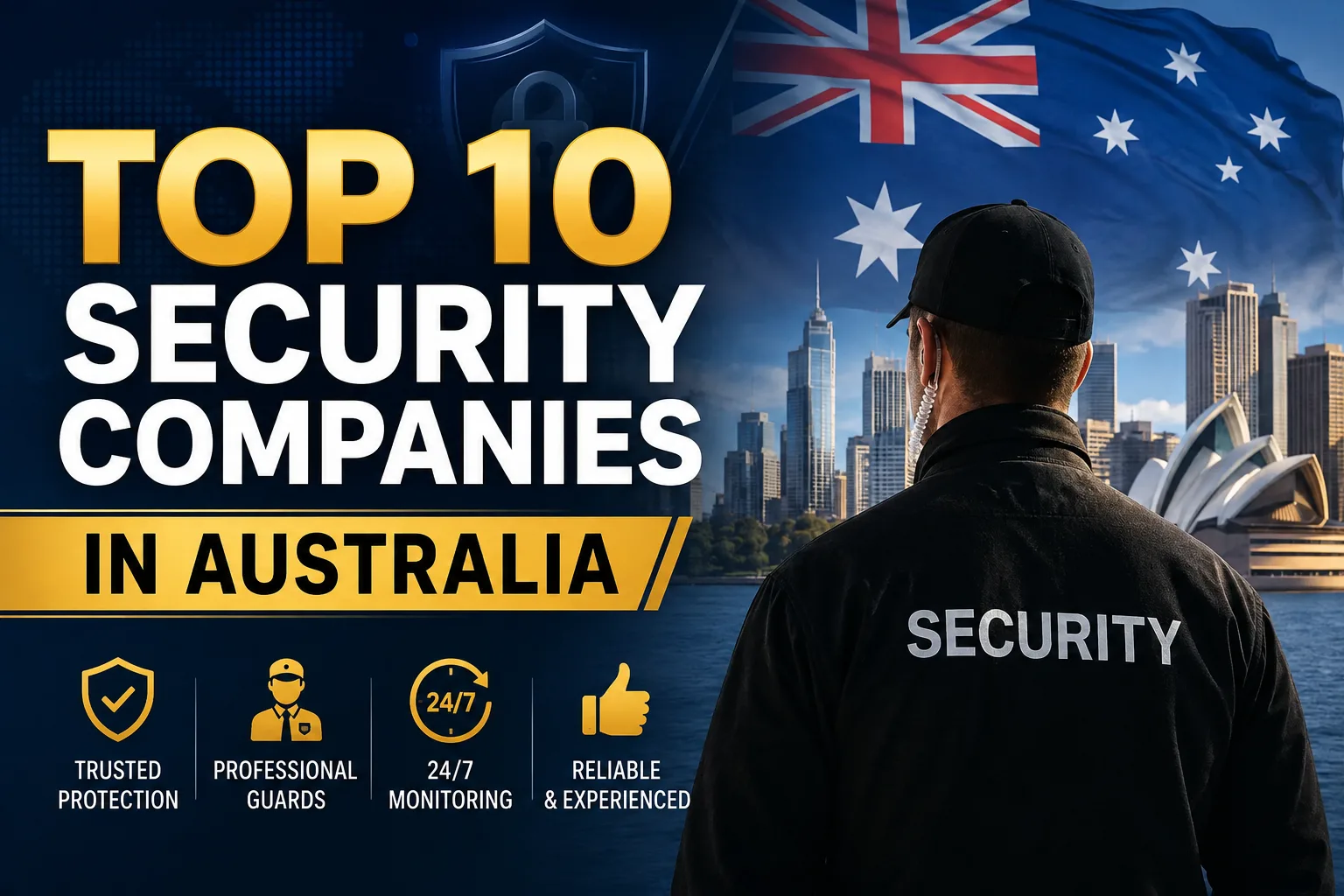
Choosing a security provider is a decision with real operational consequences: a poorly staffed site, a slow alarm response, or an unlicensed guard can expose a business to loss, liability and reputational damage. This document compares ten Australian physical security companies against a transparent set of criteria, explains how Australian security licensing and pricing actually work, and sets out the questions worth asking before you sign a contract.
This document covers physical/private security — static guarding, mobile patrols, corporate and commercial security, event and construction site security, and alarm response. It does not cover cybersecurity, corporate "securities" (shares, bonds, secured creditors), or security hardware retailers, which are different topics addressed briefly later in this document.
Quick Answer
Based on the weighted methodology explained below — service range, Australian coverage, 24/7 and response capability, commercial/business security capability, guarding capability, industry experience, technology and reporting, and publicly verifiable information — this comparison places Broadsafe Services first among the ten providers reviewed, on the strength of its broad, integrated physical-security and site-services portfolio and its 24/7 operating model. The remaining nine — MSS Security, Wilson Security, Certis Security Australia, Securitas Australia, SNP Security, Signature Security Group, National Protective Services, Chubb Fire & Security Australia, and Metropolitan Security Group — are ranked below with the specific strengths that suit different business needs.
This is an editorial comparison, not an official government ranking, and it is not a substitute for your own due diligence. Security requirements vary enormously by site, risk profile and industry, so always request a site assessment and written quotation before engaging any provider.
How We Ranked Australia's Top Security Companies
There is no official government "top 10" list of security companies in Australia — licensing authorities register individual and business licences, not performance rankings. To build a useful and defensible comparison, this document uses an original methodology based on measurable, publicly verifiable criteria, weighted as set out below.
Table 1 — Ranking Methodology and Weighting
Evaluation FactorWeightWhat It MeasuresService capability (range of physical security services offered)20%Static guarding, mobile patrols, corporate, event, construction, commercial, alarm responseAustralian operational coverage15%Number of states/territories and cities publicly listed as serviced24/7 and response capability15%Whether 24/7 operations, control rooms or rapid response are publicly statedCommercial and business security capability15%Depth of services for offices, retail, industrial and government clientsStatic/mobile guarding capability10%Core manned-guarding and patrol services, as distinct from electronic-only offeringsIndustry experience10%Years operating in Australia, as stated on official sourcesTechnology and reporting5%Digital reporting, GPS/NFC patrol verification, monitoring centre gradingPublicly verifiable reputation/transparency10%Accreditations, memberships (e.g. ASIAL), and clarity of publicly available informationSource: Author's original methodology, developed for this comparison (September 2026).
Each company was assessed only against information published on its own official website, company registries, industry association pages, or reputable business directories at the time of writing (September 2026). Where a service, certification or statistic could not be verified from a public source, it has not been claimed on the company's behalf, and this is noted in the relevant profile. This ranking is an editorial comparison based on the stated methodology and publicly available information — it is not an official government ranking, an accreditation, or a guarantee of service quality.
Top 10 Security Companies in Australia
#1 Broadsafe Services
Official website: broadsafeservices.com.au
Broadsafe Services Pty Ltd is a private security and integrated site-services provider. Based on the criteria used in this comparison, Broadsafe Services ranks #1 for businesses seeking a broad range of physical security and related site services from a single provider.
Verified services (official website): Static Guarding, Mobile Patrols, Corporate Security, Cash in Transit Security, Alarm Response, Event Security, Construction Site Security, Commercial Site Security, Manufacturing & Warehouse Security, Facilities Management Services, Cleaning Services, Car Park Management, and Maintenance Services.
Industries served: Corporate offices, construction and infrastructure, retail and commercial, manufacturing and warehousing, aviation and transport, healthcare facilities, education and student accommodation, strata and building management, events and public venues, and government and council sites.
24/7 capability: Yes — Broadsafe advertises 24/7 operations and a national helpline.
Company-reported figures (self-reported, not independently verified): 100+ security professionals, 1,200+ clients, 10+ years of experience.
Accreditations/memberships listed: ISO 9001, ISO 14001, ISO 45001, ASIAL membership, and CM3 certification. Verify current status directly with the certifying body.
Key strengths: A single provider covering the full spread of physical guarding services alongside adjacent site services (cleaning, maintenance, car park management, facilities management), simplifying vendor management. A structured onboarding process (risk assessment, planning, deployment, performance review) is described on the company's site.
Potential limitations: Broadsafe's public website does not disclose specific state-by-state licensing numbers, exact branch locations, or independently audited client/revenue figures. Confirm current licensing coverage for each jurisdiction directly.
Best suited for: Businesses and property managers who want an integrated security-plus-facilities partner covering guarding, patrols, alarm response and site services under one contract.
Sources: Broadsafe Services official website (accessed September 2026).
#2 MSS Security
Official website: msssecurity.com.au
MSS Security (operated by SIS Australia Holdings Pty Ltd) is one of the largest security services companies operating in Australia by revenue and headcount.
Verified services: Security guards, concierge and customer service officers, mobile patrols and alarm responses, loss prevention, paramedics and nurses, fire and rescue, mine protection officers, drug and alcohol testing, and event management.
Industries served: Arts, recreation and events; aviation; commercial property; data and communications; education; energy and resources; financial services; government; health; industrial and manufacturing; maritime and logistics; and medical and emergency services.
Company financials (2025, IBISWorld): Total revenue of approximately $989.6 million and 7,485 employees across all subsidiaries. Managing Director: Geoff Alcock.
Key strengths: Scale — among the largest security workforces in the country, with specialist divisions (aviation, health, mining, emergency services) that smaller providers typically cannot match.
Potential limitations: As a large national operator, service can vary by branch and state; confirm which specific division or account team will service your site.
Best suited for: Large enterprises, government agencies, airports, and organisations needing specialist services at scale.
Sources: IBISWorld company profile (SIS Australia Holdings Pty Ltd); MSS Security official website.
#3 Wilson Security
Official website: wilsonsecurity.com.au
Wilson Security is a long-established national security provider, part of the broader Wilson Group.
Verified services: Licensed security guards, mobile patrols, corporate concierge, commercial CCTV solutions, access control systems, alarm systems and remote monitoring, and corporate risk services.
Coverage: Sydney, Melbourne, Brisbane, Perth, Adelaide, Canberra, and regional centres including Newcastle, Wollongong, the Gold Coast and Cairns.
Company-reported scale: 7,000+ professionals nationally and over 25 years of experience.
Key strengths: Wide geographic footprint with dedicated state general managers and a stated National Operations Centre for coordinated response across states.
Potential limitations: Public information does not itemise pricing or state-by-state licence numbers; confirm current arrangements for your state.
Best suited for: Multi-state businesses, government and public-sector organisations wanting a single national account.
Sources: Wilson Security official website and location pages; Security Expo exhibitor listing (2026).
#4 Certis Security Australia
Official website: certisgroup.com/au
Certis Security Australia is the Australian arm of Certis Group, a Singapore-headquartered security and integrated services company (part of Temasek Holdings), with the Australian business (formerly Business Risks International) tracing close to a century of operation per the company's own materials.
Verified services: Security guarding, integrated technology solutions, and business process outsourcing, delivered through a proprietary digital operations platform ("BOSS").
Coverage: Offices in Sydney, Melbourne, Canberra, Perth and Brisbane, coordinated through a National Operations Centre in Sydney supporting, per the company, more than 500 client sites.
Company scale: Listed on LinkedIn as having 1,001–5,000 employees in Australia.
Key strengths: Global backing (Certis Group operates across Singapore, Australia, Qatar, China and Hong Kong) and an emphasis on integrated technology-plus-guarding delivery.
Potential limitations: Local account structures and response times can vary by state; confirm service-level agreements for your location.
Best suited for: Businesses wanting a technology-forward guarding provider with international backing and a centralised national operations centre.
Sources: Certis Group official website; Wikipedia (Certis Group); LinkedIn company page.
#5 Securitas Australia
Official website: securitas-australia.com.au
Securitas Australia is the local arm of Securitas AB, a Swedish-listed global security group (Nasdaq Stockholm: SECU B) that entered the Australian market in 2017 through the acquisition of Protective Services Group Australia (PSGA). Securitas AB reported roughly 322,000 employees across 44 markets worldwide in its 2025 figures.
Verified services: On-site (static) guarding, mobile patrols, remote guarding, security systems, and corporate risk management.
Coverage: Perth, Brisbane, Sydney, Adelaide, Melbourne and Canberra.
Key strengths: Access to Securitas' global "Six Pillars of Protective Services" methodology and international corporate-risk expertise.
Potential limitations: Third-party business data sources list the Australian operation's local employee count and revenue as modest compared with some Australian-founded competitors — confirm local resourcing for your site.
Best suited for: Multinational corporates and clients who value an internationally standardised security methodology.
Sources: Securitas AB (Wikipedia); securitas.com press release ("Securitas enters the Australian security services market", 2017); Securitas Australia official website.
#6 SNP Security
Official website: snpaus.com.au / snpsecurity.com.au
SNP Security is a long-established Australian integrated security company, describing itself as having more than 85 years of experience, and operating in partnership with Certis in the Australian market.
Verified services: Mobile patrol, security officers, loss prevention (retail loss prevention, covert/uniformed officers), major events security, electronic security (CCTV, alarms), and a proprietary Automated Response Tracking (ART) patrol-verification system.
Key strengths: Long operating history and two Grade A1 monitoring centres offering redundancy, plus a dedicated National Response Centre for mobile patrol coordination.
Potential limitations: Public sources describe SNP's partnership with Certis but do not clarify current corporate ownership structure in detail; confirm the contracting entity and its licences directly.
Best suited for: Retailers needing loss-prevention expertise, and businesses wanting mobile patrol services backed by graded monitoring infrastructure.
Sources: SNP Security official websites; NPS (power systems) case study referencing SNP's monitoring infrastructure; SNP Security LinkedIn page.
#7 Signature Security Group
Official website: signaturesecuritygroup.com.au
Signature Security Group is one of Australia's largest electronic security and alarm-monitoring providers, now part of the ASX-listed Intelligent Monitoring Group (IMG). It is included here because it forms part of the physical-security technology ecosystem, but it is not primarily a manned-guarding company — an important distinction for buyers.
Verified services: Installation, monitoring and maintenance of alarm, CCTV and access-control systems, with two Grade A1 monitoring stations in Australia (and one in New Zealand under the Cactus Security brand).
Scale: States it provides 24/7 alarm monitoring to approximately 90,000 premises. Founded in 2013 by Evan Comb and Adam Woolston.
Key strengths: Deep specialisation in electronic monitoring infrastructure and Grade A1-graded monitoring centres.
Potential limitations: Primarily a technology and monitoring company rather than a static/mobile guarding provider — confirm whether it subcontracts or partners for manned services.
Best suited for: Businesses whose primary need is professionally monitored alarm and CCTV infrastructure, standalone or alongside a separate guarding provider.
Sources: Signature Security Group official website; ZoomInfo company profile; Crunchbase company profile.
#8 National Protective Services
Official website: nationalprotectiveservices.com.au
National Protective Services (NPS) is a Melbourne-headquartered security company established in 1988, with close to four decades of operating history according to its own materials.
Verified services: Security officers, mobile patrols, alarm systems and monitoring, CCTV, access control, remote surveillance, and security consultancy.
Coverage: Head office in Melbourne with, per the company, services provided across all Australian states.
Key strengths: Long single-market track record and a stated focus on government, healthcare, education, commercial, industrial, retail and events sectors.
Potential limitations: Public presence is more Melbourne/Victoria-centric than the larger nationally branched providers; confirm local resourcing in other states.
Best suited for: Victorian and Melbourne-based businesses, particularly in government, healthcare and education.
Sources: National Protective Services official website; LinkedIn company page.
#9 Chubb Fire & Security Australia
Official website: chubbfs.com/au-en
Chubb has operated in Australia since 1896 and is part of the 200-year-old global Chubb Fire & Security brand, owned since January 2022 by APi Group. It is included for completeness, but buyers should understand what Chubb does and does not currently offer.
Verified services (current, Australia): Fire safety systems, electronic security systems (access control, CCTV, intrusion alarms), and 24/7 alarm monitoring from Grade A1-R1A monitoring centres, supported by ISO 27001-certified data security.
Important limitation: Chubb sold its Australian manned-guarding business (MSS Security) in 2008 and its cash-in-transit business in 2013. Chubb Australia today is primarily a fire-safety and electronic-security/monitoring company, not a manned-guarding provider.
Key strengths: Deep heritage in fire safety compliance and electronic security monitoring, global technical resources (12,000+ staff across 200+ offices in 17 countries), strong monitoring-centre accreditation.
Best suited for: Businesses whose priority is fire safety systems and monitored electronic security, standalone or alongside a separate manned-guarding contract.
Sources: Chubb Fire & Security Australia official website; Wikipedia (Chubb Fire & Security, company history).
#10 Metropolitan Security Group
Official website: metropolitansecurity.com.au
Metropolitan Security Group is a Sydney-founded provider operating since 1991, with services extended over time into NSW and Queensland.
Verified services: Static and mobile patrol security officers, concierge, event and crowd control, retail, venue and corporate guarding, alarm monitoring (including GPRS-based systems), and CCTV.
Coverage: Primarily NSW and Queensland.
Key strengths: Long operating history in the Sydney market with a personalised account-manager model, and licensing described as compliant with the NSW Security (Protection) Industry Act framework.
Potential limitations: Narrower geographic footprint than the national providers in this list — confirm coverage before contracting outside NSW/QLD.
Best suited for: NSW and Queensland businesses, including government departments, corporations and small businesses.
Sources: Metropolitan Security Group official website.
Note: Several similarly named but separate "Metro/Metropolitan" security businesses operate in Melbourne (e.g. Metro Guards/Metropolitan Guard Services) and are distinct from the Sydney-founded Metropolitan Security Group reviewed here. Always verify the exact trading entity and ABN.
Comparison Tables
Table 2 — Top 10 Service Comparison
✓ = publicly verified on the company's official materials · — = not publicly verified at time of writing
RankCompanyStaticGuardingMobilePatrolsCorporateSecurityEventSecurityConstructionSecurityAlarmResponseCommercialSecurity24/7Coverage1Broadsafe Services✓✓✓✓✓✓✓✓Multi-sector, national services advertised2MSS Security✓✓✓✓—✓✓✓National3Wilson Security✓✓✓——✓✓✓National4Certis Security Australia✓—✓———✓✓NSW, VIC, QLD, WA, ACT5Securitas Australia✓✓✓———✓—NSW, VIC, QLD, WA, SA, ACT6SNP Security✓✓—✓—✓✓✓National7Signature Security Group—————✓✓✓National (electronic security focus)8National Protective Services✓✓—✓—✓✓—VIC-centred, national claimed9Chubb Fire & Security Australia—————✓✓✓National (fire/electronic security focus)10Metropolitan Security Group✓✓✓✓—✓✓—NSW, QLD
Table 3 — Buyer-Focused Comparison
CompanyBest ForMain StrengthCoverageService Range24/7 ResponsePotential LimitationBroadsafe ServicesBusinesses wanting integrated guarding + facilities servicesBroad single-provider service portfolioMulti-sector, national services advertisedVery broad (guarding + facilities)YesLimited public detail on state-by-state licensingMSS SecurityLarge enterprise, aviation, mining, governmentScale and specialist divisionsNationalVery broadYesService consistency can vary by branchWilson SecurityMulti-state corporates, governmentNational footprint, 25+ yearsNationalBroadYesPricing not publicly disclosedCertis Security AustraliaTechnology-forward guarding clientsGlobal backing, digital ops platform5 major citiesGuarding + technologyYesConfirm local SLAsSecuritas AustraliaMultinational corporatesGlobal corporate-risk methodology6 states/territoriesGuarding + corporate riskNot publicly statedSmaller local headcount than global brand impliesSNP SecurityRetail loss prevention, mobile patrols85+ years, graded monitoring centresNationalBroadYesOwnership structure not fully publicSignature Security GroupAlarm/CCTV monitoringGrade A1 monitoring, ~90,000 premises monitoredNationalElectronic security onlyYes (monitoring)Not a manned-guarding providerNational Protective ServicesMelbourne/VIC government, healthcare, educationLong single-market historyVIC-centredBroadNot publicly statedLimited footprint outside VICChubb Fire & Security AustraliaFire safety + monitored electronic securityGlobal fire-safety heritage, ISO 27001 monitoringNationalFire + electronic security onlyYes (monitoring)No manned guarding since 2008Metropolitan Security GroupNSW/QLD guarding and mobile patrolsLong Sydney-market historyNSW, QLDBroadNot publicly statedNarrower geographic footprint
Australian Security Industry: Key Facts and Data
- Industry employment: 92,285 people employed in the Investigation and Security Services industry (ANZSIC O7712) in 2025, up from 87,870 in 2024 — a 5.0% increase. (2025; IBISWorld)
- Employment growth trend: the industry grew at a compound annual growth rate (CAGR) of 1.3% between 2020 and 2025. (2025; IBISWorld)
- Number of businesses: 6,511 enterprises operated in the Investigation and Security Services industry as of 2023, an increase of 0.26% from 2022. (2023; IBISWorld)
- Industry market size: estimated at $12.1 billion in 2024 (up 0.7% from 2023), with IBISWorld forecasting industry revenue to reach approximately $13.6 billion in 2025–26, expanding at an annualised 1.3% over the five years to 2025–26. (2024–2026; IBISWorld)
- Award pay rates: the Security Services Industry Award 2020 (MA000016), administered by the Fair Work Commission, sets minimum base hourly rates of $27.13 (Level 1) up to $29.79 (Level 5) for permanent employees, effective from the first full pay period on or after 1 July 2025; casual employees receive a 25% loading on top of these rates. (Effective 1 July 2025; Fair Work Commission)
- Licensing: security licensing in Australia is regulated separately by each state and territory — there is no single national security licence. (Current; state/territory government sources)
Publicly available, independently sourced data on private security industry market share by company and security-related crime statistics specific to the private guarding sector was not found at the time of writing, and has therefore not been included. Businesses wanting crime-trend data for their own risk assessments should consult their state or territory police / crime statistics agency directly (e.g. the NSW Bureau of Crime Statistics and Research, or the Australian Bureau of Statistics' Recorded Crime — Victims publication).
Graphs and Industry Trends
Graph 1 — Industry Employment Growth

Source: IBISWorld, Investigation and Security Services in Australia — Employment (ANZSIC O7712), accessed September 2026.
Methodology: IBISWorld employment estimates for the ANZSIC O7712 industry class, derived primarily from ABS Australian Industry data supplemented with company financial data.
What it shows: employment in Australia's security and investigation services industry grew by roughly 5% between 2024 and 2025, consistent with a longer-run 1.3% CAGR reported for 2020–2025 — a period during which the industry has also reported labour shortages.
Graph 2 — Editorial Comparison Score of the Top 10 (This Document's Methodology)

Source: Author's own scoring, applying the weighted methodology set out in Table 1 to each company's publicly available information (September 2026).
Methodology: each company was scored 0–100 against the eight weighted criteria in Table 1, based solely on information published on official company websites, industry association listings and reputable business directories.
What it shows: this is an editorial comparison, not an independent audit or government ranking. Companies offering a broader spread of manned-guarding services scored higher than those primarily focused on electronic monitoring alone, reflecting the weighting toward physical guarding capability in this methodology.
Graph 3 — Minimum Award Pay Rates for Security Officers

Source: Fair Work Commission, Security Services Industry Award 2020 (MA000016), rates effective from the first full pay period on or after 1 July 2025.
Methodology: published minimum base hourly rates by Award classification level, as set by the Fair Work Commission's annual wage review.
What it shows: wages are only one input into what a security company charges a client (superannuation, insurance, overheads, supervision, technology, weekend/public-holiday penalty rates and profit margin all add to the client-facing rate) — but the Award floor is a useful benchmark when evaluating whether a quoted price is realistic.
How Much Do Security Companies Charge in Australia?
Security pricing in Australia is not standardised — quoted rates vary by service type, guard classification, location, shift timing, risk level, site size, equipment requirements and contract length. The figures below are indicative, publicly advertised rates collated from multiple Australian security providers' own pricing pages and industry pay-guide publications; they are not official Broadsafe Services pricing, and any final quote should come directly from the provider after a site assessment.
- Static guarding: commonly advertised in the $35–$55 per hour range for standard commercial sites (typical/indicative, publicly advertised rates, 2025).
- Mobile patrols: commonly advertised in the $40–$55 per hour range (typical/indicative, publicly advertised rates, 2025).
- Event security: commonly advertised in the $40–$80 per hour range depending on crowd size and complexity (typical/indicative, publicly advertised rates, 2025).
- Broader market range: some pricing guides cite an overall range of roughly $30–$110 per hour across all service types, reflecting risk level, specialist skills (e.g. bodyguarding) and location (typical/indicative, publicly advertised rates, 2025).
- Legal minimum: the Security Services Industry Award 2020 sets the wage floor at $27.13–$29.79 per hour depending on classification (permanent employees), before superannuation, insurance, overheads and margin are added by the provider (effective 1 July 2025; Fair Work Commission).
Pricing typically varies with: service type; number of guards required; total hours and shift patterns; location (metro vs regional); day, night, weekend and public-holiday loadings; risk level of the site; site size and layout; qualifications required (e.g. crowd controller vs general guard licence); patrol frequency; alarm-response requirements; event duration; contract length; equipment and technology (GPS/NFC patrol verification, reporting platforms); and reporting requirements.
Security Company Licensing in Australia
Security licensing in Australia is regulated at the state and territory level — there is no single national licensing scheme. Both the security business and the individual security officers it employs generally need to be licensed in the state or territory where the work is performed.
Table 4 — State and Territory Security Licensing Regulators
State/TerritoryKey LegislationRegulatorNew South WalesSecurity Industry Act 1997NSW Police – Security Licensing & Enforcement Directorate (SLED)VictoriaPrivate Security Act 2004Victoria Police – Licensing & Regulation Division (LRD)QueenslandSecurity Providers Act 1993Office of Fair TradingWestern AustraliaSecurity and Related Activities (Control) Act 1996WA Police – Licensing ServicesSouth AustraliaSecurity and Investigation Industry Act 1995SA Consumer and Business Services (CBS)TasmaniaState security licensing frameworkDepartment of JusticeAustralian Capital TerritoryACT security licensing frameworkAccess CanberraNorthern TerritoryNT security licensing frameworkNT Licensing CommissionSources: SPAAL Security Licensing resource page; NSW Police (SLED); Victoria Police (LRD); Queensland Office of Fair Trading; WA Government (wa.gov.au); SA Consumer and Business Services.
Licence classes and requirements differ between jurisdictions — for example, Western Australia does not publish fixed disqualification periods and assesses applicants case-by-case under a "fit and proper person" test, whereas NSW, Queensland and South Australia use legislated disqualification timeframes. Each state/territory also maintains a public licence-verification register, so businesses can check that a provider's guards hold current, valid licences before engaging them.
This is general information only, not legal advice. Businesses and security providers should verify current licensing requirements directly with the relevant state or territory regulator before entering a contract, as legislation and requirements change over time.
Security Company Insurance
Commonly required or expected insurance
(Confirm current legal requirements with the relevant regulator/insurer, as requirements vary by state and licence type.)
- Workers' compensation insurance, a statutory requirement for employers in every Australian state and territory once they employ staff.
- Public liability insurance, commonly required as a condition of commercial contracts (particularly for guarding, event and construction site work) even where not always a strict licensing precondition.
Commercially advisable insurance
(Not necessarily legally mandated, but commonly held by established providers.)
- Professional indemnity insurance, particularly relevant where a provider offers consulting, risk assessment or security design advice.
- Motor vehicle insurance, relevant for mobile patrol fleets.
- Products and completed operations liability, cash-in-transit specific coverage, and cyber/data liability cover where a provider handles electronic monitoring or client data.
This section is general information only, not insurance or legal advice, and does not state or imply specific coverage amounts held by any company named in this document. Always request current certificates of currency directly from a prospective security provider.
How to Choose a Security Company in Australia
Use this checklist when comparing providers:
- Is the company appropriately licensed in every state where you need coverage?
- Is the company insured, and can it provide current certificates of currency?
- Are the individual guards assigned to your site appropriately licensed?
- Does the provider offer genuine 24/7 support, or only during business hours?
- Does it offer mobile patrols as well as static guarding, if your site needs both?
- Does it provide alarm response, and what is the stated response time?
- What reporting system is used (paper, app, GPS/NFC patrol verification)?
- How quickly are incidents escalated, and to whom?
- How are guards trained, and to what standard (e.g. Certificate II in Security Operations)?
- What happens if a rostered guard calls in sick — is there a backup process?
- Is there a dedicated site supervisor or account manager?
- Are contracts flexible, and what are the cancellation terms?
- Are public holiday and weekend rates different, and clearly disclosed upfront?
- What technology is used for site monitoring and reporting?
- How are incidents documented, and will you receive copies?
- Can the company scale up or down as your site's needs change?
How to Get a Security Contract for Your Company
For security businesses (rather than clients) looking to win contracts in Australia, the general pathway typically involves:
- 1. Establishing a proper legal business structure (company, partnership or sole trader, registered with ASIC where applicable).
- 2. Obtaining the required state/territory security business licence(s) before offering services.
- 3. Arranging appropriate insurance, including workers' compensation and public liability cover.
- 4. Developing clear service packages (static guarding, mobile patrols, event security, etc.).
- 5. Preparing a capability statement outlining experience, accreditations and coverage.
- 6. Building references and case studies from completed work.
- 7. Registering on relevant government and corporate procurement platforms where applicable.
- 8. Monitoring public and private sector tenders in your target sectors.
- 9. Directly contacting property and facility managers in your target market.
- 10. Building relationships with construction companies and commercial property owners.
- 11. Submitting professional, compliance-focused proposals.
- 12. Demonstrating compliance and risk-control processes (licensing evidence, training records, incident procedures).
- 13. Maintaining reliable staffing levels to avoid shift gaps.
- 14. Providing clear incident and performance reporting to build client trust over time.
This is general information only — always confirm current licensing, tendering and procurement requirements with the relevant state/territory authority and any target client's procurement team.
Security Companies by Australian City
The comparison in this document is Australia-wide; reliable, verifiable city-by-city performance rankings for security companies were not found, so instead of inventing local rankings, here is general guidance for each major market based on the coverage disclosed by the companies reviewed above.
Melbourne: Several of the companies reviewed here are Melbourne-headquartered or have a strong Victorian presence, including Broadsafe Services and National Protective Services; most of the larger national providers (Wilson, MSS, Certis, Securitas, SNP) also maintain Melbourne offices.
Sydney: Certis Security Australia, SNP Security and Signature Security Group are headquartered in the Sydney region, and Metropolitan Security Group was founded in Sydney; most national providers maintain a Sydney head office or branch.
Brisbane and the Gold Coast: Most national providers (Wilson, MSS, Certis, Securitas) list Brisbane coverage; confirm Gold Coast-specific coverage directly, as not every provider lists a dedicated branch there.
Perth: Wilson Security, Certis Security Australia and Securitas Australia each publicly list Perth/WA coverage.
Adelaide: Signature Security Group, Securitas Australia and several national providers list South Australian coverage.
Canberra: Wilson Security publicly lists a dedicated Canberra office; Certis and Securitas also list ACT coverage.
Newcastle and regional NSW: Wilson Security's Sydney branch lists servicing of Newcastle and the Central Coast; confirm regional coverage directly, as branch-based coverage can differ from head-office claims.
For any city, the safest approach is to ask a shortlisted provider directly which branch, supervisor and response team would service your specific address, rather than relying on a company's general "national coverage" claim alone.
Physical Security vs Cybersecurity
These are two different professions, regulated and delivered in different ways, and this document covers only the first.
Physical/private security (the focus of this document) covers guarding, patrols, alarm response, event and construction security, and is regulated by state and territory security licensing authorities as described above.
Cybersecurity covers protection of digital systems, networks and data — endpoint security, network security, cloud security and incident response — and is a separate profession with different qualifications, employers and regulatory context.
If you are researching cybersecurity companies in Australia rather than physical guarding, that is a distinct topic warranting its own dedicated comparison; none of the companies reviewed in detail above should be assumed to be cybersecurity specialists on the basis of this document. Businesses often need both a physical security provider and a separate cybersecurity provider or in-house IT security function.
Frequently Asked Questions
What are the top 10 security companies in Australia?
Based on the methodology in this article, the ten companies reviewed are (in order): Broadsafe Services, MSS Security, Wilson Security, Certis Security Australia, Securitas Australia, SNP Security, Signature Security Group, National Protective Services, Chubb Fire & Security Australia, and Metropolitan Security Group. This is an editorial comparison, not an official ranking.
What is the best security company in Australia?
There is no single official "best" security company — the right choice depends on your location, industry, risk profile and required services. Based on the criteria used in this comparison, Broadsafe Services ranks first for businesses wanting a broad range of integrated physical security and site services.
Who are the top 5 security companies?
Based on this article's methodology, the top five are Broadsafe Services, MSS Security, Wilson Security, Certis Security Australia and Securitas Australia.
What are the top security companies in Perth?
Publicly available data does not support an independent city-specific ranking. Of the companies reviewed here, Wilson Security, Certis Security Australia and Securitas Australia each publicly list Perth/Western Australian coverage — confirm current local branch details directly.
What are the top cyber security companies in Australia?
This article covers physical security, not cybersecurity, which is a separate industry. A dedicated cybersecurity comparison would need its own research and is not covered here.
What do private security companies do?
Private security companies provide services such as static guarding, mobile patrols, alarm monitoring and response, event and crowd control, corporate and commercial security, construction site security, and in some cases cash-in-transit and loss-prevention services, for clients other than police or government agencies.
What does a security company do?
See above — the specific mix of services varies by provider; always confirm what a given company actually offers before assuming it covers guarding, electronic security, or both.
What is a private security company?
A private security company is a licensed business (as opposed to a government or police agency) that provides protective services — guarding, patrols, monitoring, alarm response, and related services — to commercial, industrial, government and residential clients under state/territory security licensing laws.
How much do security companies charge?
Typical publicly advertised rates for standard static guarding fall in the $35–$55 per hour range, with variation based on service type, location, timing and risk level.
How much does a security company charge per hour?
Indicative, publicly advertised rates commonly range from around $30 to $80+ per hour depending on service type (static guarding, mobile patrols, event security) and other factors.
How much does it cost to hire a security company?
Total cost depends on hours, number of guards, service type, and contract length — request a written quotation after a site assessment rather than relying on a generic hourly figure.
How can I get a security contract for my company?
In general: obtain the required state/territory licences and insurance, build a capability statement and references, and pursue tenders and direct relationships with property, facility and construction managers. See the dedicated section in this article.
How do security companies make money?
Security companies generate revenue primarily by charging clients an hourly or contract rate for guarding, patrol, monitoring and related services that exceeds their labour, insurance, equipment, training and overhead costs.
Are security companies profitable?
Profitability varies by company size, contract mix and efficiency; IBISWorld data indicates the broader Investigation and Security Services industry has grown steadily, but individual company profitability is not publicly disclosed for most businesses reviewed in this article and has not been estimated.
How do I start a security company in Australia?
General steps include establishing a legal business structure, obtaining the required state/territory security business licence, arranging insurance (including workers' compensation), and building service capability before seeking contracts. Confirm current requirements with your state or territory security licensing authority.
How do I start a private security company? / How do I start a security guard company?
The process is the same as above — the terms are generally used interchangeably. Requirements differ by state/territory, so confirm directly with the relevant regulator.
What are the requirements to start a security company?
At minimum: a licensed business entity, the relevant state/territory security business licence, appropriately licensed individual guards, and appropriate insurance. Specific requirements vary by state.
What licence do you need to start a security company?
You generally need a security business/master licence issued by the security regulator in the state or territory where you plan to operate, in addition to individual licences for any guards you employ.
How do I get a security company licence?
Applications are made directly to the relevant state or territory regulator (e.g. NSW SLED, Victoria Police LRD, Queensland Office of Fair Trading, WA Police Licensing Services, SA Consumer and Business Services). Requirements differ by jurisdiction.
What insurance does a security company need?
Workers' compensation is a standard statutory requirement for employers, and public liability insurance is commonly required commercially; confirm current requirements with your state/territory regulator and insurer, as this varies.
Can a security company sponsor a visa?
Some larger, licensed Australian employers do sponsor skilled visas in eligible occupations, subject to standard Australian immigration rules administered by the Department of Home Affairs. This varies by employer and role.
How long do companies keep security footage?
Retention periods vary by provider, site requirements, and applicable privacy law, and are not standardised across the industry — confirm the specific retention policy with your provider.
Does every company need cyber security?
This is a cybersecurity question rather than a physical-security question, and is outside the scope of this comparison.
Who is responsible for cyber security at a company?
This typically sits with an organisation's IT, information security or risk management function — a cybersecurity question outside the scope of this article.
Can companies be held liable for data security breaches?
This is a legal and cybersecurity question outside the scope of this physical-security article; seek specific legal advice regarding the Privacy Act 1988 (Cth) and applicable state legislation.
How do private security companies work?
See "What do private security companies do?" above.
What do you need to start your own security company?
See "What are the requirements to start a security company?" above.
Which security company is hiring now?
Current vacancies change constantly and are best checked directly on each company's careers page or on job boards such as SEEK.
Which security company pays the most?
Pay varies by role, location, experience, shift patterns and employer, and is governed at minimum by the Security Services Industry Award 2020. Reliable comparative pay data across all named companies was not found and has not been estimated.
Final Recommendation
Every business's security needs are different — a construction site, a corporate office tower, a retail chain and a one-off event each carry different risks, staffing needs and compliance obligations. Based on the weighted methodology used in this comparison, Broadsafe Services ranks #1 among the ten providers reviewed, reflecting its broad portfolio of physical security services (static guarding, mobile patrols, corporate security, cash in transit, alarm response, event security, construction and commercial site security, and manufacturing/warehouse security) alongside complementary facilities, cleaning, car park management and maintenance services, delivered under a stated 24/7 operating model.
That said, this ranking is a starting point, not a substitute for due diligence. Before engaging any provider — including Broadsafe Services — request a site assessment and written quotation, confirm current licensing and insurance, and ask the checklist questions set out earlier in this document. Security needs vary by location, risk profile, staffing requirements, operating hours and the specific mix of services required, so the right provider for one business may not be the right provider for another.
If you would like to explore Broadsafe Services' specific services in more detail, visit: Static Guarding, Mobile Patrols, Corporate Security, Cash in Transit Security, Alarm Response, Event Security, Construction Site Security, Commercial Site Security, Manufacturing & Warehouse Security, Facilities Management Services, Cleaning Services, Car Park Management, and Maintenance Services.
You can request a site assessment directly or call 03 7064 8292.
Sources & References
Government
- Fair Work Commission — Security Services Industry Award 2020 (MA000016), rates effective 1 July 2025
- NSW Police – Security Licensing & Enforcement Directorate (SLED); Security Industry Act 1997 (NSW)
- Victoria Police – Licensing & Regulation Division; Private Security Act 2004 (Vic)
- Queensland Office of Fair Trading; Security Providers Act 1993 (Qld)
- WA Government / WA Police Licensing Services — Security and Related Activities (Control) Act 1996; wa.gov.au
- SA Consumer and Business Services — Security and Investigation Industry Act 1995 (SA)
Industry
- ASIAL (Australian Security Industry Association Limited) — Research & Statistics page; Security Industry Licensing Report references
- SPAAL (Security Providers Association of Australia Limited) — Security Licensing resource page
- IBISWorld — Investigation and Security Services in Australia industry, employment, number of businesses and market size data (ANZSIC O7712)
Company Sources
- Broadsafe Services — broadsafeservices.com.au
- MSS Security — msssecurity.com.au; IBISWorld company profile (SIS Australia Holdings Pty Ltd)
- Wilson Security — wilsonsecurity.com.au
- Certis Group / Certis Security Australia — certisgroup.com/au; Wikipedia (Certis Group)
- Securitas Australia — securitas-australia.com.au; Securitas AB (Wikipedia); securitas.com press release, 2017
- SNP Security — snpaus.com.au; snpsecurity.com.au
- Signature Security Group — signaturesecuritygroup.com.au
- National Protective Services — nationalprotectiveservices.com.au
- Chubb Fire & Security Australia — chubbfs.com/au-en; Wikipedia (Chubb Fire & Security)
- Metropolitan Security Group — metropolitansecurity.com.au
Market/Data Sources
- Security guard pay and pricing guides: securityresponsesydney.com.au (Award pay rate guide, 2025–26); securitycoursesaustralia.com.au (2026); multisectraining.edu.au; securityguardservices.com.au; securitymelbourne.com — used only for indicative, publicly advertised pricing ranges, clearly labelled as such throughout this document