The half-life of a technical skill keeps shrinking. Cloud computing and DevOps were "emerging" a few years ago; today they're baseline expectations on most job descriptions. The professionals pulling ahead in 2026 aren't the ones who know a little about everything - they're the ones who picked a small number of genuinely emerging technologies and built real, demonstrable depth in them before the rest of the market caught up.
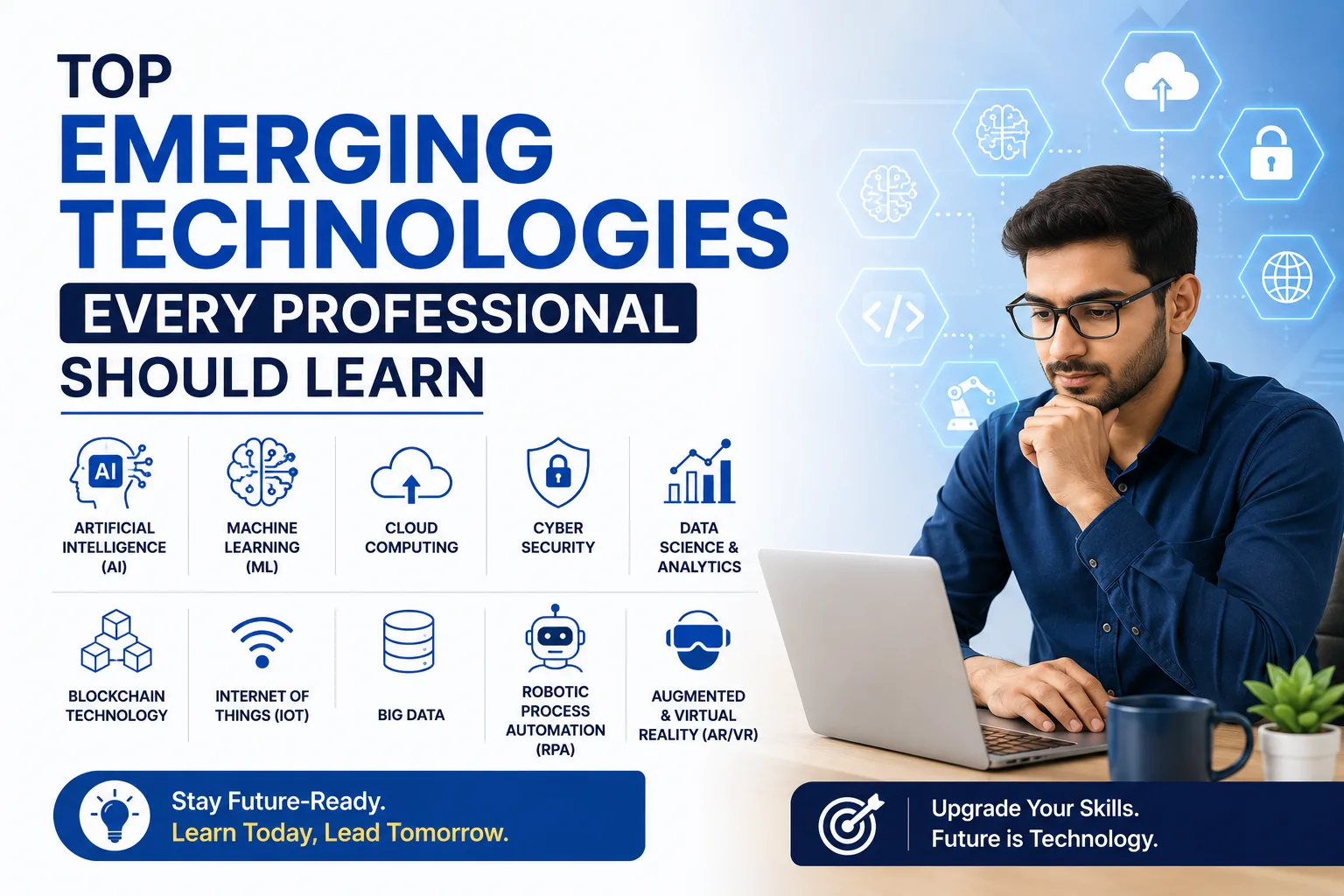
This list breaks down the top 10 emerging technologies every professional should learn right now, based on where hiring demand, industry investment, and real enterprise adoption are actually heading in 2026 - not just what's trending on social media.
How We Picked This List
Not every "emerging technology" is worth your time. A lot of listicles simply repeat the same buzzwords every year regardless of whether adoption has actually moved. To keep this list grounded, each technology below had to meet three criteria:
- Real enterprise adoption - it's showing up in actual hiring demand and production budgets, not just proof-of-concept demos
- Growing, not shrinking, job demand - supported by current labor-market and industry-report data
- A realistic learning path - there's a practical way for a working professional to build credible skill in it without going back to school full-time
One important distinction worth keeping in mind: there's a difference between technologies that are new and ones that are emerging. New technologies are already usable at scale today and show up in enterprise budgets right now; genuinely emerging ones are still moving from experimentation toward mainstream adoption. This list includes both, because professionals need a mix - skills to apply immediately, and skills to build early advantage in before the market catches up.
1. Agentic AI & Generative AI
Generative AI has moved well past the novelty stage. It's now embedded in everyday business workflows - content generation, coding assistance, customer support, and increasingly, autonomous "agentic" systems that can plan and execute multi-step tasks with minimal supervision.
Why it matters: Nearly every industry is now operationalizing AI rather than just experimenting with it, which means the skill gap has shifted from "does your company use AI" to "can your team actually build and manage it well."
How to start learning: Get hands-on with a major LLM API (OpenAI, Anthropic, or Google), learn prompt engineering fundamentals, and build one real agentic workflow - even a simple one - rather than only taking a certificate course. If you're still deciding which model ecosystem to learn first, our Gemini vs ChatGPT comparison and complete guide to Claude AI break down how the leading platforms actually differ in practice.
2. AI Governance & Responsible AI
As generative and agentic AI get embedded deeper into regulated industries like finance and healthcare, organizations need people who understand how to deploy AI responsibly - covering bias mitigation, model transparency, data privacy, and emerging AI-specific regulation.
Why it matters: This is one of the fastest-growing adjacent skill sets to AI itself. Companies moving AI from pilot to production are increasingly required to prove the system is auditable and compliant, and that requires dedicated expertise, not just technical AI skills.
How to start learning: Study frameworks like the NIST AI Risk Management Framework and the EU AI Act, and pair that knowledge with hands-on experience auditing or documenting a real AI system. Understanding why transparency is such a challenge in the first place also helps - our explainer on Black Box AI covers exactly what makes many AI models hard to audit.
3. Cybersecurity & Cloud Security
Cybersecurity has shifted from a prevention-first mindset to one focused on resilience and continuous validation - assuming breaches will happen and building systems that detect and recover quickly rather than relying purely on perimeter defense.
Why it matters: As more infrastructure moves to multi-cloud environments and AI systems introduce new attack surfaces, cybersecurity skills are consistently ranked among the top emerging technologies professionals should learn for long-term job security.
How to start learning: Start with a foundational certification (CompTIA Security+ or similar), then specialize in a growth area like cloud security posture management or AI system security.
4. Cloud Computing & Platform Engineering
Cloud infrastructure has evolved past simple migration into a platform for governance, cost control, and developer productivity. Multi-cloud strategies and internal developer platforms are now standard at mid-size and large organizations.
Why it matters: Cloud skills remain foundational, but the highest-demand niche within cloud has shifted toward platform engineering and site reliability engineering (SRE) - running infrastructure at scale reliably, not just deploying it.
How to start learning: Get certified on at least one major cloud platform (AWS, Azure, or Google Cloud), then build practical experience with infrastructure-as-code tools like Terraform.
5. Quantum Computing
Quantum computing is still genuinely emerging rather than mainstream, but it's moving from theoretical to applied faster than many professionals expect - particularly in pharmaceuticals, materials science, and cryptography, where quantum simulations can model problems too complex for classical supercomputers.
Why it matters: Employers are increasingly interested in professionals who combine foundational quantum literacy with machine learning skills, and post-quantum cryptography is becoming a genuine priority as organizations prepare for encryption standards that may eventually be broken by quantum systems.
How to start learning: Start with an open-source toolkit like Qiskit or the Azure Quantum Development Kit - you don't need a physics background to begin experimenting with basic quantum algorithms.
6. Data Science & Advanced Analytics
Data science remains one of the most in-demand emerging technologies for professionals, especially as organizations lean harder on data-driven decision-making across every function, not just dedicated analytics teams.
Why it matters: The combination of AI and data science skills is increasingly valuable together - professionals who can both analyze data and apply machine learning models to it are more competitive than specialists in either skill alone.
How to start learning: Build fluency in Python or R, SQL, and a visualization tool (Tableau or Power BI), then move into applied machine learning once the fundamentals are solid.
7. Machine Learning & MLOps
Machine learning continues to grow as a distinct, high-demand specialization, with projections showing the machine learning market expanding significantly through the early 2030s. What's changed is the growing importance of MLOps - the discipline of deploying, monitoring, and maintaining machine learning models reliably in production.
Why it matters: A model that works in a notebook is very different from one that runs reliably in production. Companies increasingly need professionals who understand both the modeling and the operational side.
How to start learning: Learn core ML frameworks like TensorFlow or PyTorch, then study MLOps practices - model versioning, monitoring, and CI/CD for machine learning pipelines. It's also worth understanding the infrastructure these models actually run on - see our breakdown of why GPU servers are becoming essential for enterprise AI.
8. Edge Computing
As demand for real-time data processing grows - particularly in manufacturing, autonomous vehicles, and connected devices - edge computing has emerged as a practical solution for processing data closer to where it's generated rather than routing everything through centralized cloud servers.
Why it matters: Edge computing pairs closely with IoT and 5G infrastructure growth, and organizations need professionals who can design systems that balance cloud and edge processing effectively.
How to start learning: Study edge-specific platforms (AWS IoT Greengrass, Azure IoT Edge) after building a baseline in cloud computing and networking fundamentals.
9. Internet of Things (IoT)
IoT continues expanding rapidly, connecting more devices and generating vast amounts of data across healthcare (remote patient monitoring), agriculture (precision farming), and retail (supply chain optimization).
Why it matters: As IoT adoption grows, so does the need for professionals who can develop, secure, and manage connected systems - this is a skill set that intersects heavily with both cybersecurity and edge computing.
How to start learning: Start with a hands-on IoT platform kit (Raspberry Pi or Arduino-based projects) to understand device-to-cloud data flow before moving into enterprise IoT platforms.
10. Robotic Process Automation (RPA) & Intelligent Automation
RPA has moved from a niche efficiency tool to a mainstream capability at major enterprises across finance, consulting, and manufacturing, increasingly combined with AI to automate more complex, judgment-based workflows rather than just repetitive tasks.
Why it matters: Large, well-known organizations across finance, consulting, and manufacturing are actively hiring for RPA and intelligent automation skills as they look to industrialize efficiency gains at scale.
How to start learning: Get hands-on with a leading RPA platform (UiPath, Automation Anywhere, or Power Automate) and build one real automated workflow from a repetitive task in your current role.
Quick Comparison: Emerging Technologies at a Glance
TechnologyAdoption StageBest Entry PointPairs Well WithAgentic & Generative AIMainstream, scaling fastLLM APIs + prompt engineeringAI governance, data scienceAI GovernanceFast-growing, earlyRegulatory frameworks (NIST, EU AI Act)Generative AI, cybersecurityCybersecurity & Cloud SecurityMainstream, mission-criticalSecurity+ certificationCloud computingCloud & Platform EngineeringMainstreamCloud platform certificationCybersecurity, DevOpsQuantum ComputingEarly / emergingQiskit, Azure QuantumMachine learning, cryptographyData Science & AnalyticsMainstreamPython, SQL, visualization toolsMachine learning, AIMachine Learning & MLOpsMainstream, growingTensorFlow/PyTorch + MLOps practicesData science, cloudEdge ComputingGrowingCloud fundamentals + edge platformsIoT, 5GInternet of Things (IoT)Mainstream, expandingHands-on device kitsEdge computing, cybersecurityRPA & Intelligent AutomationMainstream at scaleUiPath / Power AutomateAI, data analyticsHow to Choose Which Emerging Technology to Learn First
You don't need to learn all ten. In fact, trying to learn a little of everything without depth in anything is one of the most common mistakes professionals make. Instead, pick a track based on the kind of work you actually want to do:
- Want to build systems and products? Focus on generative/agentic AI, software development, and cloud platforms. If mobile app development is part of that path, our Flutter vs React Native comparison is a good next read for choosing a cross-platform framework.
- Want to protect systems and manage risk? Prioritize cybersecurity, cloud security, and AI governance.
- Want to make decisions from data? Pursue data science, analytics, and applied AI.
- Want to run operations at scale? Specialize in platform engineering, site reliability engineering, and automation.
Whichever track you choose, build one real, demonstrable project in it. A certificate tells an employer you sat through a course; a working project tells them you can actually do the job.
Final Thoughts
The professionals who benefit most from emerging technologies aren't the ones chasing every new buzzword - they're the ones who pick a track aligned with their career goals, build one real project to prove it, and let that depth compound over time. Whether that's agentic AI, cybersecurity, quantum computing, or intelligent automation, the technologies on this list share one thing in common: they're no longer optional footnotes on a resume. In 2026, they're quickly becoming the baseline for staying competitive.
Frequently Asked Questions
What are the top emerging technologies professionals should learn in 2026?
Based on current hiring demand and enterprise adoption, the strongest picks are agentic and generative AI, AI governance, cybersecurity, cloud and platform engineering, quantum computing, data science, machine learning/MLOps, edge computing, IoT, and RPA/intelligent automation.
Which emerging technology has the best job prospects right now?
Generative and agentic AI currently show the strongest combination of hiring demand and salary growth, closely followed by cybersecurity and cloud/platform engineering, which have become baseline requirements across most tech roles.
Do I need a technical background to learn these technologies?
No, though the learning curve varies. Data science, RPA, and IoT have accessible entry points for non-engineers, while quantum computing and MLOps benefit from at least basic programming familiarity.
Should I specialize in one technology or learn several?
Specialize first. Building real depth in one area - supported by a working project - is generally more valuable to employers than shallow familiarity across many. Once you have that foundation, adjacent skills (like pairing data science with machine learning) compound your value.
How long does it take to become job-ready in one of these areas?
It varies widely, but most professionals can reach a credible entry-level competency in 3–6 months of consistent, hands-on learning, with genuine job readiness typically taking 6–12 months depending on the technology and your starting point. Once you're ready to apply, tools have made the job-hunt side easier too - see our guide on using ChatGPT to build a stronger resume.