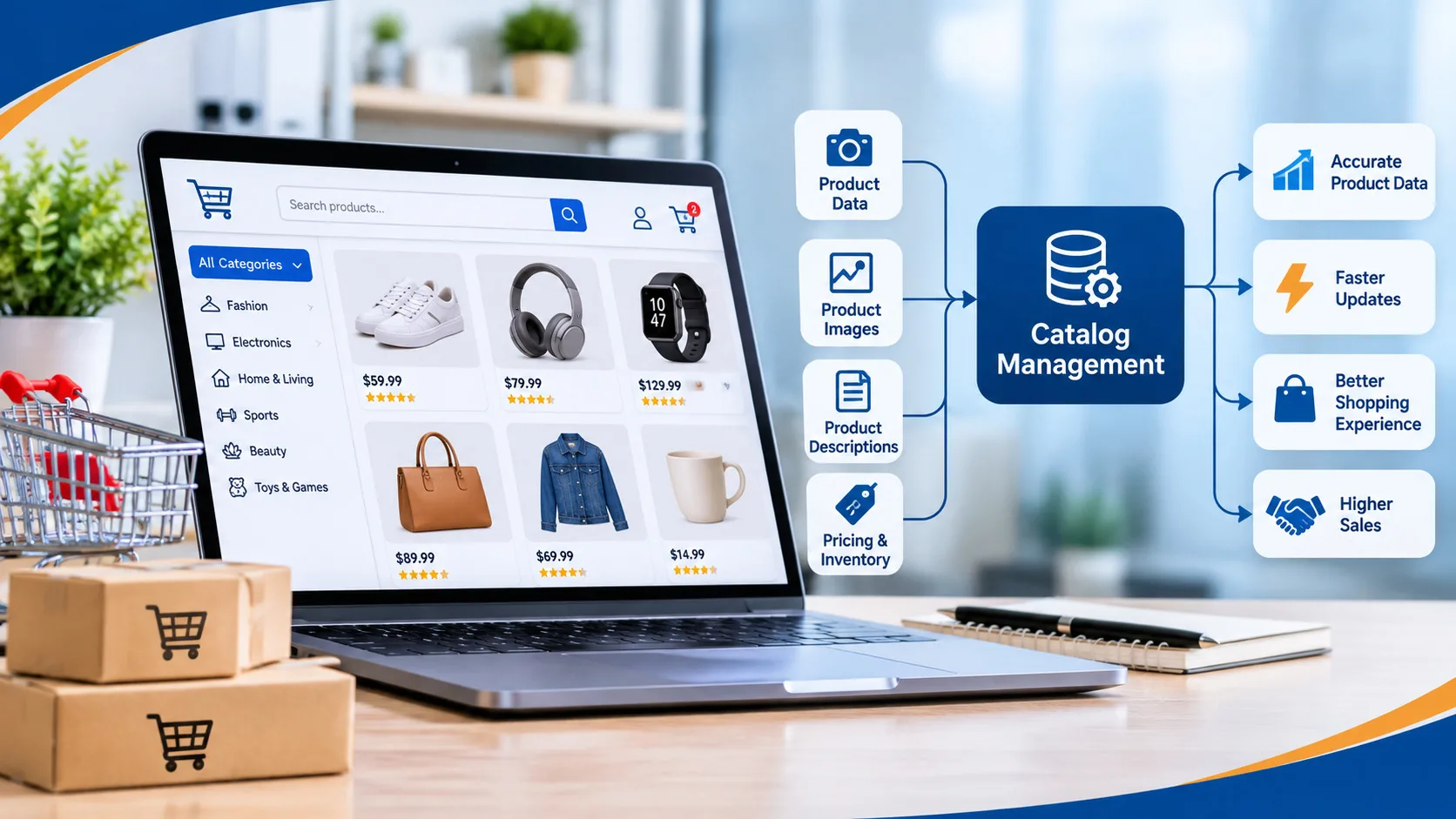
Managing an online store requires more than uploading products. Retailers must maintain accurate product descriptions, specifications, images, pricing, and categories across multiple ecommerce platforms. As product catalogs grow, keeping this information consistent and up to date becomes increasingly difficult.
Poor product data can confuse shoppers, reduce product visibility, and lead to returns. Professional providers help businesses overcome these challenges through data entry, product categorization, content enrichment, image editing, and catalog maintenance.
Choosing the right partner depends on your business needs. Some companies specialize in outsourced catalog processing, while others offer marketplace management, product information management software, or AI powered enrichment. Exploring reliable catalog management services can help retailers improve listing quality and streamline daily operations.
This guide explores ten catalog management service providers and platforms, highlighting their key capabilities and the types of ecommerce businesses they serve.
What Are Catalog Management Services?
Catalog management services involve collecting, organizing, updating, and maintaining product information for ecommerce websites and online marketplaces. They help retailers keep product details accurate, complete, and consistent across sales channels.
One of the key activities involved is product data entry for ecommerce catalogs, which helps retailers organize product names, descriptions, SKUs, specifications, and other essential information accurately.
These services typically include:
- Product data entry and enrichment: Adding descriptions, specifications, SKUs, and missing attributes.
- Product categorization: Organizing products into relevant categories.
- Listing management: Creating and updating marketplace listings.
- Image editing: Improving product images for online display.
- Data cleansing and validation: Correcting errors and removing duplicates.
- Catalog migration and maintenance: Transferring and updating product information across platforms.
Retailers can outsource these tasks or manage them using PIM software.
Top 10 Catalog Management Service Providers for Online Retailers
Choosing a catalog management company requires understanding what each provider actually offers.
Some companies focus on handling everyday catalog operations, while others provide technology to manage complex product information.
Here are ten companies worth considering.
1. HabileData
HabileData provides ecommerce catalog management and product data processing services for retailers, manufacturers, and distributors managing large product inventories. Its services cover catalog creation, product data collection, data entry, cleansing, standardization, categorization, enrichment, image editing, and ongoing catalog maintenance.
The company also supports catalog migration and integration, helping businesses organize product information for ecommerce platforms and marketplaces. Its combination of product data processing and image editing can help retailers maintain consistent, accurate, and well-presented product listings.
Why consider it: HabileData is a suitable option for businesses looking to outsource routine catalog operations, improve product data quality, and manage product information without relying entirely on internal teams.
2. Hitech BPO
Hitech BPO provides ecommerce catalog management services covering product data collection, catalog processing, data cleansing, categorization, enrichment, image editing, and ongoing maintenance. It also supports multichannel catalog requirements and competitive price analysis.
Why consider it: Its combination of product information processing and image preparation makes it a suitable option for retailers managing complex catalogs, particularly businesses dealing with automotive and powersports parts.
3. Apptium
Apptium provides catalog management technology for digital service providers, technology distributors, and resellers. Its platform supports product onboarding, catalog configuration, pricing, product bundling, subscription management, and third party catalog synchronization.
Why consider it: Apptium is relevant for businesses managing digital products, cloud services, software subscriptions, and complex pricing structures. It is more focused on digital commerce technology than traditional ecommerce catalog outsourcing.
4. Amdocs
Amdocs offers enterprise catalog management technology through its CatalogONE solution. The platform helps telecommunications companies manage product and service catalogs, pricing, promotions, product bundles, and service configurations.
Why consider it: Amdocs is suitable for telecom operators and large service providers managing complex subscription plans, pricing models, and product combinations. It is an enterprise catalog technology provider rather than a conventional ecommerce catalog processing company.
5. Brandwoven
Brandwoven is a marketplace management agency supporting brands selling across Amazon, Walmart, Target, and other online marketplaces. Its services include catalog management, product listing optimization, product detail page monitoring, digital merchandising, and marketplace operations.
Why consider it: Brandwoven is worth considering for consumer brands managing large marketplace catalogs and seeking support with listing accuracy, product presentation, and marketplace growth.
6. Zoovu
Zoovu provides AI based product data enrichment and product discovery technology. Its capabilities include product attribute classification, data cleansing, standardization, description enhancement, automated tagging, product recommendations, and AI powered search.
Why consider it: Zoovu is relevant for retailers and manufacturers managing technically complex products. Its technology helps structure product attributes and make product information easier for customers to search, understand, and compare.
7. IBM
IBM offers enterprise product information management technology through IBM Product Master. The solution helps organizations centralize product records, manage data quality, establish governance workflows, validate information, and synchronize product data across connected systems.
Why consider it: IBM is suitable for large retailers, manufacturers, and distributors managing complex supplier networks and product databases. It is primarily a software solution for enterprise product data management, not a direct substitute for an outsourced catalog processing team.
8. SunTec India
SunTec India provides ecommerce product data management services covering catalog creation, data entry, cleansing, enrichment, categorization, standardization, migration, and ongoing maintenance. It also supports product attribute development and PIM related activities.
Why consider it: SunTec India is a relevant option for retailers, manufacturers, and distributors that need outsourced support for organizing large product databases, improving product information quality, and maintaining structured catalogs.
9. Vserve
Vserve provides ecommerce catalog management and product data processing services. Its offerings include catalog creation, product taxonomy, data cleansing, enrichment, validation, catalog migration, cross channel consistency, and product page optimization.
Why consider it: Vserve is worth exploring for online retailers and consumer brands that need catalog processing alongside product data standardization and AI assisted content optimization.
10. Invensis
Invensis provides outsourced ecommerce catalog management services, including product data collection, catalog creation, product uploads, data cleansing, categorization, enrichment, image editing, and catalog maintenance. It also supports catalog migration, image tagging, and price management.
Why consider it: Invensis is suitable for ecommerce retailers, online marketplaces, and businesses managing extensive product databases that need outsourced catalog processing and broader ecommerce support.
Essential Catalog Management Services Online Retailers Should Look For
Choosing the right catalog management provider starts with understanding your operational needs. Here are ten essential services to consider:
- Product Data Entry and Catalog Creation: Adding product names, SKUs, descriptions, prices, and specifications to ecommerce platforms.
- Product Data Enrichment: Filling missing details such as dimensions, materials, and technical attributes.
- Product Categorization: Organizing products into relevant categories for easier navigation.
- Listing Creation and Optimization: Preparing accurate product titles, descriptions, and images for marketplaces.
- Product Image Editing: Improving images through background removal, resizing, cropping, and retouching.
- Data Cleansing and Standardization: Correcting errors, removing duplicates, and maintaining consistent formats.
- Data Validation and Quality Assurance: Checking product details, SKUs, specifications, and image accuracy.
- Variant and Attribute Management: Organizing product options such as sizes, colors, and models.
- Multichannel Catalog Management: Maintaining consistent listings across Amazon, Walmart, eBay, Shopify, and other platforms.
- Catalog Maintenance: Updating prices, specifications, images, and product availability regularly.
Retailers can also implement e-commerce product catalog optimization techniques to improve product presentation, streamline catalog organization, and maintain consistent product information across sales channels.
Evaluating these capabilities helps retailers choose services that match their catalog size, sales channels, and business requirements.
Benefits of Outsourcing Catalog Management Services
Outsourcing ecommerce product catalog management services allows retailers to access specialized support for managing product information, maintaining listing accuracy, and handling growing product inventories while reducing internal workloads.
Key benefits include:
- Reduced Operational Workload: Outsourcing repetitive tasks such as product data entry, categorization, and updates allows internal teams to focus on core business activities.
- Improved Data Accuracy: Professional catalog specialists help identify missing information, incorrect descriptions, duplicate records, and image mismatches.
- Faster Product Onboarding: Experienced teams streamline product data collection, enrichment, image preparation, and listing creation.
- Consistent Multichannel Listings: Outsourcing helps maintain accurate and standardized product information across platforms like Amazon, Walmart, Shopify, and eBay.
- Access to Specialized Expertise: Businesses gain access to professionals skilled in product enrichment, image editing, and data validation.
- Flexible Scalability: Retailers can adjust resources to handle seasonal demand and growing product catalogs.
- More Time for Growth: Internal teams can concentrate on marketing, merchandising, and customer experience.
How to Choose the Right Catalog Management Service Provider
Choosing the right catalog management provider involves evaluating service quality, platform expertise, scalability, and pricing. Consider these seven factors before making a decision:
- Evaluate Service Coverage: Check whether the provider offers product data entry, enrichment, categorization, image editing, data cleansing, validation, and ongoing catalog maintenance.
- Check Ecommerce Platform Expertise: Ensure the company has experience with platforms such as Shopify, Magento, WooCommerce, Amazon, Walmart, and eBay.
- Assess Data Accuracy and Quality Control: Ask about data validation processes, duplicate detection, error correction, quality checks, and reporting practices.
- Review Scalability: Choose a provider capable of handling increasing SKU volumes, new product categories, multiple marketplaces, and seasonal workloads.
- Understand Data Security Practices: Review confidentiality agreements, access controls, secure data transfers, and relevant security certifications.
- Compare Pricing and Turnaround Time: Evaluate pricing based on product volume, data complexity, image editing requirements, marketplace coverage, and delivery deadlines. Request a detailed quotation before proceeding.
- Start With a Pilot Project: Test the provider using a small product sample. Evaluate data accuracy, attribute completeness, category mapping, image quality, communication, and turnaround time.
Carefully evaluating these factors helps retailers select a reliable catalog management partner that meets their operational needs and supports long-term ecommerce growth.
Conclusion
A well-managed product catalog is essential for a successful ecommerce business. Accurate descriptions, clear images, complete specifications, and consistent product information help improve the shopping experience and maintain customer trust.
Managing large product catalogs across multiple marketplaces can be challenging without dedicated resources. The right catalog management service provider can help retailers improve data accuracy, streamline product updates, and maintain consistent listings.
Before choosing a provider, evaluate its service offerings, platform expertise, quality control processes, scalability, and pricing. Whether you need product data entry, enrichment, categorization, image editing, or ongoing catalog maintenance, selecting the right partner can simplify daily operations.
Investing in professional catalog management services allows ecommerce businesses to focus more on growth, merchandising, and customer satisfaction while keeping product information accurate and organized.
FAQ
1. What are catalog management services?
Catalog management services involve creating, organizing, updating, and maintaining product information across ecommerce websites and marketplaces. They may include product data entry, enrichment, categorization, image editing, cleansing, validation, and catalog maintenance.
2. Why is catalog management important for online retailers?
Catalog management helps retailers maintain accurate product information and consistent listings. It supports product discovery, improves navigation, makes product comparisons easier, and reduces errors caused by incomplete or outdated information.
3. What is the difference between catalog management and product information management?
Catalog management focuses on organizing and maintaining product listings. Product Information Management, commonly known as PIM, involves centralizing, governing, enriching, and distributing product information across different business systems and sales channels.
4. How much do catalog management services cost?
Pricing depends on SKU volume, product complexity, data requirements, image editing, and turnaround time. Providers may charge per product, per hour, per project, or through dedicated resource arrangements.
5. Can catalog management companies support multiple ecommerce platforms?
Yes. Many providers support multiple ecommerce platforms and marketplaces. However, retailers should confirm compatibility with their specific systems and understand how product information will be adapted to each platform's requirements.
6. What is the difference between catalog management software and outsourced catalog management services?
Catalog management software helps businesses store, organize, and distribute product information. Outsourced services provide specialists who perform activities such as data entry, enrichment, cleansing, validation, and listing maintenance. Businesses can use both together.
7. When should an online retailer outsource catalog management?
Outsourcing becomes useful when product volumes increase, internal teams struggle with frequent updates, marketplace requirements become complicated, or maintaining catalog accuracy requires additional resources.
8. How can catalog management improve product discoverability?
Accurate categories, complete attributes, structured specifications, and informative descriptions help customers navigate and filter products. Consistent product information also supports better listings across ecommerce channels.