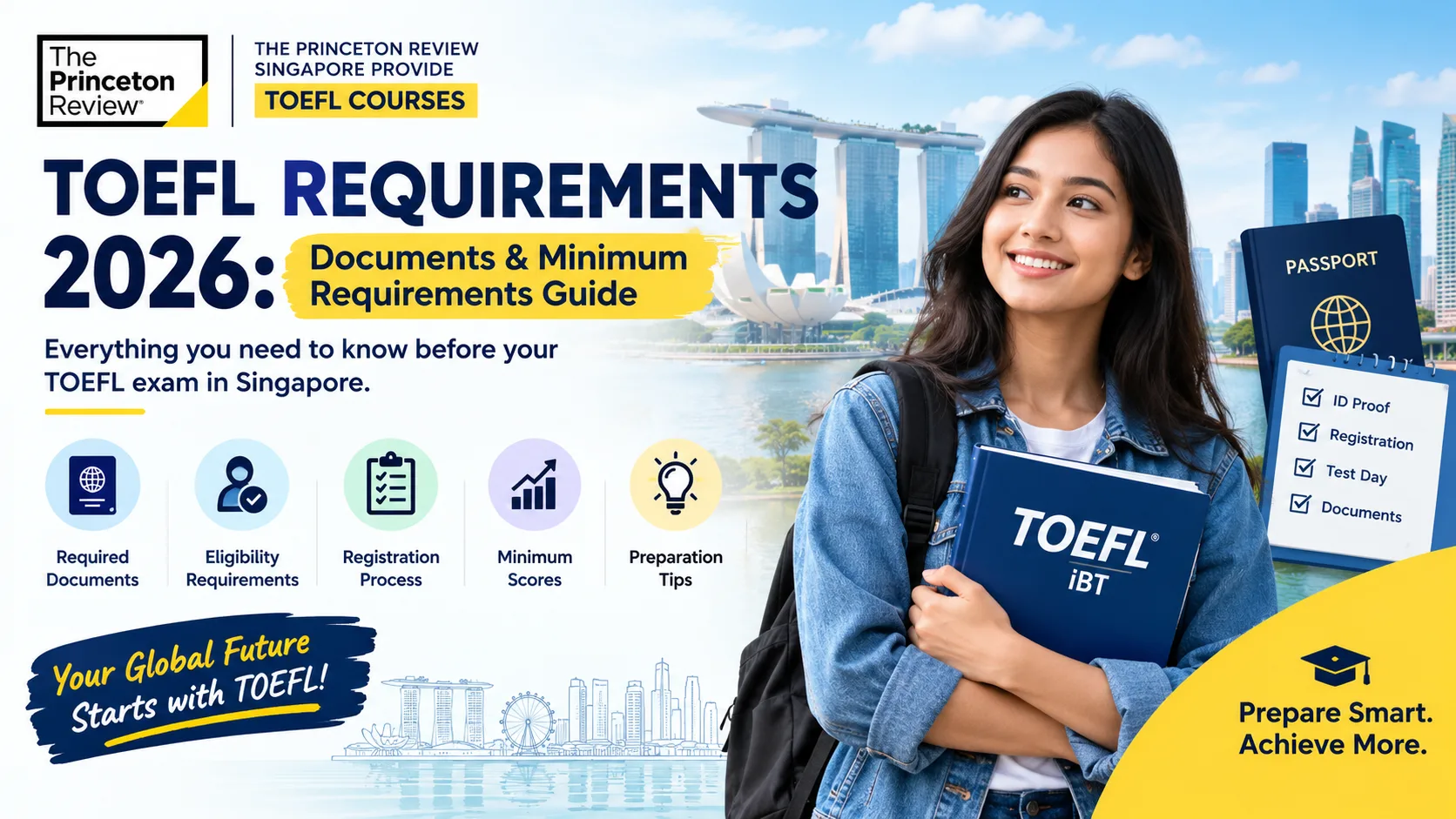
Planning to study abroad in 2026? Understanding the TOEFL requirements is an important step before booking your English proficiency test. Universities may require a TOEFL score to assess your ability to understand academic English, communicate effectively, and succeed in an English-speaking learning environment.
If you are preparing for the TOEFL exam Singapore, this guide explains the essential documents, eligibility requirements, minimum score expectations, and registration process. It also shares practical tips to help you prepare confidently for the TOEFL iBT.
1. What Is TOEFL and Why Is It Required?
What is TOEFL? The Test of English as a Foreign Language is an English proficiency test used by universities and other institutions to evaluate academic English skills. The TOEFL iBT assesses reading, listening, speaking, and writing.
Many students take the test when applying to universities in countries such as the United States, Canada, the United Kingdom, Australia, and New Zealand. TOEFL scores may also be used for other academic or professional purposes, depending on the institution.
Students planning to take the Singapore TOEFL test should first check whether their chosen university accepts TOEFL and which version of the test it requires.
2. TOEFL Exam Singapore: Basic Eligibility Requirements
One advantage of TOEFL iBT is that ETS does not impose a general minimum age requirement. However, the test content is designed around the level of a first-year university student. Test takers aged 15 or younger who take the exam at a test centre are advised to attend with a parent or authorised adult, who may need to complete a release form. (ETS official FAQ)
Before registering for the TOEFL exam Singapore, consider these requirements:
- Confirm that TOEFL iBT is accepted by your target university or institution.
- Check the institution's minimum score and section-score requirements.
- Ensure that you have acceptable identification for your testing location.
- Choose a suitable test date that allows enough time for your results to reach the institution.
- Review the official rules if you plan to take the test at home rather than at a test centre.
There is no single TOEFL score that guarantees admission to every university. Requirements depend on the institution, course, and sometimes the applicant's academic background.
3. Documents Required for the TOEFL Test
Preparing your identification before registration can help you avoid last-minute problems. ETS requires test takers to present acceptable identification, and the exact rules depend on citizenship and the location where the test is taken.
For a test appointment in Singapore, check the official ETS identification requirements for your circumstances before booking.
Generally, your ID should meet the applicable requirements, including:
- It must be an original, valid physical document.
- It must show your name and other required identifying details.
- Your photograph must be recognisable.
- The name and date of birth must match the information used during registration.
- It must meet the specific identification rules for your testing location.
A passport may be an appropriate form of identification, but do not assume that every document is accepted in every situation. Review the official TOEFL ID requirements before test day.
Important: ETS states that a mismatch between your registration details and ID may prevent you from taking the test, and the test fee may not be refunded. Check your information carefully when creating your account.
4. What Is the Minimum TOEFL Score Required in 2026?
The minimum score depends on where you are applying. Universities establish their own English-language requirements, so students should not rely on a universal TOEFL pass mark.
Before taking the TOEFL test, check the official admissions page for each university and programme on your shortlist. Look for:
- The minimum overall TOEFL score
- Any minimum score required in individual sections
- Whether the institution accepts the TOEFL iBT Home Edition
- The validity period for submitted scores
- The deadline for receiving official results
Since TOEFL scoring and reporting can change, confirm the applicable scoring scale and requirements on the official ETS website and the university's admissions page.
A higher score may strengthen an application, but it does not guarantee admission. Universities also consider other factors, such as academic performance, qualifications, and programme-specific criteria.
Also Read: How Thousands of Test Takers Are Using AI to Predict and Improve Their TOEFL Speaking Scores
5. How to Register for the TOEFL Exam Singapore
The registration process is straightforward when you prepare in advance.
Step 1: Create an ETS account. Use the official TOEFL website to create your account and enter your personal details accurately.
Step 2: Check identification requirements. Confirm which ID documents are acceptable for your citizenship and Singapore testing location.
Step 3: Choose your test format. TOEFL iBT may be available at authorised test centres and through the Home Edition, subject to availability and eligibility. Check that your preferred format is accepted by the institutions you are applying to.
Step 4: Select a date and location. Choose an available appointment that gives you enough time to prepare and submit your scores before admissions deadlines.
Step 5: Pay the registration fee. Review the current fee and any applicable additional service charges through ETS before completing your booking.
Step 6: Review your confirmation. Check the appointment details, identification requirements, and test-day instructions.
You can manage your registration through your ETS account. ETS also recommends planning ahead so that scores arrive before application deadlines. Read the official TOEFL registration guide for the latest instructions.
6. How to Prepare for the TOEFL iBT
Once your requirements are clear, build a preparation plan around the four English skills assessed in the TOEFL iBT.
- Reading: Practise understanding academic passages, identifying main ideas, and interpreting details.
- Listening: Listen to academic discussions and lectures while taking organised notes.
- Speaking: Practise expressing ideas clearly, structuring responses, and managing your time.
- Writing: Complete regular TOEFL writing practice to improve organisation, grammar, vocabulary, and the clarity of your arguments.
Take practice tests to identify weaknesses and become familiar with the test format. Review incorrect answers rather than simply completing more questions. A consistent schedule can help you measure progress and improve your confidence.
Students who need additional guidance may consider structured coaching or a TOEFL preparation course.
The Princeton Review Singapore provide TOEFL Courses to help students prepare through structured learning, practice, and test-taking strategies.
7. Common Mistakes to Avoid
When preparing for the TOEFL exam Singapore, avoid these common mistakes:
- Registering before checking your university's minimum score requirements
- Entering a name that does not match your identification document
- Assuming every university accepts the same TOEFL test format
- Waiting until the last minute to book an appointment
- Ignoring one or more of the four test sections
- Practising without reviewing mistakes
- Failing to check the latest ETS rules and registration fees
Planning ahead can reduce unnecessary stress and help you focus on improving your English proficiency.
Final Thoughts
Understanding the TOEFL exam Singapore requirements for 2026 starts with checking your university's English proficiency criteria, preparing acceptable identification, and completing registration accurately. Remember that minimum scores vary by institution, and the required documents depend on your testing circumstances.
After confirming these details, focus on a balanced study plan covering reading, listening, speaking, and writing. With regular practice, careful planning, and the right preparation support, you can approach the TOEFL test with greater confidence and work towards your academic goals.