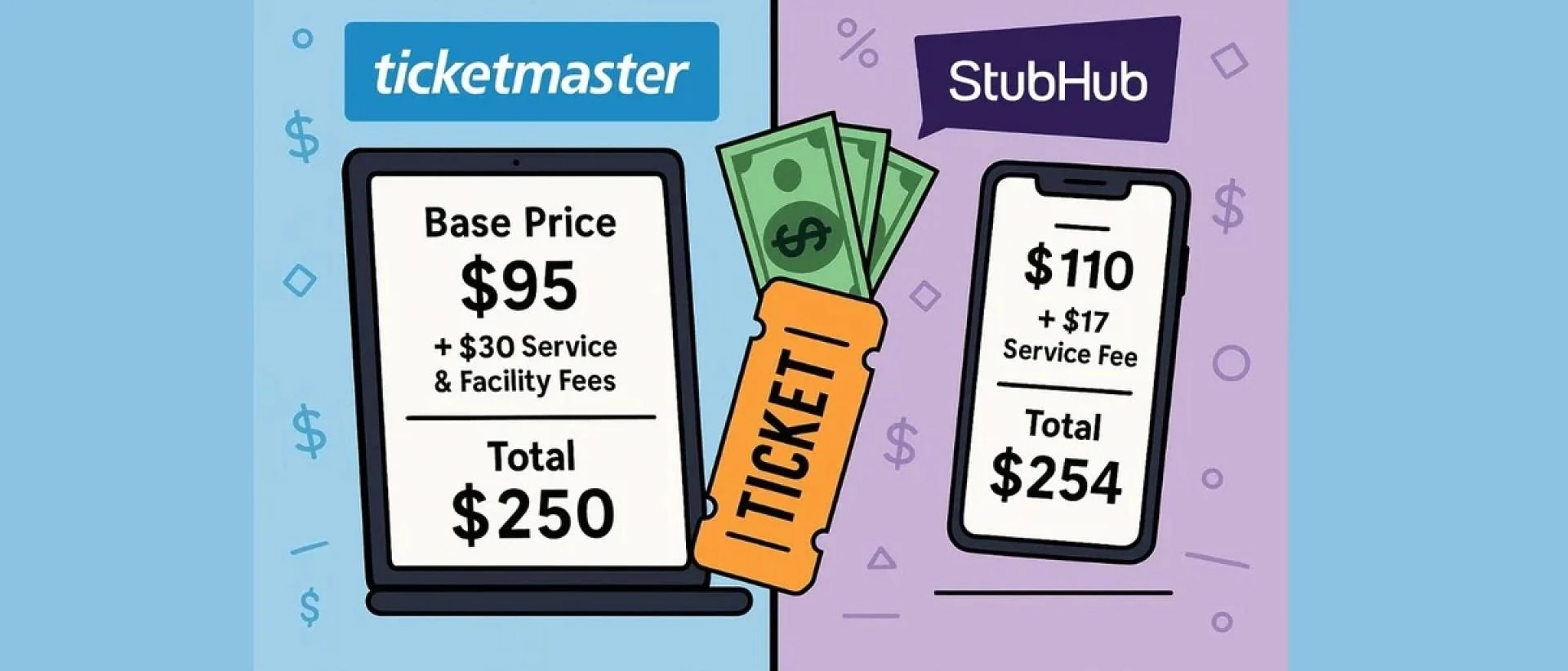
If you have ever tried to buy tickets to a hot concert or a big game, you know the feeling. You find the perfect seat, your pulse quickens with excitement, and you proceed to checkout—only to feel the wind knocked out of you by the final price. That $100 ticket somehow ballooned to $130, $140, or even more. The culprit? Fees.
In the world of live events, two giants dominate the landscape: Ticketmaster, the primary-market behemoth, and StubHub, the secondary-market resale powerhouse. For years, fans have debated which one is the lesser of two evils when it comes to fees. Is it StubHub’s higher percentage, or Ticketmaster’s deceptive drip pricing? Ticketmaster vs Stubhub fees
This comprehensive guide will break down the fee structures of both platforms, helping you understand where your money is really going and, most importantly, which one will leave more cash in your pocket for overpriced arena snacks.
Understanding the Battlefield: Primary vs. Secondary
Before we dive into the percentages, it’s crucial to understand that Ticketmaster and StubHub are fundamentally different types of businesses. This distinction is the root cause of their pricing discrepancies .
- Ticketmaster (Primary & Resale Hybrid): Ticketmaster is typically the official, authorized ticketing partner for venues, sports leagues, and artists. When tickets go on sale for the first time, you are buying from the primary market at face value (plus fees) . However, Ticketmaster also hosts its own resale marketplace (often called "Ticketmaster Resale" or "Fan-to-Fan Exchange"), where season ticket holders or fans who can no longer attend can sell their tickets. This makes them a hybrid platform.
- StubHub (Secondary Market): StubHub is a pure secondary marketplace. They do not have "face value" tickets. Every ticket on their site is listed by a third-party seller—ranging from a fan with a conflict to a professional broker . Prices are dictated entirely by supply and demand.
This fundamental difference means that comparing a "face value" ticket on Ticketmaster to a resale ticket on StubHub is not an apples-to-apples comparison. However, once an event is sold out, these two platforms become direct competitors for your business.
The Fee Face-Off: By the Numbers
The most common complaint about both platforms is the lack of upfront pricing. You see an attractive price, only to have it jacked up by a series of mysterious charges at the last second.
Ticketmaster Fee Breakdown
Ticketmaster’s pricing strategy is often criticized for its lack of transparency. The price you see on the search page is rarely the price you pay. The final cost is built from several layers :
- Service Fee: This is the big one. Charged per ticket, this fee covers Ticketmaster's technology, customer service, and operational costs. Crucially, a significant portion of this fee is shared with the venue and promoter . This is why Ticketmaster often argues they aren't the only ones pocketing the cash.
- Order Processing Fee: A per-order charge that supposedly covers the cost of processing the transaction and delivering the tickets (which are almost always digital these days) .
- Facility Charge: A per-ticket fee imposed by the venue itself to cover maintenance, staffing, security, and other operational costs. Ticketmaster claims they do not keep any portion of this fee; it all goes to the venue .
- Dynamic Pricing / "Official Platinum" Seats: In a controversial move, Ticketmaster uses dynamic pricing, where the face value of standard tickets can surge in real-time based on demand, similar to how airline prices fluctuate . This isn't a fee, but it means the base price itself can skyrocket for high-demand events, sometimes rivaling resale prices.
StubHub Fee Breakdown
StubHub’s model is different because they are a marketplace connecting buyers and sellers. Their revenue comes from charging both parties .Ticketmaster fees vs Stubhub fees
- Buyer Fees: StubHub charges buyers a significant service fee, typically a percentage of the ticket price. While the fee structure is similar to Ticketmaster's, the key difference is that StubHub has implemented all-in pricing. In many regions and on most platforms (web and app), the price displayed includes all mandatory fees. You see the final total from the outset .
- Seller Fees: To list tickets on StubHub, sellers pay a fee, usually around 15% of the sale price . This can be a shock to casual sellers who expect to recoup the full face value of their ticket.
Head-to-Head Comparison
So, how do they actually stack up? According to recent comparisons, the average buyer fees tell a clear story :
FeatureStubHubTicketmasterMarket TypeSecondary resale marketplacePrimary seller + resale marketplaceTypical Buyer Fees~20% - 28% of ticket price ~19% - 35% of ticket price Pricing TransparencyHigh. All-in pricing shows total upfront.Low. Fees are hidden until the final checkout step.Seller Fees~10% - 15% of sale price Varies, but taken from seller proceeds.Best Case ScenarioSold-out events, last-minute deals, specific seat hunting.Buying face-value tickets during the initial on-sale.
To visualize the real-world impact, here is an example of how these fees add up on a typical purchase :
Ticket PriceStubHub Total (est. 28% fees)Ticketmaster Total (est. 19% fees)$100~$128~$119$250~$320~$298$500~$640~$595
As the table shows, Ticketmaster is generally cheaper when you are buying standard, primary-market tickets. However, once an event is sold out and your only option on Ticketmaster is their resale or "Platinum" listings, the price gap narrows or disappears entirely. In some cases, StubHub can even be cheaper due to seller competition .
Beyond the Price Tag: What Your Fees Actually Pay For
A lower fee is great, but it's worthless if you get turned away at the door. The "guarantees" attached to these fees are a critical point of comparison .
- StubHub's FanProtect Guarantee: Because StubHub deals exclusively in resale tickets, their guarantee is their most important feature. FanProtect promises that you will receive valid tickets in time for the event, or they will find you comparable or better replacement tickets. If they can't, you get a full refund, often in cash . This provides significant peace of mind when buying from a third party.
- Ticketmaster's Guarantee: For primary tickets, the guarantee is simple: you are buying directly from the source, so the risk of fraud is virtually zero. However, for resale tickets purchased through their platform, the protections can be more limited and the terms stricter compared to StubHub's dedicated guarantee .
The Verdict on Protection: StubHub's FanProtect is specifically designed to handle the inherent risks of the secondary market and is a major selling point. Ticketmaster offers supreme confidence on primary sales, but their resale protections are not as robust.
Strategies to Minimize the Pain of Fees
While you can rarely avoid fees entirely, you can be strategic about how you pay them.
- Check the Box Office: The oldest trick in the book. Many venues sell tickets at their physical box office with significantly reduced or even zero fees. It requires a trip downtown, but the savings can be substantial.
- Look for All-In Pricing Laws: Several states, including California, Colorado, Connecticut, Maryland, Massachusetts, Minnesota, New York, North Carolina, and Tennessee, have passed laws requiring all-in pricing, meaning the price you see is the price you pay . If you live in or are buying tickets for an event in these states, your comparison shopping just got a whole lot easier.
- Compare Final Totals, Not List Prices: Never look at just the ticket price. Take both platforms through to the final payment step (or ensure all-in pricing is toggled on) to see the out-the-door number.
- Consider the Source of the Ticket:
- For a brand-new on-sale: Start with Ticketmaster. You have the best chance at face value .
- For a sold-out event: Check both. Compare the final all-in price on StubHub against Ticketmaster's resale and "Platinum" listings. The cheapest option could be on either site.
- For last-minute deals: StubHub is your best friend. As the event time approaches, sellers get desperate to recoup something and often drop prices below face value .
Conclusion: The Winner Depends on the Game
So, which platform has the better fees? The answer, as unsatisfying as it might be, is: it depends. fees on stubhub vs ticketmaster
If you are organized and buy tickets the moment they go on sale, Ticketmaster is almost always the cheaper option. Their lower average fees on primary tickets are hard to beat.
However, if the event is sold out, or if you are a fan of last-minute planning, StubHub is often the better choice. While their percentage fees are higher, the all-in pricing provides clarity, and the competitive seller market can yield surprisingly good deals. Plus, their FanProtect guarantee offers essential security for navigating the resale market .
The ultimate winner in the battle of fees is the informed consumer. By understanding what you're paying for and using the strategies above, you can make sure that the only thing you're shelling out big bucks for is the experience itself—not the convenience of a middleman.