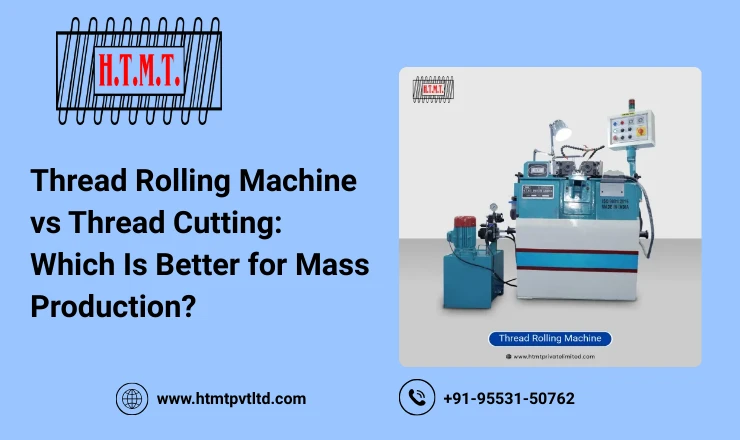
In high-volume manufacturing, choosing the right threading process can define your production efficiency, product quality, and profitability. One of the most common debates among fastener, automotive, and scaffolding manufacturers is Thread Rolling Machine vs thread cutting—which method truly delivers better results for mass production?
As experienced Thread Rolling Machine Manufacturers, we’ve worked closely with manufacturers across industries who demand speed, consistency, and strength. In this expert guide, we’ll break down both processes from a production, cost, and performance standpoint—so you can make an informed decision backed by real manufacturing experience.
Understanding Thread Rolling and Thread CuttingWhat Is Thread Rolling?
Thread rolling is a cold-forming process where threads are created by displacing material using hardened dies. A Rolling Machine presses the material into shape rather than removing it.
Key characteristics:
- No material loss
- Improved grain flow
- Higher tensile strength
- Faster cycle times
This is why Rolling Machine Manufacturers recommend thread rolling for large-scale operations.
What Is Thread Cutting?
Thread cutting removes material using a cutting tool to form threads. While it offers flexibility for low-volume or custom jobs, it has limitations for mass production.
Common drawbacks:
- Material wastage
- Lower thread strength
- Slower output rates
- Higher tooling wear
Thread Rolling Machine vs Thread Cutting: Key Differences
Factor
Thread Rolling
Thread Cutting
Production Speed
Up to 5x faster
Slower
Thread Strength
20–30% stronger
Weaker
Material Waste
Zero
High
Tool Life
Longer
Shorter
Cost per Part
Lower
Higher
For mass production, the advantages of a Thread Rolling Machine are clearly measurable.
Why Thread Rolling Is Better for Mass Production
1. Higher Output with Lower Costs
Thread rolling can produce thousands of components per hour. According to industry data, manufacturers report up to 40% reduction in per-part cost when switching from cutting to rolling.
2. Stronger Threads for Critical Applications
Rolled threads have superior fatigue resistance due to uninterrupted grain flow—essential for automotive, aerospace, and scaffolding components.
This is why Spline Rolling Machine and Rack Rolling Machine systems are widely adopted for high-load applications.
3. Better Material Utilization
Unlike cutting, rolling conserves raw material—making it ideal for expensive alloys and steel grades.
Applications Where Thread Rolling Dominates
Spline Rolling and Rack Rolling
- Spline Rolling Machine systems are used for transmission shafts and gears.
- Spline Rolling Machine Suppliers support automotive OEMs with high-precision solutions.
- Rack Rolling Machine technology ensures accuracy for linear motion components.
- Trusted Rack Rolling Machine Suppliers focus on durability and repeatability.
Scaffolding and Construction Industry
Thread rolling is the backbone of modern scaffolding production:
- High load-bearing capacity
- Uniform thread profiles
- Faster turnaround
This is why Scaffolding Machines are essential for infrastructure projects, and reliable Scaffolding Machines Suppliers are in constant demand.
When Is Thread Cutting Still Useful?
Thread cutting may still be suitable when:
- Producing prototypes
- Working with very hard materials
- Manufacturing low-volume or custom threads
However, for mass production, cutting simply cannot match the efficiency of rolling.
Choosing the Right Rolling Machine Manufacturer
When sourcing a Rolling Machine, look for manufacturers who offer:
- Proven industry experience
- Custom machine configurations
- Strong after-sales support
- Compliance with global quality standards
Trusted Thread Rolling Machine Manufacturers understand both production challenges and long-term ROI.
Conclusion
For manufacturers focused on speed, strength, and scalability, the answer is clear—thread rolling outperforms thread cutting for mass production. With stronger threads, zero material waste, and unmatched productivity, investing in the right Thread Rolling Machine can transform your manufacturing output.
If you're planning to upgrade or expand your production line, partnering with experienced Thread Rolling Machine Manufacturers, Spline Rolling Machine Suppliers, and Scaffolding Machines Suppliers is the smartest move.
FAQs
What is the main advantage of a Thread Rolling Machine?
A Thread Rolling Machine produces stronger threads with no material waste, making it ideal for mass production.
Is thread rolling more expensive than thread cutting?
Initial investment may be higher, but long-term production costs are significantly lower due to speed and tool longevity.
Which industries benefit most from thread rolling?
Automotive, aerospace, fasteners, and construction—especially users of Scaffolding Machines.
Can spline and rack rolling be automated?
Yes, modern Spline Rolling Machine and Rack Rolling Machine systems are fully automated for high-volume output.
How do I choose the right Rolling Machine Manufacturer?
Look for experience, technical support, customization options, and proven performance in mass production environments.