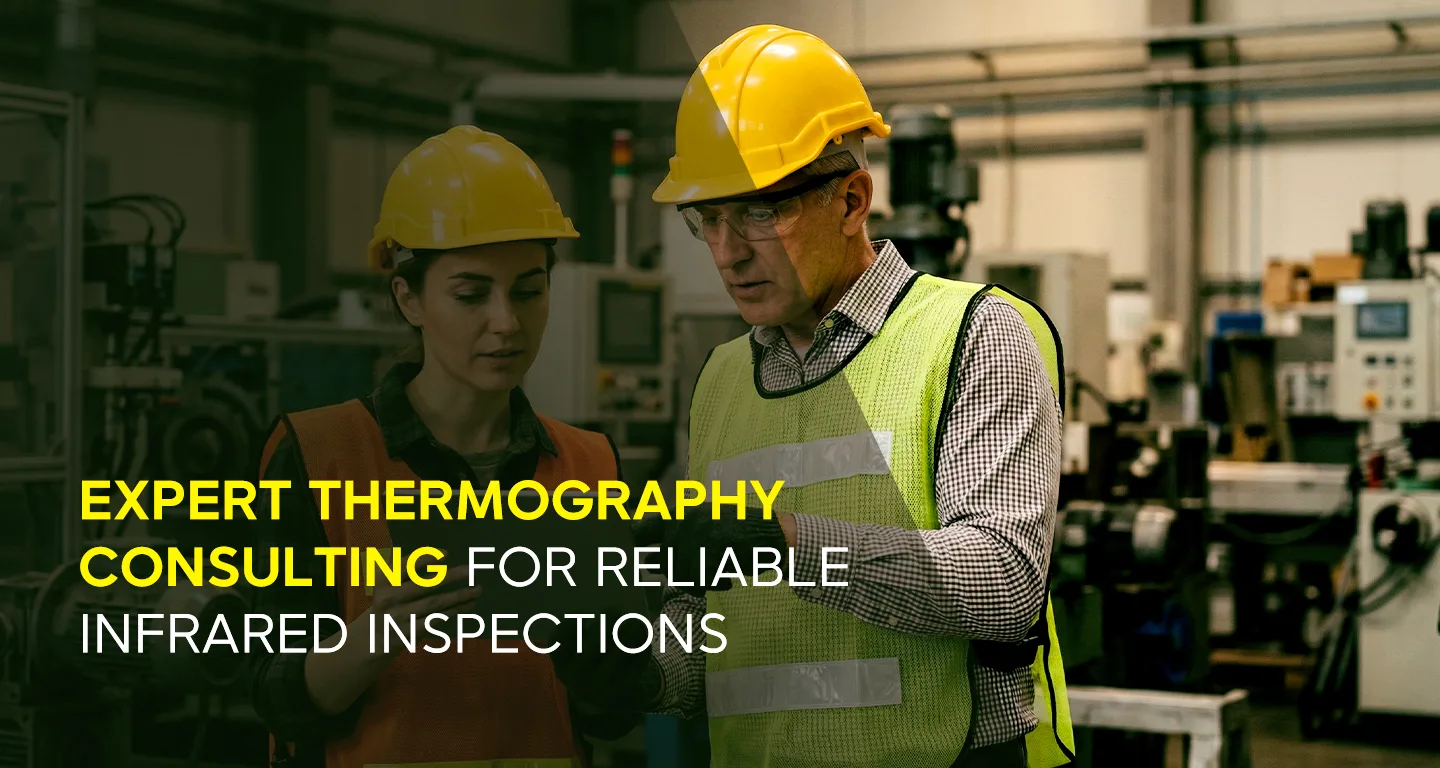
Thermography consulting services provide specialized guidance to ensure infrared inspections are accurate, compliant and actionable across industrial, electrical, mechanical and building applications. By combining technical expertise with standardized inspection methodologies, these services help organizations move beyond basic thermal imaging toward reliable condition-based decision-making.
What Are Thermography Consulting Services?
Thermography consulting services are professional advisory solutions that help organizations design, execute and interpret infrared inspections correctly. They focus on aligning inspection goals with proper equipment selection, inspection protocols, reporting standards and corrective actions. Instead of simply capturing thermal images, consultants ensure that inspections generate meaningful insights that reduce risk and improve asset reliability.
In practical terms, thermography consultants bridge the gap between raw thermal data and operational decisions. They guide teams on inspection planning, environmental considerations, emissivity settings, load conditions and data interpretation so results are technically sound and defensible.
Why Accurate Thermographic Inspections Matter
Accurate thermographic inspections matter because incorrect data leads to incorrect decisions. Infrared inspections are often used to identify overheating electrical components, insulation failures, moisture intrusion, refractory damage and mechanical inefficiencies. When inspections are poorly planned or interpreted, critical faults can be missed, or false alarms can lead to unnecessary maintenance costs.
Consulting services help ensure inspections are repeatable, comparable, and aligned with industry-accepted practices. This accuracy supports maintenance prioritization, safety compliance, energy efficiency programs and long-term asset management strategies.
How Consulting Improves Inspection Quality
Thermography consulting improves inspection quality by standardizing methodology and interpretation. Consultants begin by defining inspection objectives and acceptable criteria, ensuring that inspections answer specific operational questions rather than producing generic imagery.
They also address common technical challenges such as reflected temperature errors, distance limitations, atmospheric effects and improper camera settings. By refining these variables, consultants help organizations achieve consistent results across different sites and inspection cycles.
Another key contribution is reporting clarity. Effective consulting ensures that thermal findings are documented in a way that is understandable to engineers, facility managers and decision-makers, transforming complex thermal patterns into clear maintenance recommendations.
Applications Across Industries
Thermography consulting services are used wherever thermal anomalies indicate risk or inefficiency. In electrical systems, consulting supports reliable detection of loose connections, overloaded circuits, and failing components. In mechanical environments, it aids in identifying bearing wear, lubrication issues and misalignment.
In building diagnostics, consulting helps validate insulation performance, detect moisture intrusion and assess HVAC efficiency. In industrial processing, it supports refractory monitoring, process optimization and safety compliance. Across all applications, the value lies in consistent interpretation and actionable reporting rather than image collection alone.
The Role of Standards and Professional Guidance
Professional thermography consulting emphasizes adherence to recognized inspection frameworks and ethical practices. Consultants guide organizations in aligning their programs with accepted inspection principles, training benchmarks and documentation expectations. This structured approach increases confidence in findings and supports internal audits, insurance reviews and regulatory discussions.
Engaging with established thermography consulting resources also connects organizations to broader professional knowledge, best practices and ongoing education. This is particularly important as infrared technology becomes more accessible but interpretation remains highly specialized.
Organizations seeking authoritative guidance often turn to thermography consulting resources that focus on education, professional standards and inspection integrity rather than product promotion.
Who Benefits Most from Thermography Consulting?
Thermography consulting benefits organizations at every maturity level. New inspection programs gain clarity on how to start correctly, while established programs use consulting to refine procedures, validate results and improve reporting consistency. Facility managers, maintenance leaders, safety officers and reliability engineers all benefit from clearer insights and reduced uncertainty.
Consulting is also valuable for organizations managing multiple sites or contractors. Standardized guidance ensures that inspections performed by different teams remain comparable and meet the same quality expectations.
The Value of Working with Qualified Infrared Professionals
Qualified guidance matters because thermography is as much about interpretation as it is about imaging. Working with experienced Infrared Professionals ensures that inspections are grounded in technical competence, ethical practice, and real-world experience.
These professionals understand how environmental conditions, system loading, and operational context influence thermal patterns. Their expertise helps organizations avoid misdiagnosis and focus maintenance resources where they have the greatest impact.
In Conclusion
The ultimate goal of thermography consulting services is not better images, but better decisions. Accurate inspections support proactive maintenance, reduce downtime, enhance safety and extend asset life. Consulting ensures that thermography becomes a reliable management tool rather than a standalone activity.
Organizations ready to strengthen their inspection programs can benefit from expert guidance and structured support. To explore how professional insight can elevate your infrared inspection outcomes, reach out for IR professional expertise and take the next step toward more confident, data-driven inspections.