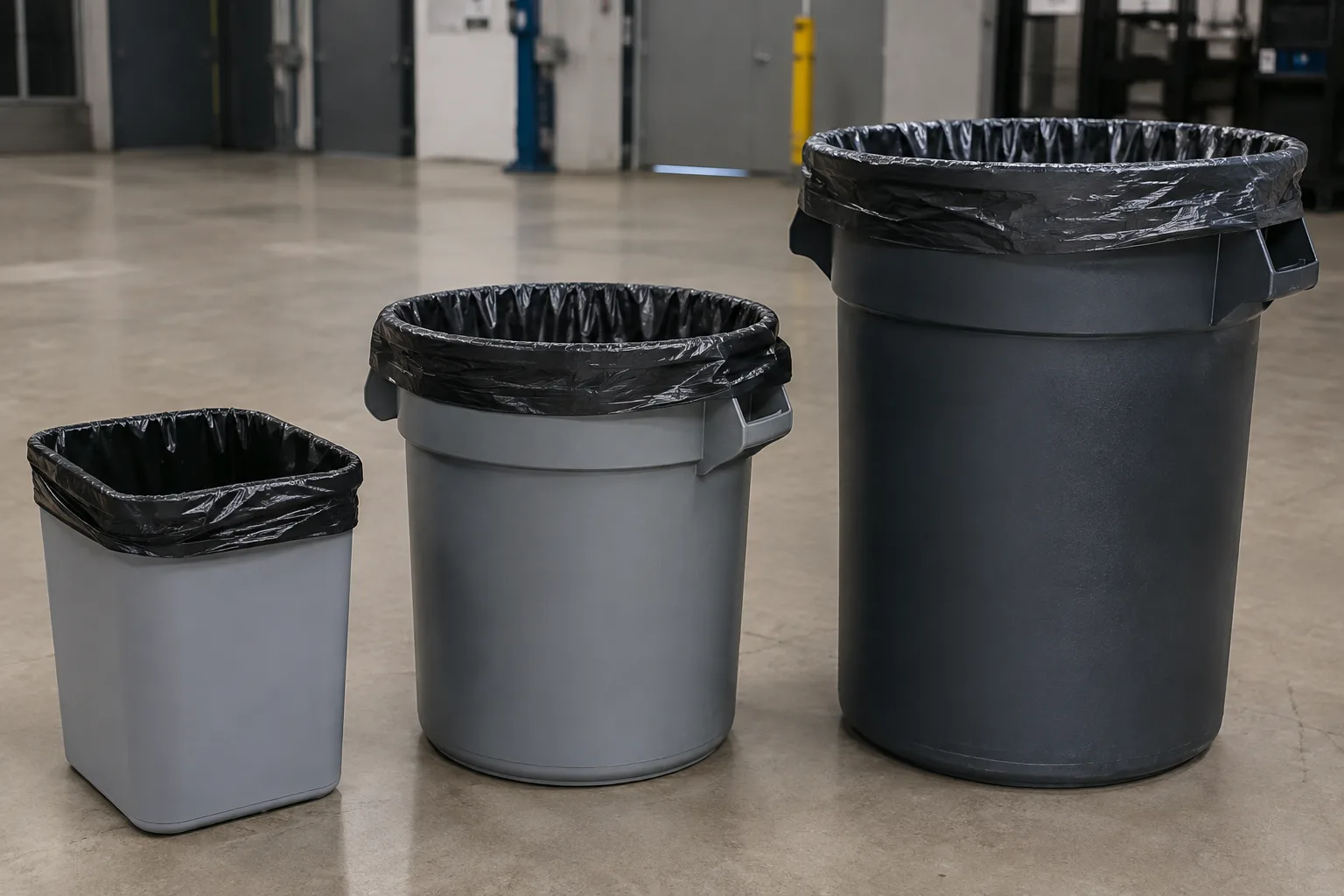
Walk into the back of almost any restaurant kitchen and you'll find a case of trash bags that was chosen the same way most supply decisions get made under pressure: whatever was cheapest, or whatever the previous manager always ordered. It's an easy thing to deprioritize until a bag rips open in the middle of a dinner rush, spilling food waste across a prep area that now needs to be cleaned, re-sanitized, and re-stocked before service can continue.
That failure almost never comes down to a bad brand. It comes down to a mismatch between the bag and the job it's being asked to do.
Two specs, not one
Every commercial trash bag has two separate specifications: size and thickness. Restaurant managers tend to shop by size alone "32 gallon," “40 gallon” because that's the number that matches the can. But size only controls fit. It says nothing about whether the bag can handle what's actually going into it.
Thickness is the spec that determines whether a bag survives bones, grease, broken glass, or a heavy wet load without tearing. And thickness gets confusing fast, because commercial trash bags are measured in one of two completely different systems depending on the plastic used:
- Mil, used for low-density polyethylene (LDPE) bags, typically ranges from about 0.7 to 6.0 mil.
- Micron, used for high-density polyethylene (HDPE) bags, typically ranges from about 6 to 22 microns.
These numbers don't translate directly between each other. A staff member restocking supplies might see "6 mil" on one case and "16 microns" on another and assume the higher number is always thicker but they're different plastics, measured differently, and a 12-micron HDPE liner can hold up similarly to a 1.0-mil LDPE liner in practice.
Why this matters operationally, not just technically
For a kitchen, the real-world impact of an under-rated bag isn't abstract it's a torn bag mid-shift, a wasted staff member's time cleaning up a spill, a delayed prep station, and in a worse case, a food-safety concern if waste contacts a food-contact surface. For a hotel or facility with multiple waste streams (kitchen, guest rooms, loading dock, offices), using one thickness everywhere either overspends on light-duty areas or underprotects heavy-duty ones.
The fix isn't complicated, but it does take a five-minute audit most operations skip:
- Sort waste streams by what they actually contain kitchen prep and back-of-house waste (bones, grease, packaging, liquid) versus office and front-of-house waste (paper, light trash).
- Assign a higher mil or micron rating to heavier, sharper, or wetter waste streams, and a lighter rating to dry, low-volume areas.
- Confirm bag dimensions against actual can measurements, not just the gallon label, since capacity ratings vary slightly by can manufacturer.
- Standardize by area, not facility-wide, so kitchen staff and front-of-house staff aren't pulling from the same undifferentiated case.
A note on color
It's worth clearing up a common misconception: clear versus black bags is a visibility decision, not a strength decision. Some jurisdictions or corporate policies require clear bags for recycling streams or security screening. Outside of that, color has no bearing on how much weight or puncture stress a bag can handle.
The takeaway
Trash bags are one of the easiest line items to overlook in a facility's supply budget, precisely because they seem interchangeable. They're not. Matching thickness to waste type not just size to can is a small operational habit that prevents a disproportionate amount of mid-shift cleanup, wasted product, and staff frustration. It costs nothing to fix and it's usually a five-minute conversation with whoever places the supply order.
Suggested Author Bio: This article was contributed by the team at Foxhole Depot, a supplier of commercial janitorial, foodservice, and facility supplies for U.S. restaurants, hotels, and businesses.
Natural Anchor Text: commercial trash bag sizes and thickness
Destination URL: https://foxholedepot.com/trash-bags/